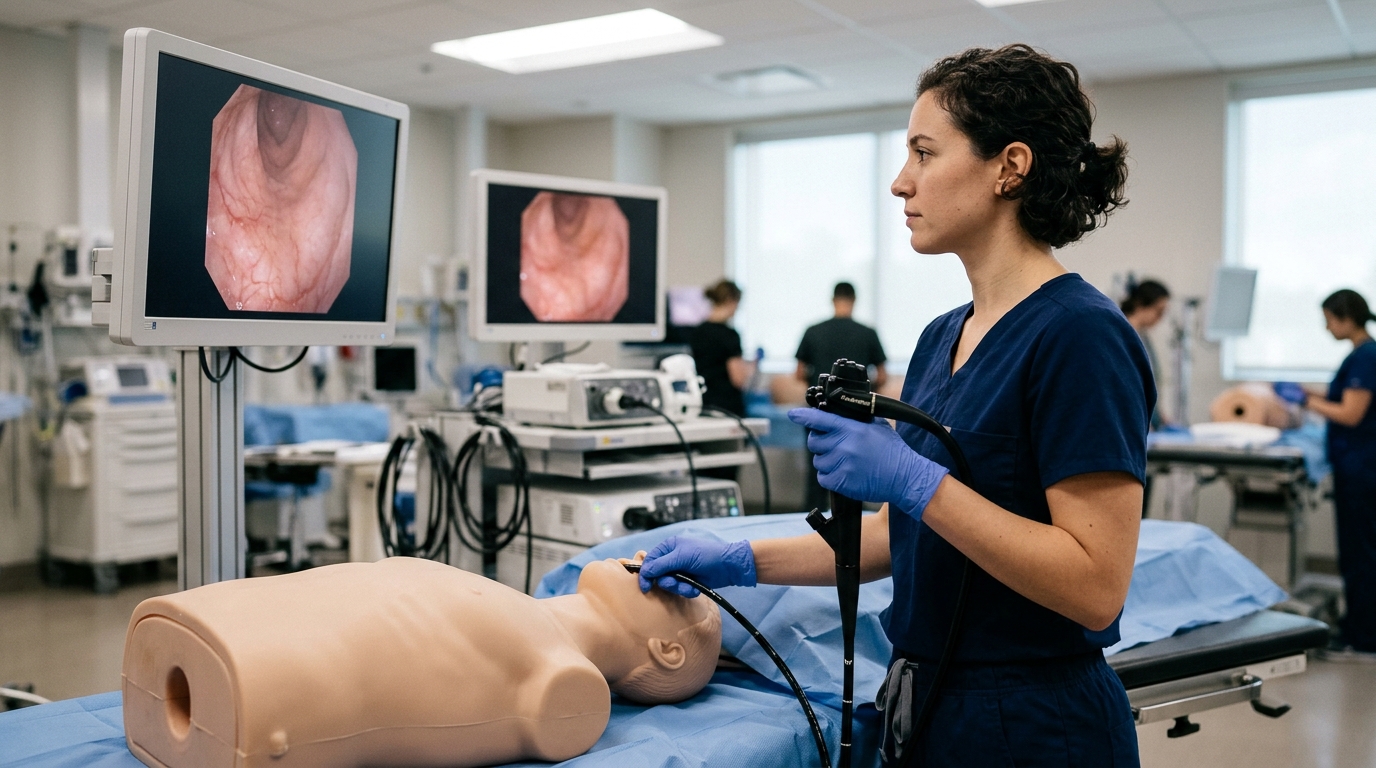
Participation in a brief simulation-based ergonomics training program was associated with improved performance on an ergonomics knowledge assessment among gastroenterology fellows, with evidence of partial retention at two months, according to a pilot pre-post study. Musculoskeletal disorders represent a major concern for endoscopists, and knowledge and training in endoscopic ergonomics may help prevent them. To address this issue, researchers developed and evaluated a dedicated simulation-based ergonomics training program tailored specifically for gastrointestinal fellows.
A total of eighty-four gastrointestinal fellows from four university hospitals participated in the pilot evaluation. Most participating fellows were women, accounting for 59.5 percent of the study group, and the median age of the cohort was 28.4 years with an interquartile range spanning 27.5 to 30.5 years. Notably, 98.8 percent of the participating fellows had never received prior ergonomic training before taking part in the study session.
The specialized ergonomics curriculum was designed to combine active learning methods with theoretical instruction for the fellows. The practical component of the training featured a “spot the difference” exercise in which participants were tasked with identifying nine distinct ergonomic errors. Following the exercise, the program included a structured debriefing, a live demonstration of correct ergonomic positioning, and a theoretical lecture dedicated to principles of ergonomics.
To measure the impact of the educational program, ergonomic knowledge was evaluated using the same nine-item questionnaire at three time intervals: before the session at baseline (T0), one week later (T1), and two months afterward (T2). Before attending the training session, most participating fellows did not correctly identify the prevalence of endoscopy-related musculoskeletal disorders, with only 26.2 percent answering the prevalence question correctly.
Among the fifty-nine fellows who completed the assessment at one week post-training, four knowledge items improved significantly compared to baseline. Accurate identification of musculoskeletal disorder prevalence increased from 30.5 percent to 61.0 percent (p < 0.001). Furthermore, correct identification of ideal bed height rose from 71.2 percent to 91.5 percent (p = 0.014), knowledge of ideal screen position improved from 55.9 percent to 86.4 percent (p < 0.001), and recognition of proper foot pedal position increased from 39.0 percent to 62.7 percent (p = 0.006).
Longer-term follow-up demonstrated evidence of partial retention among the thirty-seven fellows who completed the evaluation two months after the session. Three assessment items remained significantly higher than their baseline levels: correct identification of ideal bed height was maintained at 83.8 percent compared to 59.5 percent at baseline (p = 0.039), ideal screen position knowledge remained at 75.7 percent compared to 40.5 percent (p = 0.006), and proper foot pedal position recognition stayed at 62.2 percent compared to 32.4 percent at baseline (p = 0.010).
The study authors emphasized that while participation in the brief simulation-based ergonomics training program was associated with improved knowledge assessment performance and partial retention, important questions remain regarding clinical outcomes. Specifically, controlled studies are needed to determine whether such educational programs change endoscopic practice and reduce the risk of musculoskeletal disorders over time.
Subject of Research: Simulation-based endoscopy ergonomics training for gastroenterology fellows
Article Title: Endoscopy ergonomics training based on active simulation among gastroenterology fellows: a pilot pre-post study
Article References: Yzet, C., Privé, F., Rili, R., Brazier, F., Le Mouel, J.-P., Ammirati, C., Roger, N., Fumery, M., & Telliez, F. (2026). Endoscopy ergonomics training based on active simulation among gastroenterology fellows: a pilot pre-post study. BMC Medical Education. https://doi.org/10.1186/s12909-026-10889-1
Image Credits: AI Generated
DOI: 10.1186/s12909-026-10889-1
Keywords: endoscopy, ergonomics, musculoskeletal disorders, gastroenterology fellows, active simulation, simulation training, medical education, endoscopic ergonomics, bed height, screen position, foot pedal position, pre-post study, knowledge retention, spot the difference, occupational health, gastrointestinal endoscopy
News Source: Sophia Mitchell. (November 22, 2026). Active Simulation Training Improves Endoscopy Ergonomics Knowledge Among Gastroenterology Fellows. Scienmag.