A laboratory investigation evaluating natural and chemically modified clay minerals has demonstrated that hydrochloric acid activation substantially enhances the capacity of Libyan bentonite to capture the industrial diazo dye Congo red from aqueous environments. Drawing mineral deposits directly from the Umm al-Razm region in northern Libya, researchers determined that raw clay exhibited a maximum dye adsorption capacity of thirty-eight milligrams per gram, whereas bentonite treated with a five-molar hydrochloric acid solution attained a maximum adsorption capacity of one hundred thirty-two milligrams per gram under identical contact conditions. The experimental findings confirm that targeted chemical leaching restructures the native aluminosilicate matrix, expanding porous networks and exposing a greater density of active surface sites capable of retaining dye molecules. Thermodynamic profiling further established that this uptake process is spontaneous and endothermic across operational temperatures ranging from twenty-five to fifty-five degrees Celsius. By clarifying the physicochemical shifts induced by mineral acidification, the study provides valuable empirical benchmarks for applying abundant domestic clay resources to industrial wastewater remediation systems.
Industrial discharge containing synthetic dyes represents a severe environmental hazard due to the recalcitrant nature and structural stability of complex aromatic compounds. Congo red, a synthetic anionic diazo dye with the chemical formula C32H22N6Na2O6S2 and a molecular weight of 696.7 grams per mole, is utilized extensively across textile, paper, and plastic manufacturing sectors. When released into natural waterways, even trace concentrations of the dye impart intense red coloration that impedes solar radiation penetration, thereby disrupting photosynthetic processes and damaging aquatic ecosystems. Furthermore, the chemical breakdown of Congo red under specific environmental conditions can yield hazardous, mutagenic, and carcinogenic aromatic metabolites that impair mammalian cardiovascular, circulatory, and digestive systems while inhibiting plant and animal development. Although conventional effluent management techniques employ chemical coagulation, membrane filtration, and advanced oxidation, solid-phase adsorption remains an exceptionally attractive remediation pathway due to its operational simplicity, low cost, and design flexibility. However, untreated bentonites typically carry a hydrophilic exterior and permanent negative surface charges that hinder interactions with anionic organic molecules, necessitating structural modification to optimize pollutant uptake.
To evaluate potential performance enhancements, raw bentonite ore was extracted from geological deposits located in the Umm al-Razzam district of northern Libya. Sample preparation required mechanical crushing and rigorous grinding to yield fine mineral powders with particle diameters of fifty micrometers or smaller. The crushed powder was washed with distilled water to eliminate soluble salts and particulate impurities before being thoroughly dried in an oven. Acid activation was conducted by combining one hundred grams of the purified clay powder with five hundred milliliters of five-molar hydrochloric acid solution in a reaction vessel. The resulting slurry underwent continuous mechanical agitation for two hours at room temperature, followed by a twenty-four-hour quiescent soaking period to ensure thorough interaction between the acid and mineral layers. The acidified suspension was subsequently filtered through a Buchner funnel and rinsed repeatedly with distilled water to remove residual chloride ions until the effluent reached a stable pH value of six, after which the modified clay was dried at one hundred five degrees Celsius for four hours.
Elemental and structural characterization revealed profound chemical modifications within the clay matrix following the acid treatment protocol. Quantitative X-ray fluorescence analysis demonstrated that the silica content increased from 66.678 percent in the natural bentonite to 76.785 percent in the acid-activated material. Concurrently, the proportion of alumina decreased from 19.003 percent to 15.323 percent, iron oxide dropped sharply from 10.178 percent to 5.458 percent, and calcium oxide declined from 0.353 percent to 0.022 percent, alongside reductions in sulfur trioxide and chloride contents. Bulk X-ray diffraction patterns verified that the primary mineral constituent was Ca-montmorillonite, evidenced by a characteristic silica-to-alumina ratio of 2.71, accompanied by subordinate fractions of kaolinite as well as trace impurities of quartz, feldspar, dolomite, and calcite.
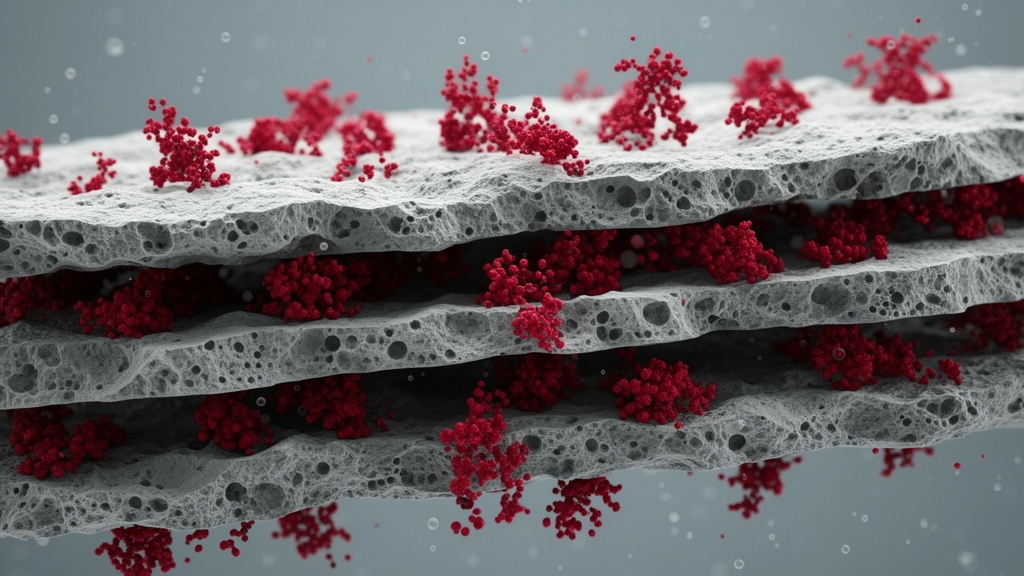
Vibrational spectroscopy and surface electron microscopy provided direct physical evidence of structural reorganization and porosity creation within the clay substrates. Fourier-transform infrared spectroscopy conducted across the 500 to 4000 reciprocal centimeter range documented distinctive spectral shifts resulting from chemical activation. The natural material exhibited hydrocarbon absorption bands between 683.30 and 759.67 reciprocal centimeters that shifted to 694.55 and 787.33 reciprocal centimeters following acid exposure. Furthermore, the characteristic aluminum-oxygen-silicon absorption cluster observed between 910.59 and 992.21 reciprocal centimeters in raw clay relocated to 912.08 reciprocal centimeters in the activated sample, while an isolated oxygen-silicon band emerged prominently at 1028.86 reciprocal centimeters. Structural dehydroxylation was evidenced by an absorption peak at 3619.95 reciprocal centimeters in the activated clay, replacing the natural water deformation band located at 1635.38 reciprocal centimeters. Complementary scanning electron microscopy conducted at the Industrial Research Center in Tripoli revealed marked morphological contrasts, transitioning from the predominantly smooth, uniform plate surfaces of natural bentonite to highly irregular, void-rich surfaces created through the selective dissolution of acid-soluble salts.
Batch adsorption experiments were systematically conducted to quantify dye uptake behavior under varied operational parameters, including contact duration, adsorbent dosage, initial dye concentration, solution pH, and ambient temperature. Aqueous Congo red solutions were prepared by serial dilution of a standard stock concentration of one thousand milligrams per liter, using spectrophotometric absorbance measurements at a maximum wavelength of 491 nanometers to determine residual dye levels via an established calibration curve. Standard baseline evaluations introduced 0.005 grams of clay adsorbent into forty milliliters of dye solution held at an initial concentration of fifty milligrams per liter and a neutral pH of 6.9, with mixtures agitated mechanically on a shaker at one hundred twenty revolutions per minute. Following designated reaction intervals, phases were separated by high-speed centrifugation operating at sixty-five hundred revolutions per minute for ten minutes. Mathematical mass balance equations were subsequently applied to evaluate equilibrium adsorption capacity per unit mass of clay alongside total percentage dye removal efficiency across all experimental permutations.
Temporal evaluations and adsorbent dosage trials revealed distinct kinetic regimes and site saturation thresholds governing dye uptake for both natural and modified clays. Kinetic assessments tracking contact duration from five to one hundred twenty minutes demonstrated that dye uptake accelerated rapidly during initial contact stages before progressively approaching equilibrium at one hundred twenty minutes. The acid-activated clay demonstrated exceptionally rapid early uptake kinetics owing to abundant macropores and micropores, achieving a maximum capacity of one hundred thirty-two milligrams per gram, whereas untreated bentonite progressed slowly toward a ceiling of thirty-eight milligrams per gram due to electrostatic repulsion from its unconditioned negative surface. Dosage investigations spanning 0.001 to 0.007 grams per liter revealed that the activated clay achieved its highest individual unit capacity of approximately eighty-five milligrams per gram at the lowest tested dosage of 0.001 grams per liter.
Testing across a broad pH range from five to ten illustrated that the acidity of the surrounding aqueous solution strongly dictates adsorption efficiency. Adjusting the solution from pH five to pH six produced a noticeable increase in adsorption capacity, rising from 27.2 to 44.8 milligrams per gram for raw bentonite and from 105.6 to 114.4 milligrams per gram for acid-activated clay. Above pH six, further shifts toward alkaline conditions up to pH ten exhibited negligible influence on equilibrium dye capacity or removal percentages, establishing that electrostatic stabilization occurs once functional surface groups are established. Concurrently, evaluating initial dye concentrations from ten to sixty milligrams per liter demonstrated that higher concentration gradients enhanced driving forces for mass transfer across the solid-liquid boundary layer. Although absolute equilibrium adsorption capacity expanded steadily with increasing initial dye concentration, overall removal efficiency percentages declined from seventy-seven percent down to thirty-nine percent for activated bentonite, and from fifty-two percent down to twenty-one percent for natural bentonite, reflecting the progressive saturation of fixed surface sites.
Thermodynamic analyses conducted across experimental temperatures of 25, 35, 45, and 55 degrees Celsius confirmed that Congo red uptake on Libyan bentonite is an endothermic and spontaneous phenomenon. Calculated Gibbs free energy values remained negative across all tested temperatures, becoming increasingly negative as thermal energy increased, shifting from -3224.2 to -3549.3 joules per mole for natural clay and from -7016.9 to -7724.1 joules per mole for acid-activated clay. This persistent thermodynamic trend demonstrates that thermal agitation enhances the affinity between adsorbate molecules and active clay sites while promoting spontaneous uptake. Furthermore, positive standard entropy changes of 10.8 joules per mole-Kelvin for natural clay and 23.6 joules per mole-Kelvin for activated clay indicated increased molecular randomness and disorder at the solid-solution interface during dye binding.
Mathematical modeling of the experimental equilibrium data demonstrated that the pseudo-second-order kinetic model provided an exceptional fit for both clay materials, yielding correlation coefficients of 0.993 for natural bentonite and 0.999 for acid-activated bentonite, thereby indicating that chemisorption processes dominate rate control. Isotherm modeling confirmed that equilibrium dye partitioning adhered most closely to the empirical Freundlich model, which yielded correlation coefficients of 0.98 for the natural material and 0.97 for the activated clay, outperforming competing Langmuir and Temkin models. This strong correlation demonstrates that Congo red adsorption occurs across heterogeneous surfaces characterized by multilayer formation and non-uniform energetic distributions. Comparative regional analyses contextualized these outcomes alongside alternative regional materials, illustrating that activated Libyan bentonite surpasses untreated Egyptian bentonite and natural Iraqi bentonite under similar batch configurations.
Subject of Research: Adsorption of Congo red dye from aqueous solutions using natural and acid-activated Libyan bentonite
Article Title: Investigating the Adsorption of Congo Red From Aqueous Solutions on Naturally Occurring and Acid‐Activated Libyan Bentonite
Article References: Aghila, S. M., Jamhour, H. A., Jangher, A. A., Mahara, B. M., Hamammu, I. M., & Tawati, D. M. (2026). Investigating the Adsorption of Congo Red From Aqueous Solutions on Naturally Occurring and Acid‐Activated Libyan Bentonite. The Scientific World Journal, 2026(1), Article 6075083. https://doi.org/10.1155/tswj/6075083
Image Credits: AI Generated
DOI: 10.1155/tswj/6075083
Keywords: Libyan bentonite, acid activation, Congo red dye, water remediation, adsorption capacity, Umm al-Razm, montmorillonite, batch adsorption, Freundlich isotherm, pseudo-second-order kinetics, wastewater treatment, textile effluent, azo dye removal, chemical activation, thermodynamic analysis, scanning electron microscopy, X-ray fluorescence, X-ray diffraction
News Source: Ophelia Keating. (November 24, 2026). Acid Activation Boosts Congo Red Dye Adsorption on Libyan Bentonite Clay. Scienmag.