A beating heart. A complicated organ that pumps blood around the body of animals and humans. Not exactly something you associate with a Petri dish in a laboratory.
Credit: By Woranop Sukparangsi
A beating heart. A complicated organ that pumps blood around the body of animals and humans. Not exactly something you associate with a Petri dish in a laboratory.
But that may change in the future, and save the lives of people whose own organs fail. And the research is now one step closer to that.
To design artificial organs you first have to understand stem cells and the genetic instructions that govern their remarkable properties.
Professor Joshua Mark Brickman at the Novo Nordisk Foundation Center for Stem Cell Medicine (reNEW) has unearthed the evolutionary origins of a master gene that acts on a network of genes instructing stem cells.
“The first step in stem cell research is to understand the gene regulatory network that supports so-called pluripotent stem cells. Understanding how their function was perfected in evolution can help provide knowledge about how to construct better stem cells,” says Joshua Mark Brickman.
Pluripotent stem cells are stem cells that can develop into all other cells. For example, heart cells. If we understand how the pluripotent stem cells develop into a heart, then we are one step closer to replicating this process in a laboratory.
A ‘living fossil’ is the key to understanding stem cells
The pluripotent property of stem cells – meaning that the cells can develop into any other cell – is something that has traditionally been associated with mammals.
Now Joshua Mark Brickman and his colleagues have found that the master gene that controls stem cells and supports pluripotency also exists in a fish called coelacanth. In humans and mice this gene is called OCT4 and they found that the coelacanth version could replace the mammalian one in mouse stem cells.
In addition to the fact that the coelacanth is in a different class from mammals, it has also been called a ‘living fossil,’ since approximately 400 million years ago it developed into the form it has today. It has fins shaped like limbs and is therefore thought to resemble the first animals to move from the sea onto land.
“By studying its cells, you can go back in evolution, so to speak,” explains Assistant Professor Molly Lowndes.
Assistant Professor Woranop Sukparangsi continues:
“The central factor controlling the gene network in stem cells is found in the coelacanth. This shows that the network already existed early in evolution, potentially as far back as 400 million years ago.”
And by studying the network in other species, such as this fish, the researchers can distill what the basic concepts that support a stem cell are.
“The beauty of moving back in evolution is that the organisms become simpler. For example, they have only one copy of some essential genes instead of many versions. That way, you can start to separate what is really important for stem cells and use that to improve how you grow stem cells in a dish,” says PhD student Elena Morganti.
Sharks, mice and kangaroos
In addition to the researchers finding out that the network around stem cells is much older than previously thought, and found in ancient species, they also learned how exactly evolution has modified the network of genes to support pluripotent stem cells.
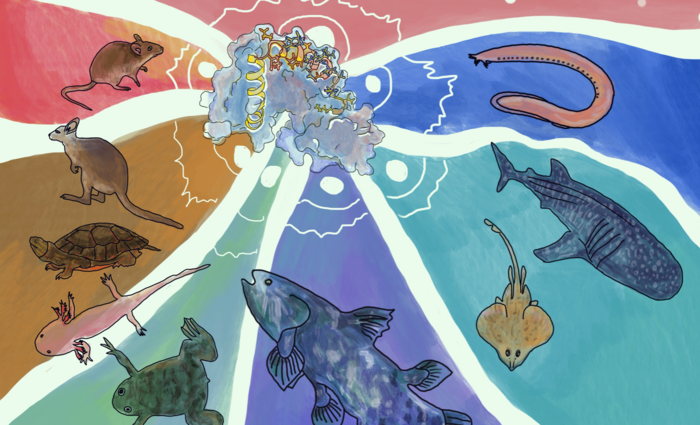
The researchers looked at the stem cell genes from over 40 animals. For example sharks, mice and kangaroos. The animals were selected to provide a good sampling of the main branch points in evolution.
The researchers used artificial intelligence to build three-dimensional models of the different OCT4 proteins. The researchers could see that the general structure of the protein is maintained across evolution. While the regions of these proteins known to be important for stem cells do not change, species-specific differences in apparently unrelated regions of these proteins alter their orientation, potentially affecting how well it supports pluripotency.
“This a very exciting finding about evolution that would not have been possible prior to the advent of new technologies. You can see it as evolution cleverly thinking, we don not tinker with the ‘engine in the car’, but we can move the engine around and improve the drive train to see if it makes the car go faster,” says Joshua Mark Brickman.
You can read the entire study “Evolutionary origin of vertebrate OCT4/POU5 functions in supporting pluripotency” in Nature Communications.
The study is a collaborative project spanning Australia, Japan and Europe, with vital strategic partnerships with the groups of Sylvie Mazan at the Oceanological Observatory of Banyuls-sur-Mer in France and professor Guillermo Montoya at Novo Nordisk Foundation Center for Protein Research at University of Copenhagen.
|
What are stem cells? Stem cells are non-specialized cells found in all multicellular organisms. Stem cells have two properties that distinguish them from other cell types. On the one hand, stem cells can undergo an unlimited number of cell divisions (mitoses), and on the other hand, stem cells have the ability to mature (differentiate) into several cell types. A pluripotent stem cell is a cell that can develop into any other cell, such as a heart cell, hair cell or eye cell. |
Journal
Nature Communications
DOI
10.1038/s41467-022-32481-z
Method of Research
Randomized controlled/clinical trial
Subject of Research
Cells
Article Title
Evolutionary origin of vertebrate OCT4/POU5 functions in supporting pluripotency
Article Publication Date
21-Sep-2022
COI Statement
All the authors declare no competing interests, except Guillermo Montoya, who is a co-founder and member of Twelve Bio BoD.