• HOME
  • NEWS
  • EXPLORE
    • CAREER
      • Companies
      • Jobs
    • EVENTS
    • iGEM
      • News
      • Team
    • PHOTOS
    • VIDEO
    • WIKI
  • BLOG
  • COMMUNITY
    • FACEBOOK
    • INSTAGRAM
    • TWITTER
Sunday, August 16, 2026
BIOENGINEER.ORG
No Result
View All Result
  • Login
  • HOME
  • NEWS
  • EXPLORE
    • CAREER
      • Companies
      • Jobs
        • Lecturer
        • PhD Studentship
        • Postdoc
        • Research Assistant
    • EVENTS
    • iGEM
      • News
      • Team
    • PHOTOS
    • VIDEO
    • WIKI
  • BLOG
  • COMMUNITY
    • FACEBOOK
    • INSTAGRAM
    • TWITTER
  • HOME
  • NEWS
  • EXPLORE
    • CAREER
      • Companies
      • Jobs
        • Lecturer
        • PhD Studentship
        • Postdoc
        • Research Assistant
    • EVENTS
    • iGEM
      • News
      • Team
    • PHOTOS
    • VIDEO
    • WIKI
  • BLOG
  • COMMUNITY
    • FACEBOOK
    • INSTAGRAM
    • TWITTER
No Result
View All Result
Bioengineer.org
No Result
View All Result
Home NEWS Science News Biology

A new way to use CRISPR

Bioengineer by Bioengineer
December 18, 2018
in Biology
Reading Time: 2 mins read
0
IMAGE
Share on FacebookShare on TwitterShare on LinkedinShare on RedditShare on Telegram

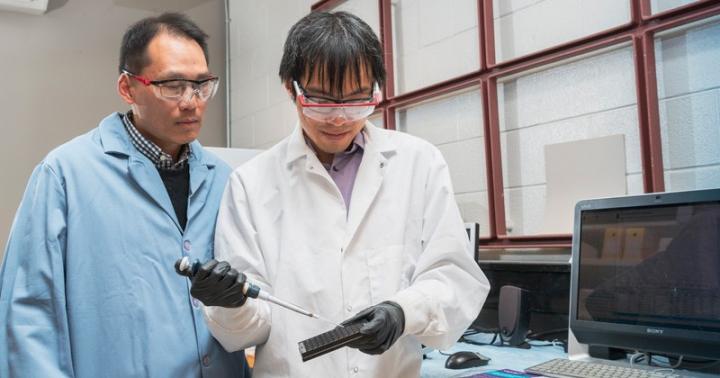
UD engineers develop methods to use CRISPR technology for conditional gene regulation
IMAGE

Credit: Photo by Kathy F. Atkinson


A team of engineers at the University of Delaware has developed a method to use CRISPR/Cas9 technology to set off a cascade of activities in cells, a phenomenon known as conditional gene regulation. Their method, described in the journal Nature Chemical Biology, introduces a new functionality to CRISPR, one of today’s most-talked-about technologies.

Gene editing with CRISPR technology has been called “one of the biggest science stories of the decade” for its applications to medicine, agriculture and much more. CRISPR allows scientists to precisely target and edit DNA within living cells, which could help them correct anomalies that cause inherited diseases. The first clinical trials in humans are underway in China.

However, until now, scientists hadn’t figured out how to program their CRISPR systems to target DNA while integrating information from within the cells they were studying.

At UD, Wilfred Chen, the Gore Professor of Chemical Engineering, and graduate student Ka-Hei Siu designed structures — dubbed toehold-gated gRNA (thgRNA)– for targeted gene regulation in E. coli bacteria.

Traditionally, in CRISPR/Cas9 genome editing, scientists use a single-stranded piece of ribonucleic acid (RNA) to guide the Cas9 enzyme to the deoxyribonucleic acid (DNA) they want to target. Instead, Chen and Siu installed a hairpin-like structure that blocks part of the RNA from recognizing the DNA. Only a small part, called the toehold, is exposed and capable of binding to other RNA. Then Chen, and Siu used RNA from within the cell as a trigger to open up their blocking mechanism, activating the Cas9 protein so that it could then bind and regulate the DNA.

“The key thing is that we wanted to use some native cellular information,” said Chen. “We wanted to be able to use this native cellular response as a way to modulate the CRISPR/Cas9 protein functions and basically develop a controlled mechanism so that we could modulate cellular functions accordingly.”

This technology offers a versatile, “plug and play” design that could be used to induce gene editing and regulation in a variety of systems, says Chen.

“Moving forward, the idea is to be able to use, ideally on paper, any kind of cellular messenger RNA as an activation or deactivation device,” he said. “You can imagine that we can activate something based on whether the cells are growing on glucose or starving for phosphate or exposed to high-temperature conditions or low-pH conditions.”

###

This work was supported by grants from NSF (MCB1615731 and MCB1817675).

Media Contact
Peter Kerwin
[email protected]
302-831-8749

Original Source

https://www.udel.edu/udaily/2018/december/wilfred-chen-crispr-gene-editing-conditional-regulation/

Tags: BiologyBiomedical/Environmental/Chemical EngineeringGenetics
Share12Tweet8Share2ShareShareShare2

Related Posts

Strubbelig–NHL3 Receptor Complex Helps Arabidopsis Respond to Cellulose Deficiency

Strubbelig–NHL3 Receptor Complex Helps Arabidopsis Respond to Cellulose Deficiency

August 15, 2026
Bombyx mori Satellitome Analysis Reveals Evolutionary Stability, Dispersed Chromosomal Organization, Transposon Origins

Bombyx mori Satellitome Analysis Reveals Evolutionary Stability, Dispersed Chromosomal Organization, Transposon Origins

August 15, 2026

Synthetic pyrenoid reconstruction reveals EPYC1-driven carbon concentration mechanisms and evolution

August 15, 2026

Endophytic Flavobacterium boosts root hairs and drought tolerance through ERF–CEP5 signaling

August 15, 2026
Please login to join discussion

POPULAR NEWS

  • Imagining natural and extra robotic thumbs together strengthens kinesthetic sensorimotor networks

    29 shares
    Share 12 Tweet 7
  • PARP1 Drives Neuropathic Pain Through GPX4-Dependent Ferroptosis in Injured Mice’s Sensory Neurons

    29 shares
    Share 12 Tweet 7
  • Strubbelig–NHL3 Receptor Complex Helps Arabidopsis Respond to Cellulose Deficiency

    29 shares
    Share 12 Tweet 7
  • Bombyx mori Satellitome Analysis Reveals Evolutionary Stability, Dispersed Chromosomal Organization, Transposon Origins

    29 shares
    Share 12 Tweet 7

About

BIOENGINEER.ORG

We bring you the latest biotechnology news from best research centers and universities around the world. Check our website.

Follow us

Recent News

Imagining natural and extra robotic thumbs together strengthens kinesthetic sensorimotor networks

PARP1 Drives Neuropathic Pain Through GPX4-Dependent Ferroptosis in Injured Mice’s Sensory Neurons

Strubbelig–NHL3 Receptor Complex Helps Arabidopsis Respond to Cellulose Deficiency

Subscribe to Blog via Email

Enter your email address to subscribe to this blog and receive notifications of new posts by email.

Join 85 other subscribers
  • Contact Us

Bioengineer.org © Copyright 2023 All Rights Reserved.

Welcome Back!

Login to your account below

Forgotten Password?

Retrieve your password

Please enter your username or email address to reset your password.

Log In
No Result
View All Result
  • Homepages
    • Home Page 1
    • Home Page 2
  • News
  • National
  • Business
  • Health
  • Lifestyle
  • Science

Bioengineer.org © Copyright 2023 All Rights Reserved.