Credit: Molecular Therapy
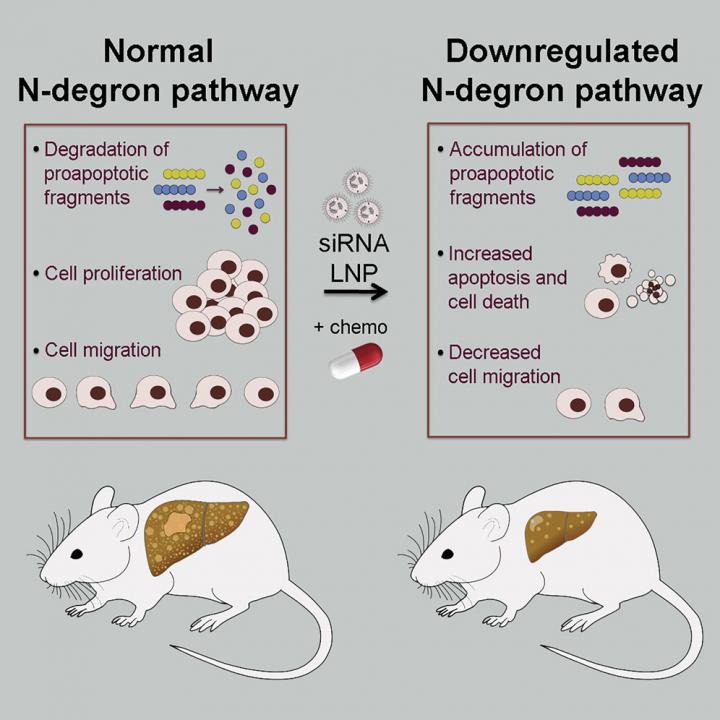
In the latest issue of Molecular Therapy, Skoltech and MIT researchers have published a new combinatorial therapy for the treatment of liver cancer. Using a siRNA approach, a field in which Dr Zatsepin (Skoltech) excels, coupled with lipid nanoparticle technology developed in the Anderson laboratory (MIT), the scientists targeted proteins that are involved in apoptosis, a regulated program for cell death. In combination with chemotherapy, this caused a significant decrease in tumor load in a mouse model of hepatocellular carcinoma.
Liver cancer is the fourth most common cancer worldwide, and incidence of the disease has more than tripled since 1980. Advanced stages of this cancer are very aggressive and resistant to all conventional chemotherapies. Only recently, multiple kinase-inhibitor regorafenib and two different check-point inhibitors were approved for patients who progress after sorafenib but this only increased the overall survival by 3 months, highlighting the need to develop novel treatments for this disease.
“What we do is simply turning off a mechanism which prevents cell death, specifically in liver cells”, explains Dominique Leboeuf, Skoltech PhD student and first author of this publication. “Once the mechanism is turned off, the cells become more susceptible to dying. This allows for the chemotherapy to be more efficient, killing more cancer cells, and preventing them from dividing. And although our siRNA reaches all liver cells, the cancer cells are more sensitive, because they are dividing rapidly, so they will be more affected by the treatment whereas normal cells survive.”
These impressive results are the fruit of a long-lasting collaboration between Skoltech and MIT, led by professors Konstantin Piatkov, Timofei Zatsepin and Daniel Anderson. Financed by the NGP program, research was conducted in Skoltech and MIT, exploiting the strengths of both teams, and maximizing the learning experience for the students and researchers involved. “This study started from a clear idea suggested by K. Piatkov, when we just started our external joint labs in Skoltech. This project combined Konstantin’s knowledge in the N-degron pathway, my expertise in siRNA and Daniel Anderson’s savoir-faire in oligonucleotide drug delivery, for the development of a new therapy against liver cancer. First, Dominique confirmed that the suggested molecular mechanisms allow selective killing of tumor cells while sparing normal cells, which is crucial for further drug development. Together with the lab of Dan Anderson in MIT, we were able to show perspectives of this combinatorial approach to treat liver cancer in animal models. We believe that siRNA combinations with other drugs should provide a solution for many diseases that are difficult to treat” stated Timofei Zatsepin.
“Because the proteins targeted by our therapy are expressed in all types of cells, the combinatorial treatment developed in this study has the potential to be applied to all types of cancer. Our approach is simple and universal, and we believe that it has the possibility of eventually improving the outcome for many cancer patients in the future”, commented the study lead, professor Konstantin Piatkov.
###
Media Contact
Alina Chernova
[email protected]
Original Source
https:/
Related Journal Article
http://dx.