• HOME
  • NEWS
  • EXPLORE
    • CAREER
      • Companies
      • Jobs
    • EVENTS
    • iGEM
      • News
      • Team
    • PHOTOS
    • VIDEO
    • WIKI
  • BLOG
  • COMMUNITY
    • FACEBOOK
    • INSTAGRAM
    • TWITTER
Saturday, January 10, 2026
BIOENGINEER.ORG
No Result
View All Result
  • Login
  • HOME
  • NEWS
  • EXPLORE
    • CAREER
      • Companies
      • Jobs
        • Lecturer
        • PhD Studentship
        • Postdoc
        • Research Assistant
    • EVENTS
    • iGEM
      • News
      • Team
    • PHOTOS
    • VIDEO
    • WIKI
  • BLOG
  • COMMUNITY
    • FACEBOOK
    • INSTAGRAM
    • TWITTER
  • HOME
  • NEWS
  • EXPLORE
    • CAREER
      • Companies
      • Jobs
        • Lecturer
        • PhD Studentship
        • Postdoc
        • Research Assistant
    • EVENTS
    • iGEM
      • News
      • Team
    • PHOTOS
    • VIDEO
    • WIKI
  • BLOG
  • COMMUNITY
    • FACEBOOK
    • INSTAGRAM
    • TWITTER
No Result
View All Result
Bioengineer.org
No Result
View All Result
Home NEWS Science News Biology

A new species of rare pseudoscorpion named after the Slovak president

Bioengineer by Bioengineer
February 20, 2024
in Biology
Reading Time: 3 mins read
0
A female individual of Olpium caputi
Share on FacebookShare on TwitterShare on LinkedinShare on RedditShare on Telegram

There are about 25,000 islands in the Pacific Ocean. The most remote of them are in North and East Polynesia, the Hawaiian Islands, and French Polynesia. Biologists have been attracted to these regions since the 18th century, but French Polynesia has received much less attention compared to the Hawaiian Islands.
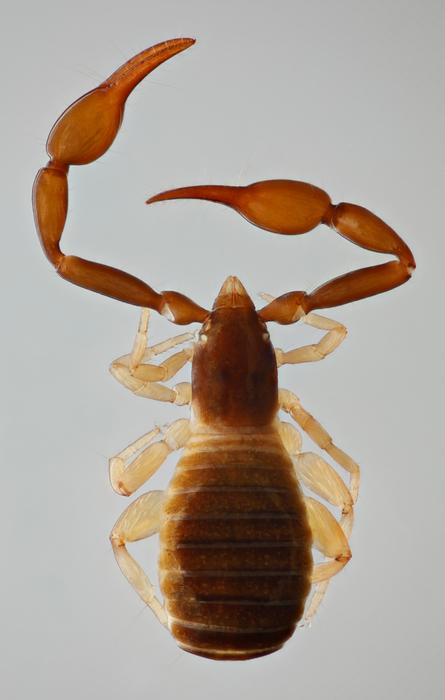
A female individual of Olpium caputi

Credit: Krajčovičová et al.

There are about 25,000 islands in the Pacific Ocean. The most remote of them are in North and East Polynesia, the Hawaiian Islands, and French Polynesia. Biologists have been attracted to these regions since the 18th century, but French Polynesia has received much less attention compared to the Hawaiian Islands.

Contributions to our knowledge of the pseudoscorpions of French Polynesia date from the 1930s and are associated with the Pacific Entomological Survey. Since then, the French Polynesian pseudoscorpion fauna has consisted of only four known species.

Thanks to international cooperation, a team of enthusiastic scientists has published the first discovery of a new species of pseudoscorpion from French Polynesia. Between 2017 and 2020, they studied French Polynesia’s fauna and environment for the French Polynesian Agricultural Service and as a part of a large-scale survey of arthropods. During their research work, they collected a few pseudoscorpion specimens on Huahine and Tahiti in the Society Islands.

Among them is a new species named Olpium caputi, collected by sieving moss at 1,450 m about sea level on the Mont Marau Summit, Tahiti, one of the Society Islands archipelago. Its scientific name honours s, the President of Slovakia.

“As a female leader, she takes a strong stance and supports women and scientists. Even in the 21st century, women in science or top positions are rare. The rarity of the research in French Polynesia, the uniqueness of the discovery, and the fact that the new species is a female, led us to name it after this inspiring woman who can be a role model of courage and perseverance for many women,” says Jana Christophoryová, who led the study.

The paper is published in the open-access, peer-reviewed journal ZooKeys.


The team:

Katarína Krajčovičová of Bratislavské regionálne ochranárske združenie – BROZ, Bratislava, and Jana Christophoryová of Comenius University, Bratislava, are both zoologists, who specialize in the taxonomy, distribution, and ecology of pseudoscorpions. Frédéric Jacq, botanist, and Thibault Ramage, entomologist, are independent naturalists who have been working on improving the faunistic and taxonomic knowledge of French Polynesia for over 15 years.

Research article:

Krajčovičová K, Ramage T, Jacq FA, Christophoryová J (2024) Pseudoscorpions (Arachnida, Pseudoscorpiones) from French Polynesia with first species records and description of new species. ZooKeys 1192: 29-43. https://doi.org/10.3897/zookeys.1192.111308


Journal

ZooKeys

DOI

10.3897/zookeys.1192.111308

Article Title

Pseudoscorpions (Arachnida, Pseudoscorpiones) from French Polynesia with first species records and description of new species

Article Publication Date

19-Feb-2024

Share12Tweet8Share2ShareShareShare2

Related Posts

blank

Exploring Heterosis in Abaca BC2 Hybrid Dioscoro 1

January 10, 2026
OFP Gene Family in Soybean: Height and Salinity Insights

OFP Gene Family in Soybean: Height and Salinity Insights

January 10, 2026

Inula britannica: Bioactivities, Components, Safety, Applications

January 10, 2026

Exploring GRAS Transcription Factors in Elymus sibiricus

January 10, 2026

POPULAR NEWS

  • Enhancing Spiritual Care Education in Nursing Programs

    154 shares
    Share 62 Tweet 39
  • PTSD, Depression, Anxiety in Childhood Cancer Survivors, Parents

    145 shares
    Share 58 Tweet 36
  • Impact of Vegan Diet and Resistance Exercise on Muscle Volume

    47 shares
    Share 19 Tweet 12
  • SARS-CoV-2 Subvariants Affect Outcomes in Elderly Hip Fractures

    45 shares
    Share 18 Tweet 11

About

We bring you the latest biotechnology news from best research centers and universities around the world. Check our website.

Follow us

Recent News

Antibiotic Use in Culture-Negative Preterm Infants Explored

Nurses Share Views on Virtual Reality for Violence Management

New Mitochondrial Inhibitor Reduces Diabetes-Related Bone Loss

Subscribe to Blog via Email

Enter your email address to subscribe to this blog and receive notifications of new posts by email.

Join 71 other subscribers
  • Contact Us

Bioengineer.org © Copyright 2023 All Rights Reserved.

Welcome Back!

Login to your account below

Forgotten Password?

Retrieve your password

Please enter your username or email address to reset your password.

Log In
No Result
View All Result
  • Homepages
    • Home Page 1
    • Home Page 2
  • News
  • National
  • Business
  • Health
  • Lifestyle
  • Science

Bioengineer.org © Copyright 2023 All Rights Reserved.