• HOME
  • NEWS
  • EXPLORE
    • CAREER
      • Companies
      • Jobs
    • EVENTS
    • iGEM
      • News
      • Team
    • PHOTOS
    • VIDEO
    • WIKI
  • BLOG
  • COMMUNITY
    • FACEBOOK
    • INSTAGRAM
    • TWITTER
Wednesday, April 1, 2026
BIOENGINEER.ORG
No Result
View All Result
  • Login
  • HOME
  • NEWS
  • EXPLORE
    • CAREER
      • Companies
      • Jobs
        • Lecturer
        • PhD Studentship
        • Postdoc
        • Research Assistant
    • EVENTS
    • iGEM
      • News
      • Team
    • PHOTOS
    • VIDEO
    • WIKI
  • BLOG
  • COMMUNITY
    • FACEBOOK
    • INSTAGRAM
    • TWITTER
  • HOME
  • NEWS
  • EXPLORE
    • CAREER
      • Companies
      • Jobs
        • Lecturer
        • PhD Studentship
        • Postdoc
        • Research Assistant
    • EVENTS
    • iGEM
      • News
      • Team
    • PHOTOS
    • VIDEO
    • WIKI
  • BLOG
  • COMMUNITY
    • FACEBOOK
    • INSTAGRAM
    • TWITTER
No Result
View All Result
Bioengineer.org
No Result
View All Result
Home NEWS Science News Chemistry

A new paradigm of material identification based on graph theory

Bioengineer by Bioengineer
June 14, 2019
in Chemistry
Reading Time: 2 mins read
0
IMAGE
Share on FacebookShare on TwitterShare on LinkedinShare on RedditShare on Telegram

IMAGE

Credit: Science China Press

Materials Genome Initiative (MGI) and National Materials Genome Project have been launched by American and Chinese government in the past decade. One of the major goals of these missions is to facilitate the identification of materials data to speed material discovery and development. Current methods are promising candidates to identify structures effectively, but have limited ability to deal with all structures accurately and automatically in the big materials database, because different material resources and various measurement error lead to variation of bond length and bond angle.

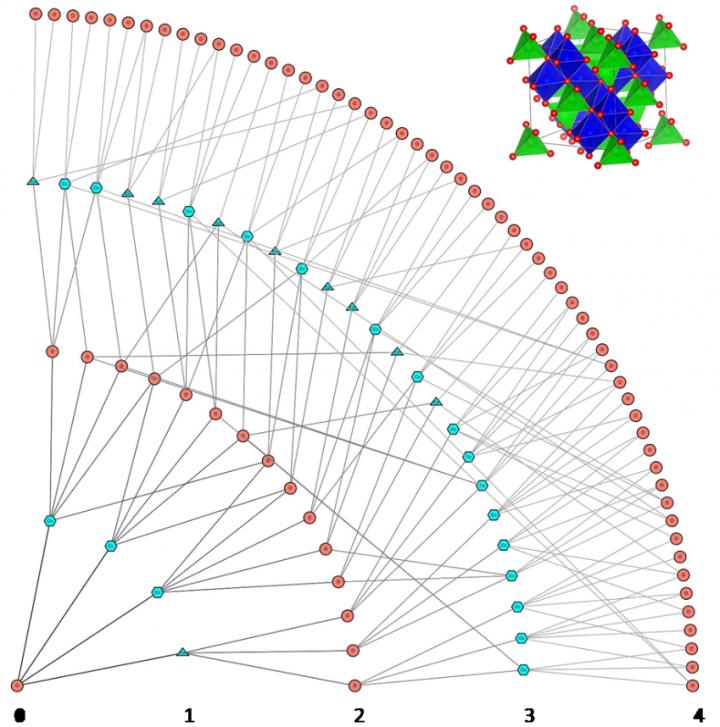
Feng Pan and his colleagues, from Peking Univerisy Shenzhen Graduate School, propose a new paradigm based on graph theory (GT scheme) to improve the efficiency and accuracy of material identification, which focuses on processing the “topological relationship” rather than the value of bond length and bond angle among different structures.

In GT scheme, the researchers first simplify crystal structures into a graph, which only consists of vertices and edges, in which atoms are simplified as vertices and adjacent atoms with the actual chemical bonds are “connected” with edges. If the topological connections in the simplified graphs between two structures are the isomorphic, the GT scheme will consider them as one structure. By using this method, automatic deduplication for big materials database is achieved for the first time, which identifies 626,772 unique structures from 865,458 original structures.

Moreover, the GT scheme has been modified to solve some advanced problems such as identifying highly distorted structures, distinguishing structures with strong similarity and classifying complex crystal structures in materials big data. Compared with the traditional structure chemistry methods, the GT scheme can address these iusses much more easily, which enhances the efficiency and reliability of material identification.

By using this artificial intelligent technique, the researchers are trying to achieve high-throughput calculation, preparation and detection for the materials database. The GT scheme subverts the traditional material research methods and accelerates the development in material research field.

###

This work “Identify crystal structures by a new paradigm based on graph theory for building materials big data” has been published in SCIENCE CHINA Chemistry, and the paper is available online at: https://doi.org/10.1007/s11426-019-9502-5

The authors thank Dr. Lin-Wang Wang from Lawrence Berkeley National Laboratory and Dr. Wenfei Fan from the University of Edinburgh for their helpful discussions. This work was supported by the National Key R&D Program of China (2016YFB0700600), the National Natural Science Foundation of China (21603007, 51672012), Soft Science Research Project of Guangdong Province (2017B030301013), and New Energy Materials Genome Preparation & Test Key-Laboratory Project of Shenzhen (ZDSYS201707281026184).

See the article: Mouyi Weng, Zhi Wang, Guoyu Qian, Yaokun Ye, Zhefeng Chen, Xin Chen, Shisheng Zheng, Feng Pan. Identify crystal structures by a new paradigm based on graph theory for building materials big data. Sci. China Chem., 2019, doi: 10.1007/s11426-019-9502-5

Media Contact
Feng Pan
[email protected]

Related Journal Article

http://dx.doi.org/10.1007/s11426-019-9502-5

Tags: Chemistry/Physics/Materials Sciences
Share12Tweet8Share2ShareShareShare2

Related Posts

Creating Desktop Particle Accelerators to Open New Frontiers in Scientific Research

Creating Desktop Particle Accelerators to Open New Frontiers in Scientific Research

April 1, 2026
Photochargeable Semiconductor Powers Efficient Amine Coupling

Photochargeable Semiconductor Powers Efficient Amine Coupling

April 1, 2026

From Cells to Smart Gels: Advancing Frontiers in Motion Science

March 31, 2026

Tides Amplify Biochar’s Carbon Capture Efficiency in Coastal Wetlands

March 31, 2026
Please login to join discussion

POPULAR NEWS

  • blank

    Revolutionary AI Model Enhances Precision in Detecting Food Contamination

    96 shares
    Share 38 Tweet 24
  • Imagine a Social Media Feed That Challenges Your Views Instead of Reinforcing Them

    1006 shares
    Share 398 Tweet 249
  • Promising Outcomes from First Clinical Trials of Gene Regulation in Epilepsy

    51 shares
    Share 20 Tweet 13
  • Popular Anti-Aging Compound Linked to Damage in Corpus Callosum, Study Finds

    43 shares
    Share 17 Tweet 11

About

We bring you the latest biotechnology news from best research centers and universities around the world. Check our website.

Follow us

Recent News

FGFR2b Links to Biomarkers, Tumor Diversity, Survival

Frailty, Malnutrition Link Falls to Daily Functioning

Dactylides D, E: Novel 22-Membered Polyol Macrolides

Subscribe to Blog via Email

Enter your email address to subscribe to this blog and receive notifications of new posts by email.

Join 78 other subscribers
  • Contact Us

Bioengineer.org © Copyright 2023 All Rights Reserved.

Welcome Back!

Login to your account below

Forgotten Password?

Retrieve your password

Please enter your username or email address to reset your password.

Log In
No Result
View All Result
  • Homepages
    • Home Page 1
    • Home Page 2
  • News
  • National
  • Business
  • Health
  • Lifestyle
  • Science

Bioengineer.org © Copyright 2023 All Rights Reserved.