• HOME
  • NEWS
  • EXPLORE
    • CAREER
      • Companies
      • Jobs
    • EVENTS
    • iGEM
      • News
      • Team
    • PHOTOS
    • VIDEO
    • WIKI
  • BLOG
  • COMMUNITY
    • FACEBOOK
    • INSTAGRAM
    • TWITTER
Thursday, March 26, 2026
BIOENGINEER.ORG
No Result
View All Result
  • Login
  • HOME
  • NEWS
  • EXPLORE
    • CAREER
      • Companies
      • Jobs
        • Lecturer
        • PhD Studentship
        • Postdoc
        • Research Assistant
    • EVENTS
    • iGEM
      • News
      • Team
    • PHOTOS
    • VIDEO
    • WIKI
  • BLOG
  • COMMUNITY
    • FACEBOOK
    • INSTAGRAM
    • TWITTER
  • HOME
  • NEWS
  • EXPLORE
    • CAREER
      • Companies
      • Jobs
        • Lecturer
        • PhD Studentship
        • Postdoc
        • Research Assistant
    • EVENTS
    • iGEM
      • News
      • Team
    • PHOTOS
    • VIDEO
    • WIKI
  • BLOG
  • COMMUNITY
    • FACEBOOK
    • INSTAGRAM
    • TWITTER
No Result
View All Result
Bioengineer.org
No Result
View All Result
Home NEWS Science News Chemistry

A hidden electronic transition ‘S0 → Tn’ in heavy-atom-containing molecules

Bioengineer by Bioengineer
March 11, 2020
in Chemistry
Reading Time: 2 mins read
0
IMAGE
Share on FacebookShare on TwitterShare on LinkedinShare on RedditShare on Telegram

IMAGE

Credit: Masaya Nakajima


Researchers in Japan have discovered S0 → Tn, a previously overlooked electronic transition in photoreactions occurring in heavy-atom-containing molecules exposed to visible light. The study was published online in Angewadte Chemie International Edition on March 9, 2020.

In recent years, researchers have paid much attention to techniques for processing materials using visible light because this is safer and easier to handle than using other light sources, such as UV light. The key in such technologies is to control the photoreaction in order to achieve the intended structural changes in the material.

“We’ve been studying the mechanism of photoreactions in basic synthetic organic chemistry, but there has always been a mystery; photoreactions are promoted in molecules containing iodine during irradiation with light from the non-absorbing region. To fully understand and be able to control photoreactions in materials, we had to solve this mystery,” says Tetsuhiro Nemoto, a professor in the Graduate School of Pharmaceutical Sciences at Chiba University in Japan.

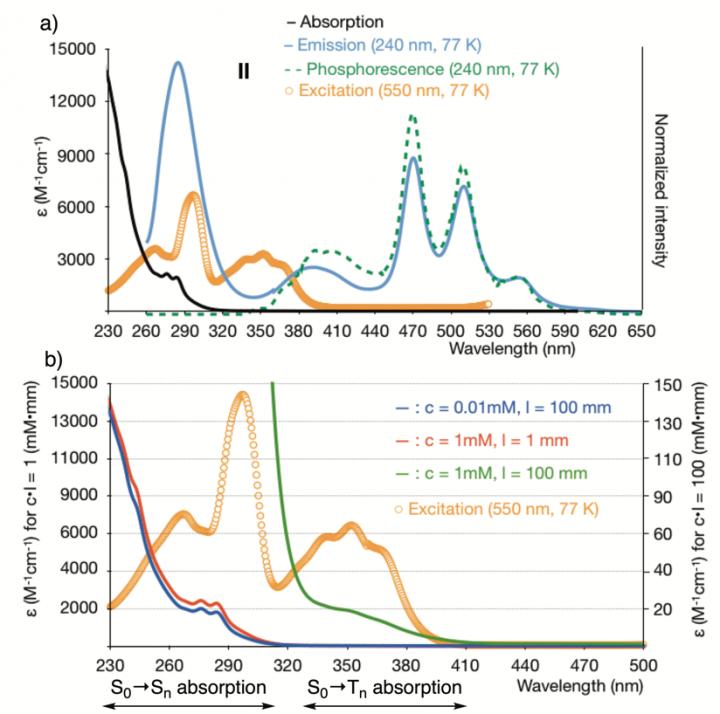
The research group led by Nemoto and Masaya Nakajima, an assistant professor, investigated emission characteristics, such as absorption wavelength, fluorescence, and phosphorescence, in iodine-containing molecules. The wavelength of excitation light required for phosphorescence at 550 nm ranged from 230 to 410 nm, even though almost no absorption band was observed at wavelengths above 320 nm (Fig.1).

Furthermore, when the absorption wavelength of high-concentration samples was measured using a 10-cm cell, 10 times as long as a normal one, a S0 → Tn absorber was observed. With these physical results, the research group succeeded in proving the existence of the S0 → Tn transition in the iodine-containing molecules.

Interestingly, the group also found that radical reactions specifically occurring in photoreactions with visible light were a common chemical phenomenon not only with iodine (I) but also with heavy-atom-containing molecules such as bromine (Br) and bismuth (Bi).

Based on these physical and chemical findings, we need to renew our understanding of S0 → Tn, which according to current textbooks, does not play the main role as a mechanism behind photoreactions.

“In the future, we expect that this mechanism of photoreaction will lead to the design of new molecules and reactions in various research fields,” Nakajima says.

###

Reference: Nakajima, M. et al. “A Direct S0 → Tn Transition in the Photoreaction of Heavy-Atom-Containing Molecules”, Angewadte Chemie International Edition, 2020: doi: https://doi.org/10.1002/anie.201915181

Contact:

Masaya Nakajima Ph.D
Assistant Professor
Graduate School of Pharmaceutical Sciences,
Chiba University
Phone: +81-43-226-2921
Email: [email protected]

Media Contact
Saori Tanaka
[email protected]
81-432-903-022

Related Journal Article

http://dx.doi.org/10.1002/anie.201915181

Tags: Chemistry/Physics/Materials SciencesMolecular PhysicsPharmaceutical/Combinatorial Chemistry
Share12Tweet8Share2ShareShareShare2

Related Posts

Isolated H2-Reduced Clusters Boost CO2-to-Methanol Catalysis

Isolated H2-Reduced Clusters Boost CO2-to-Methanol Catalysis

March 25, 2026
blank

Physicists Identify Electronic Drivers Behind Flat Band Quantum Materials

March 21, 2026

Würzburg Chemistry Professor Claudia Höbartner Receives Prestigious Honor

March 20, 2026

Scientists Reveal How Magnets Control Metamaterial Behavior

March 20, 2026
Please login to join discussion

POPULAR NEWS

  • blank

    Revolutionary AI Model Enhances Precision in Detecting Food Contamination

    96 shares
    Share 38 Tweet 24
  • Imagine a Social Media Feed That Challenges Your Views Instead of Reinforcing Them

    1003 shares
    Share 397 Tweet 248
  • Uncovering Functions of Cavernous Malformation Proteins in Organoids

    54 shares
    Share 22 Tweet 14
  • Promising Outcomes from First Clinical Trials of Gene Regulation in Epilepsy

    51 shares
    Share 20 Tweet 13

About

We bring you the latest biotechnology news from best research centers and universities around the world. Check our website.

Follow us

Recent News

In-Sensor Cryptography Links Physical Process to Digital Identity

Can Psychosocial Factors Influence Cancer Risk?

Depression Factors in Elderly: Pre vs. Post-COVID Analysis

Subscribe to Blog via Email

Success! An email was just sent to confirm your subscription. Please find the email now and click 'Confirm' to start subscribing.

Join 78 other subscribers
  • Contact Us

Bioengineer.org © Copyright 2023 All Rights Reserved.

Welcome Back!

Login to your account below

Forgotten Password?

Retrieve your password

Please enter your username or email address to reset your password.

Log In
No Result
View All Result
  • Homepages
    • Home Page 1
    • Home Page 2
  • News
  • National
  • Business
  • Health
  • Lifestyle
  • Science

Bioengineer.org © Copyright 2023 All Rights Reserved.