University of Bonn: Structure of biocatalysts depends on whether they are in cells or in the test tube
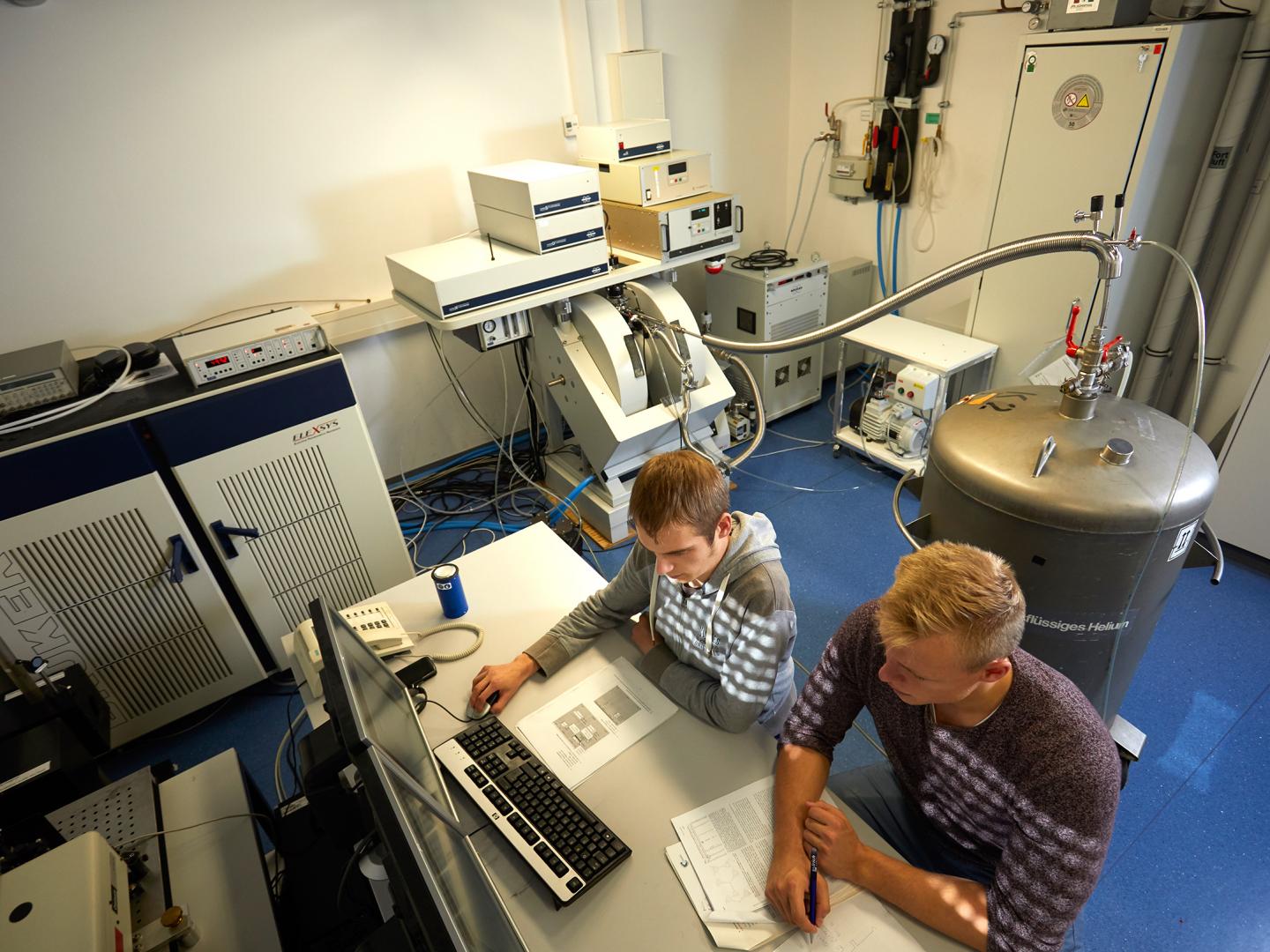
Credit: © Foto: Hamed Alaei
The structure of enzymes determines how they control vital processes such as digestion or immune response. This is because the protein compounds are not rigid, but can change their shape through movable “hinges”. The shape of enzymes can depend on whether their structure is measured in the test tube or in the living cell. This is what physicochemists at the University of Bonn discovered about YopO, an enzyme of the plague pathogen. This fundamental result, which has now been published in the journal Angewandte Chemie, is potentially also of interest for drug research.
All living cells contain proteins, which are essential for the maintenance of body functions. Proteins consist primarily of amino acids and, as catalysts (enzymes), enable biochemical reactions that would otherwise not take place. Enzymes control for example the digestion and the immune system. “The type of biochemical reactions and how they occur depends on the structure of the proteins,” says Prof. Dr. Olav Schiemann from the Institute of Physical and Theoretical Chemistry at the University of Bonn. Proteins are not rigid, but can change their shape through movable “hinges”. This interplay between structure and dynamics determines what happens. The enzyme and the substance to be transformed must fit together like a key and lock in order to catalyze a specific process.
YopO is anchored in the membrane and therefore particularly stable
The scientists used a protein from plague pathogens (Yersinia) for their research. These trick the immune system by injecting proteins such as YopO (Yersinia outer protein O) into the attacking macrophages. YopO binds to the actin of the defending cells, causing the immune cells to no longer be able to envelop and digest the pathogens. “We used YopO because this enzyme is medically interesting and can be anchored or immobilized in a membrane,” explains Schiemann. “The latter is an important prerequisite for our measurements at room temperature.”
Nico Fleck from Schiemann’s research group developed spin labels for this purpose that were specifically adapted to investigations within the cell. These are tiny “flags” that team member Caspar A. Heubach attached to different positions of the protein. Using the DQC (Double Quantum Coherence) method, which works like a ruler at the molecular level, team member Tobias Hett then measured the distances between the flags. “If we know the distances between the spin labels, we can deduce which structures a certain enzyme is able to assume,” says Hett. This works somewhat like a “sat nav” for molecules; after all, the guidance system for vehicles is also based on distance measurements.
The researchers applied the DQC method to YopO in the test tube and, for comparison, in eggs of the African clawed frog, which are frequently used as model organisms in science. For the measurements in the cell, the YopO tagged with the flags was injected into the eggs with a syringe, “very similar to the way the plague pathogens do at the molecular level,” explains Nico Fleck. This showed that YopO was able to take up a larger number of different structures when in aqueous solution in the test tube than in the eggs. “YopO is structurally more mobile in the test tube than in living cells,” says Schiemann. “In cells, structures such as membranes and interactions with other proteins reduce the structural diversity of YopO.”
Fundamental principle
This finding not only applies to YopO, but is a fundamental principle: In the test tube there is no “corset” imposed by other cell structures, the unfolding possibilities for enzymes are greater. The researchers believe that this has consequences for all studies involving biomolecules. “Investigations of the isolated biomolecules are certainly essential. For a complete picture, however, such structures and dynamics should be studied under as natural conditions as possible,” says Schiemann. Caspar Heubach adds: “If the results of a study refer to biomolecular processes in cells, one should, as in this case, also investigate the structure and dynamics of proteins in living cells.”
Results are interesting for pharmaceutical research
As proteins control different cellular processes, they are also the focus of the search for new treatments. The researchers are therefore confident that the results presented by the research team at the University of Bonn are also of potential interest for pharmaceutical research. “The interactions in the cell are important for the structure and dynamics of proteins,” says Schiemann. “It therefore makes a difference how the structure of enzymes is determined in the search for active substances.”
###
Publication: Nico Fleck, Caspar A. Heubach, Tobias Hett, Florian R. Haege, Pawel P. Bawol, Helmut Baltruschat, Olav Schiemann: SLIM: A short-linked, highly redox-stable trityl label for high sensitivity in cell EPR distance measurements, Angewandte Chemie, DOI: 10.1002/anie.202004452
Media contact:
Prof. Dr. Olav Schiemann
Institute of Physical and Theoretical Chemistry
University of Bonn
Tel. +49-(0)228-732989
E-mail: [email protected]
Media Contact
Dr. Olav Schiemann
[email protected]
Related Journal Article
http://dx.