• HOME
  • NEWS
  • EXPLORE
    • CAREER
      • Companies
      • Jobs
    • EVENTS
    • iGEM
      • News
      • Team
    • PHOTOS
    • VIDEO
    • WIKI
  • BLOG
  • COMMUNITY
    • FACEBOOK
    • INSTAGRAM
    • TWITTER
Saturday, February 7, 2026
BIOENGINEER.ORG
No Result
View All Result
  • Login
  • HOME
  • NEWS
  • EXPLORE
    • CAREER
      • Companies
      • Jobs
        • Lecturer
        • PhD Studentship
        • Postdoc
        • Research Assistant
    • EVENTS
    • iGEM
      • News
      • Team
    • PHOTOS
    • VIDEO
    • WIKI
  • BLOG
  • COMMUNITY
    • FACEBOOK
    • INSTAGRAM
    • TWITTER
  • HOME
  • NEWS
  • EXPLORE
    • CAREER
      • Companies
      • Jobs
        • Lecturer
        • PhD Studentship
        • Postdoc
        • Research Assistant
    • EVENTS
    • iGEM
      • News
      • Team
    • PHOTOS
    • VIDEO
    • WIKI
  • BLOG
  • COMMUNITY
    • FACEBOOK
    • INSTAGRAM
    • TWITTER
No Result
View All Result
Bioengineer.org
No Result
View All Result
Home NEWS Science News Biology

A conversation between plants’ daily and aging clocks

Bioengineer by Bioengineer
August 9, 2018
in Biology
Reading Time: 2 mins read
0
Share on FacebookShare on TwitterShare on LinkedinShare on RedditShare on Telegram
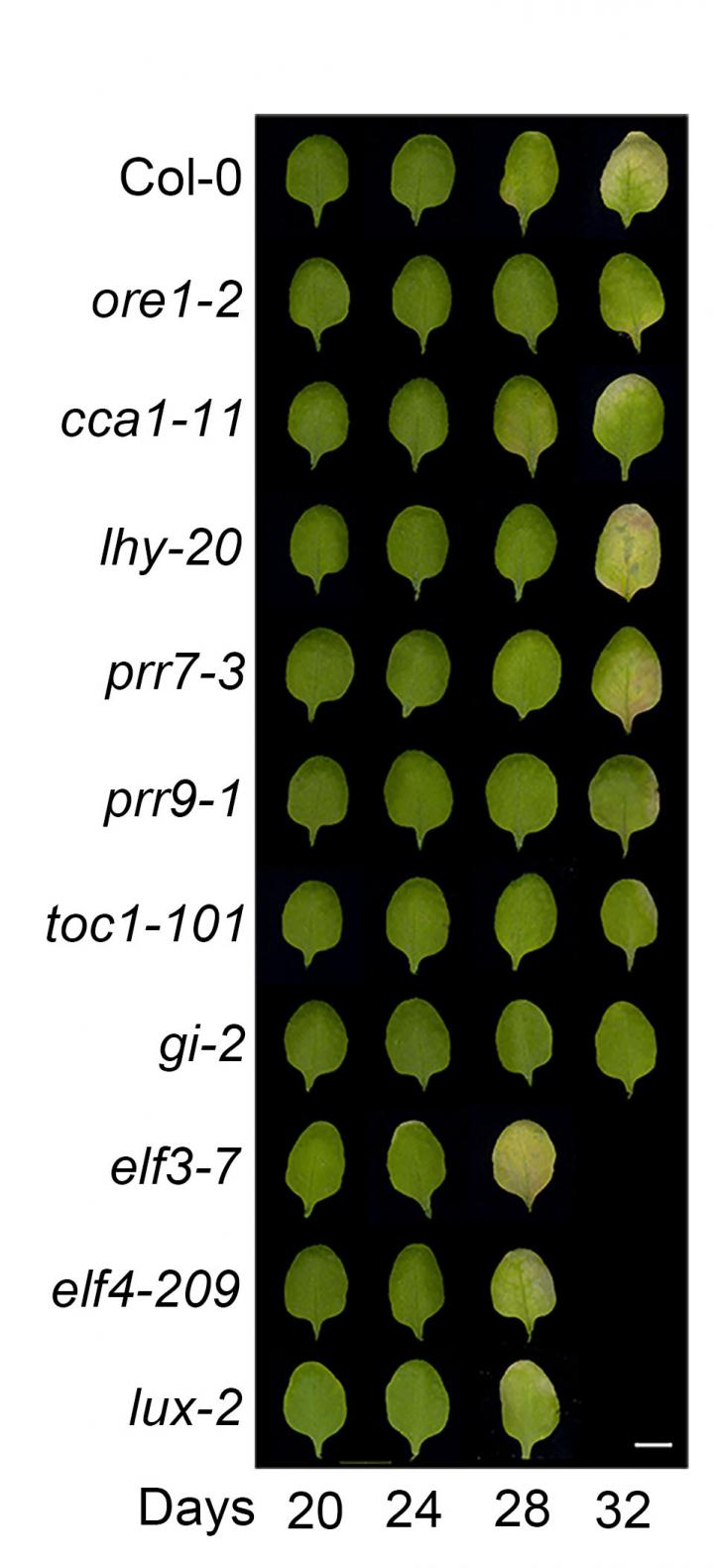
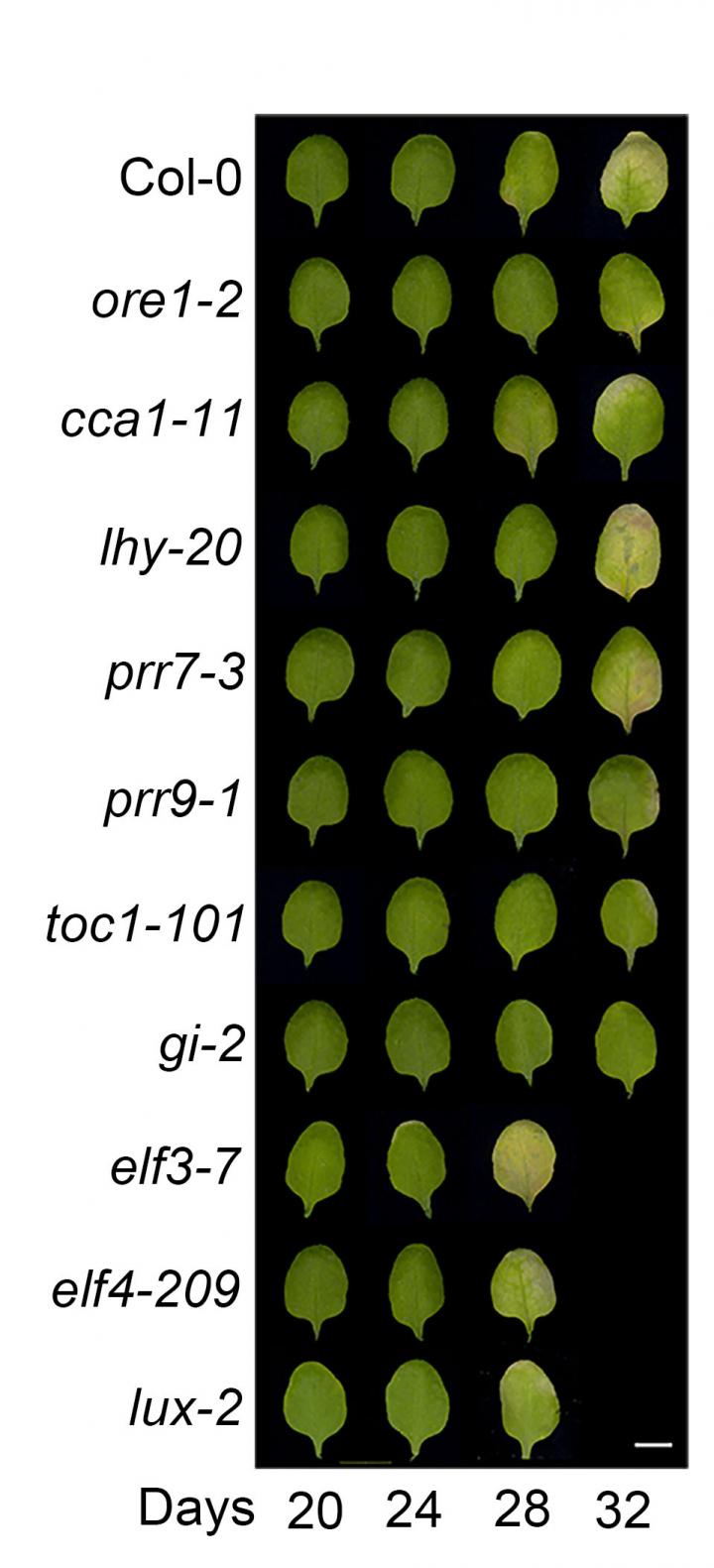
IMAGE

Credit: IBS

Every day you get a day older. So do plants. While the biological daily clock ticks, time passes also for the aging clock. Scientists at the Center for Plant Aging Research, within the Institute for Basic Science (IBS), have found out how the two clocks talk to each other genetically. Plants' circadian clock – the 24-hour cyclic rhythm – plays a critical role in regulating aging, in particular in timing the yellowing of the leaves. As aging plants recycle nutrients for the new leaves and seeds, uncovering these timekeeping mechanisms is important to understand plant productivity.

Most organisms are influenced by the daily and annual cycle of light and temperature. The circadian clock functions as a "mastermind" to align many aspects of development and physiology with certain times of the year or the day.

In plants, the main gears of the daily clock are nine genes which have a peak in their biological activity either in the morning (morning complex) or in the early evening (evening complex). They work as a network and regulate plants' growth and flowering. In this study published in PNAS, IBS researchers used plants deficient in one of these nine core circadian clock components at a time to study the effect on the aging clock.

In animals, the two biological clocks are interlinked; it was found that mutations in clock genes accelerate aging, and aging alters the circadian rhythmicity. However, the relationship between the aging and circadian clocks in plants has not been clarified yet. IBS researchers have used the model plant Arabidopsis thaliana and determined that some daily clock genes are directly or indirectly related to aging.

To identify clock components directly involved in aging, the team examined the timing of leaf yellowing over time and in the dark, as darkness makes Arabidopsis age faster. Plants lacking three components (elf3, elf4, and lux) of the evening complex had yellow leaves sooner, whereas plants without the morning component PRR9 (PSEUDO-RESPONSE REGULATORS 9) remained green for longer showing delayed aging, in both age-dependent and dark-induced conditions. Then, the researchers found that PRR9 plays an important role in the expression of a key gene for plant senescence, known as ORE1. In this way, the two clocks interact with each other.

"Time controls aging, but the question is how do plants recognize the passage of time through their lifespan? We found out that plant's daily oscillatory clock interacts with the aging linear clock during their lifetime." explains NAM Hong Gil, the Center research director and corresponding co-author.

In the future, the team would like to extend the network and understand how the circadian clock and aging interact with the external environment. Finally, the team would like to take advantage of the aging clock for regulating age-dependent developmental processes.

###

Media Contact

Dahee Carol Kim
[email protected]
82-428-788-133
@IBS_media

http://www.ibs.re.kr/en/

Related Journal Article

http://dx.doi.org/10.1073/pnas.1722407115

Share12Tweet8Share2ShareShareShare2

Related Posts

Florida Cane Toad: Complex Spread and Selective Evolution

Florida Cane Toad: Complex Spread and Selective Evolution

February 7, 2026
New Study Uncovers Mechanism Behind Burn Pit Particulate Matter–Induced Lung Inflammation

New Study Uncovers Mechanism Behind Burn Pit Particulate Matter–Induced Lung Inflammation

February 6, 2026

DeepBlastoid: Advancing Automated and Efficient Evaluation of Human Blastoids with Deep Learning

February 6, 2026

Navigating the Gut: The Role of Formic Acid in the Microbiome

February 6, 2026
Please login to join discussion

POPULAR NEWS

  • Robotic Ureteral Reconstruction: A Novel Approach

    Robotic Ureteral Reconstruction: A Novel Approach

    82 shares
    Share 33 Tweet 21
  • Digital Privacy: Health Data Control in Incarceration

    63 shares
    Share 25 Tweet 16
  • Study Reveals Lipid Accumulation in ME/CFS Cells

    57 shares
    Share 23 Tweet 14
  • Breakthrough in RNA Research Accelerates Medical Innovations Timeline

    53 shares
    Share 21 Tweet 13

About

We bring you the latest biotechnology news from best research centers and universities around the world. Check our website.

Follow us

Recent News

Digital Health Perspectives from Baltic Sea Experts

Florida Cane Toad: Complex Spread and Selective Evolution

Exploring Decision-Making in Dementia Caregivers’ Mobility

Subscribe to Blog via Email

Enter your email address to subscribe to this blog and receive notifications of new posts by email.

Join 73 other subscribers
  • Contact Us

Bioengineer.org © Copyright 2023 All Rights Reserved.

Welcome Back!

Login to your account below

Forgotten Password?

Retrieve your password

Please enter your username or email address to reset your password.

Log In
No Result
View All Result
  • Homepages
    • Home Page 1
    • Home Page 2
  • News
  • National
  • Business
  • Health
  • Lifestyle
  • Science

Bioengineer.org © Copyright 2023 All Rights Reserved.