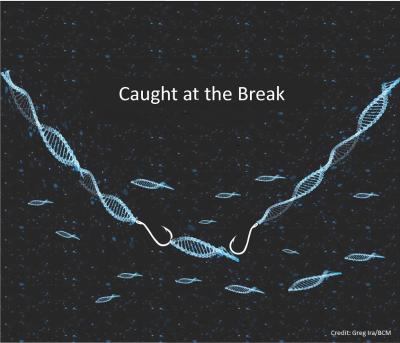
Credit: Greg Ira, BCM
Cells have in place a number of mechanisms to protect the integrity of the genome, including processes that repair mistakes that may occur during DNA replication. The enzyme Dna2 participates in DNA repair, but little is known about the consequences of its absence on chromosome instability. A study published in the journal Nature by researchers from several institutions, including Baylor College of Medicine, reveals that when Dna2 is absent, small DNA fragments jump from all over the genome into chromosome breaks. This novel mechanism may explain similar events commonly seen in cancer or during antibody diversification.
“One of the interests of my lab is to understand basic mechanisms of DNA repair,” said corresponding author Dr. Greg Ira, associate professor of molecular and human genetics and member of the Dan L Duncan Comprehensive Cancer Center at Baylor College of Medicine. “In this project we worked with yeast and discovered for the first time a mutant that shows frequent insertions of DNA fragments into DNA breaks. This mutant lacks Dna2, an enzyme conserved among all organisms.”
Mobile genetic elements called transposons are known to jump from one chromosome to another. Here, unexpectedly, Ira and his colleagues found that any piece of any chromosome can jump into a DNA break.
“During DNA synthesis, occasionally long single strands of DNA can form and are normally eliminated by Dna2. In mutants that lack Dna2, these oversynthesized fragments can get caught in DNA breaks, causing genomic instability, which mostly has negative effects on cells. However, these insertions also can lead to gene duplication and chromosome evolution, which may have positive consequences for cells,” said first author Dr. Yang Yu, postdoctoral associate in the Ira lab. “We propose that Dna2, whose activities include degradation of oversynthesized DNA fragments, prevents their insertion into the genome and alteration of the genetic code.”
The researchers also investigated the origin of the DNA fragments that insert themselves into chromosomal breaks. They discovered that small genes, DNA segments at the end of chromosomes called telomeres as well as other sequences of inserted DNA had originated from all over the genome.
“It’s been reported that similar insertion of DNA fragments is common in cancer,” Ira said. “We think that the mechanism we describe here for Dna2-deficient cells likely will be observed in many cellular conditions where small DNA fragments are generated and not properly degraded. We think that this is common in cancer but can also occur in patients that are deficient in some components of innate immune system responsible for elimination of foreign DNA.”
###
Other contributors to this work include Nhung Pham, Bo Xia, Alma Papusha, Guangyu Wang, Zhenxin Yan, Guang Peng and Kaifu Chen. The authors are affiliated with one or more of the following institutions: Baylor College of Medicine, Houston Methodist Research Institute, Houston Methodist Hospital, Cornell University and the University of Texas MD Anderson Cancer Center.
This work was funded by grants from the National Institutes of Health (GM080600, GM125650, GM125632 and HL133254) and the Cancer Prevention Research Institute of Texas (RP140456 and RP150611).
Media Contact
Allison Mickey
[email protected]
713-798-4710
Original Source
https:/
Related Journal Article
http://dx.
News source: https://scienmag.com/