Credit: PHOTO CREDIT: Rob Cahill, UTHealth
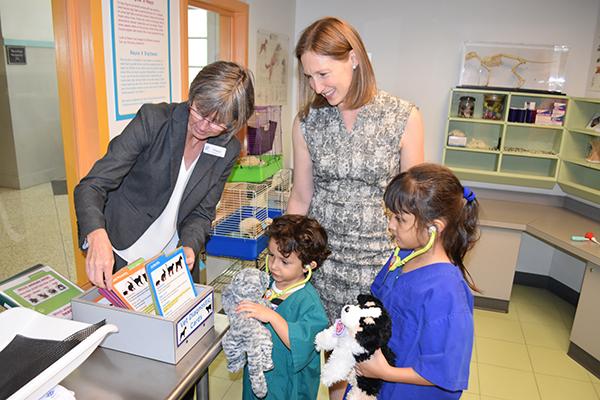
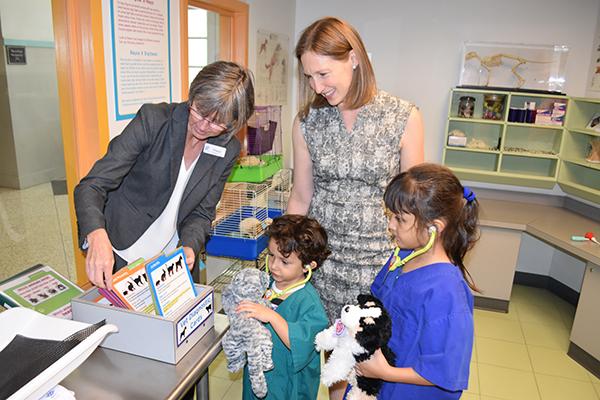
It is never too early to spark a child's interest in science and The University of Texas Health Science Center at Houston (UTHealth) and the Children's Museum of Houston are exploring new strategies to do just that.
The National Science Foundation has awarded UTHealth a four-year, $2 million grant to collaborate with the Children's Museum of Houston in looking for ways to create popular programs designed to engage children and their parents with the science, technology, engineering and math (STEM) fields.
"Some parents feel unsure about helping their children with science and math," said Tricia Zucker, Ph.D., principal investigator and associate professor of pediatrics with the Children's Learning Institute at McGovern Medical School at UTHealth. "But, parents can help young children become interested in the science and math all around them."
In addition to motivating parents to help their children, Zucker said the new program, called "Teaching Together- STEM," provides parents with access to information, materials and other resources. This project builds on a successful program called "Para Los Niños" that has been offered by the Children's Museum since 2003.
"This is all about informal science education. We're creating opportunities for parents and children to do science and math within their everyday activities such as cooking, outdoor play, tinkering and visiting special places like the museum," Zucker said. "This is a randomized experiment to evaluate the program under different conditions so we can understand the benefits of these types of programs for parents and children."
Zucker and her colleagues plan to test a variety of techniques to increase parent involvement. "First, during STEM nights at their children's school, we will model various activities and help parents practice them with their children. Secondly, we will provide home activity kits to see how this further improves children's learning. Third, we are offering parents a small incentive for each informal STEM activity they do with their child," she said.
"The idea is to understand better if there are barriers to informal learning such as access to materials or other costs that can be reduced by providing families with particular supports," Zucker said.
Zucker's co-principal investigator is Cheryl McCallum, Ed.D., education director at the Children's Museum.
"I love the idea of melding UTHealth's and the museum's tried and true methodologies for engaging parents and children together, and then making these activities available for the museum educators and others to use in schools, libraries and community centers," McCallum said.
Focused on preschool children from low-income families, the study will involve bilingual STEM nights and activities. The study will consist of 360 parent-child pairs and organizers will host 270 STEM workshops and distribute 180 home activity kits.
In this three-part study, researchers and museum educators will develop and refine the program materials via field tests and focus groups. They will then recruit parents and children to participate in a randomized control trial. The final part will include the analysis of the results of the study and dissemination of findings and resources to the public.
"Teachers can't close the knowledge gap without the help of parents," Zucker said. "We hope to identify new ways to engage parents in 'doing science and math' with their young children during the study."
###
Zucker's co-investigators from UTHealth include Michael Assel, Ph.D.; Janelle Montroy, Ph.D.; and April Crawford, Ph.D.
Media Contact
Rob Cahill
[email protected]
713-500-3030
http://www.uthouston.edu
Original Source
https://www.uth.edu/media/story.htm?id=cc8dbf87-62cb-4b83-a53b-238ef6a03b61