Credit: UNH
DURHAM, N.H. – Researchers at the University of New Hampshire have created an easy-to-make, low-cost injectable hydrogel that could help wounds heal faster, especially for patients with compromised health issues.
Wound healing can be complex and challenging, especially when a patient has other health obstacles that seriously impede the process. Often injectable hydrogels are applied to irregular shaped wounds, like diabetic ulcers, to help form a temporary matrix, or structure, to keep the wound stable while cells rejuvenate. The caveat is that current hydrogels are not porous enough and do not allow neighboring cells to pass through toward the wound to help it mend.
"While valuable for helping patients, current hydrogels have limited clinical efficacy," said Kyung Jae Jeong, assistant professor of chemical engineering at UNH. "We discovered a simple solution to make the hydrogels more porous and therefore help to speed up the healing."
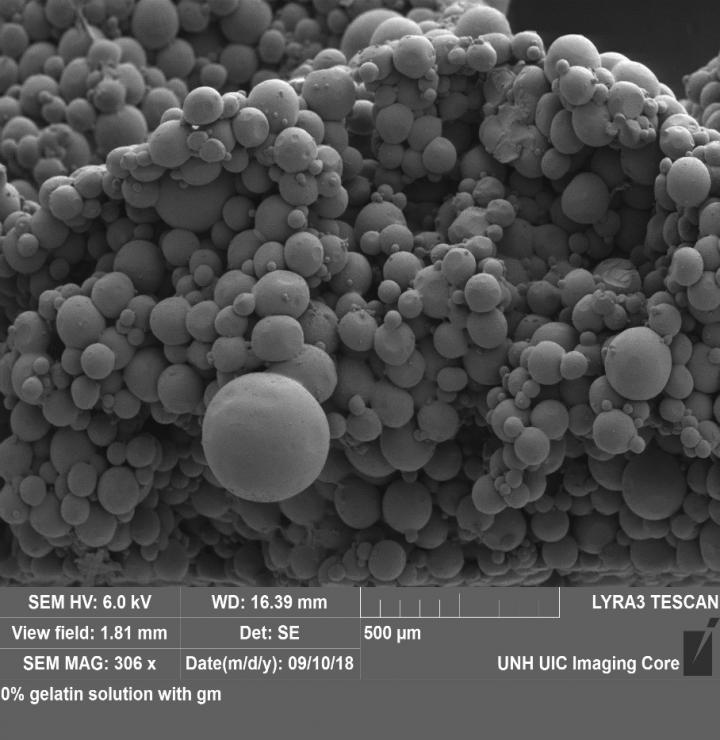
In the study, recently published in the journal of ACS Applied Bio Materials, the researchers outline how they made a macroporous hydrogel by combining readily available gelatin microgels – hydrogels that are a few hundred microns in diameter – with an inexpensive enzyme called microbial transglutaminase (mTG). Gelatin was used because it is a natural protein derived from collagen, a protein found in connective tissue in the body such as skin. Assembling these tiny microgels with mTG helped create a hydrogel with large enough pores for the neighboring cells to move into the wound for repair. In addition, this new injectable formulation allows for the slow release of protein drugs to aid wound healing, such as platelet-derived growth factor (PDGF). The researchers compared conventional nonporous hydrogels with the new macroporous hydrogels, and found a notable increase in the migration of tissue cells inside the hydrogel, which is the hallmark of wound healing.
Along with diabetic ulcers, the macroporous hydrogel could help with other forms of healing on the skin, cornea, internal organs during surgery and even has military implications.
###
This work was supported in part by the NIH COBRE Center of Integrated Biomedical and Bioengineering Research through an Institutional Development Award (IDeA) from the National Institute of General Medical Sciences.
The University of New Hampshire is a flagship research university that inspires innovation and transforms lives in our state, nation and world. More than 16,000 students from all 50 states and 71 countries engage with an award-winning faculty in top ranked programs in business, engineering, law, health and human services, liberal arts and the sciences across more than 200 programs of study. UNH's research portfolio includes partnerships with NASA, NOAA, NSF and NIH, receiving more than $100 million in competitive external funding every year to further explore and define the frontiers of land, sea and space.
PHOTOS AVAILABLE FOR DOWNLOAD
https://www.unh.edu/unhtoday/sites/default/files/media/human-skin-cells.png
This is a 3D confocal microscope image of human skin cells growing around and within the porous hydrogel.
Credit: UNH
https://www.unh.edu/unhtoday/sites/default/files/media/3-d-image-skin-cells-2.jpg
Second image of 3D confocal image of human skin cells growing around and within the porous hydrogel with different staining.
Credit: UNH
https://www.unh.edu/unhtoday/sites/default/files/media/porous-hydrogel.jpg
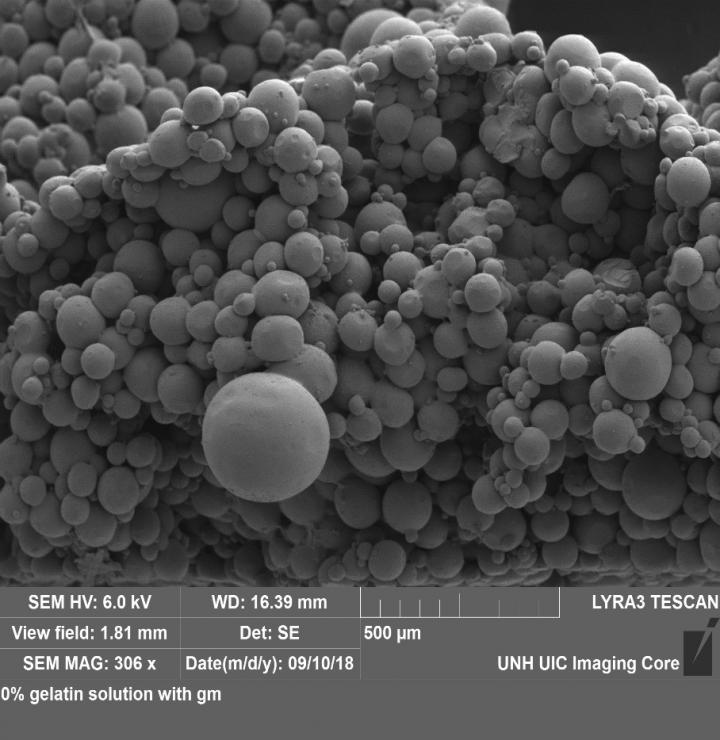
Electron microscope image of the porous hydrogel.
Credit: UNH
Media Contact
Robbin Ray
[email protected]
603-862-4864
@unhresearchnews
http://www.unh.edu/news
Original Source
https://www.unh.edu/unhtoday/news/release/2018/11/20/unh-researchers-create-more-effective-hydrogel-healing-wounds http://dx.doi.org/10.1021/acsabm.8b00380