


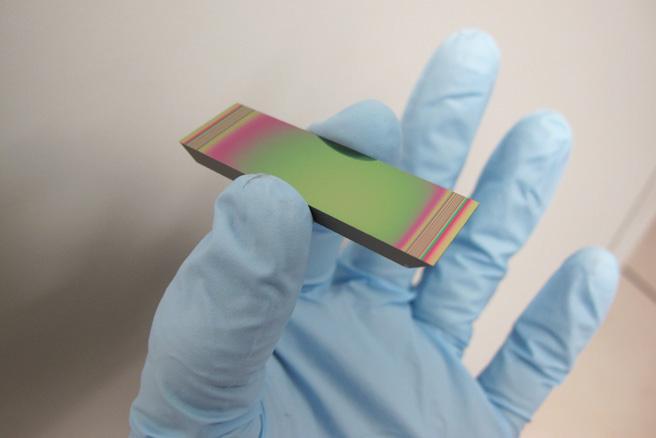
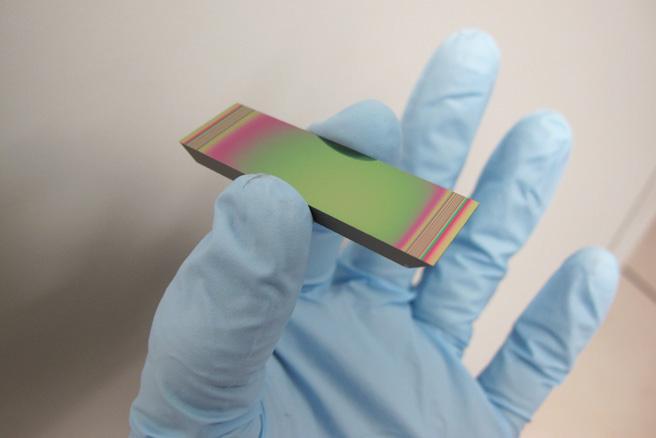
Credit: (Jason Myers/U.S. Naval Research Laboratory)
WASHINGTON — Scientists at the U.S. Naval Research Laboratory have recently demonstrated a new nonmechanical chip-based beam steering technology that offers an alternative to costly, cumbersome and often unreliable and inefficient mechanical gimbal-style laser scanners.
The chip, known as a steerable electro-evanescent optical refractor, or SEEOR, takes laser light in the mid-wavelength infrared (MWIR) as an input and steers the beam in two dimensions at the output without the need for mechanical devices — demonstrating improved steering capability and higher scan speed rates than conventional methods.
"Given the low size, weight and power consumption and continuous steering capability, this technology represents a promising path forward for MWIR beam-steering technologies," said Jesse Frantz, research physicist, NRL Optical Sciences Division. "Mapping in the MWIR spectral range demonstrates useful potential in a variety of applications, such as chemical sensing and monitoring emissions from waste sites, refineries, and other industrial facilities."
The SEEOR is based on an optical waveguide – a structure that confines light in a set of thin layers with a total thickness of less than a tenth that of a human hair. Laser light enters through one facet and moves into the core of the waveguide. Once in the waveguide, a portion of the light is located in a liquid crystal (LC) layer on top of the core. A voltage applied to the LC through a series of patterned electrodes changes the refractive index (in effect, the speed of light within the material), in portions of the waveguide, making the waveguide act as a variable prism. Careful design of the waveguides and electrodes allow this refractive index change to be translated to high speed and continuous steering in two dimensions.
SEEORs were originally developed to manipulate shortwave infrared (SWIR) light – the same part of the spectrum used for telecommunications – and have found applications in guidance systems for self-driving cars.
"Making a SEEOR that works in the MWIR was a major challenge," Frantz said. "Most common optical materials do not transmit MWIR light or are incompatible with the waveguide architecture, so developing these devices required a tour de force of materials engineering."
To accomplish this, the NRL researchers designed new waveguide structures and LCs that are transparent in the MWIR, new ways to pattern these materials, and new ways to induce alignment in the LCs without absorbing too much light. This development combined efforts across multiple NRL divisions including the Optical Sciences Division for MWIR materials, waveguide design and fabrication, and the Center for Bio/Molecular Science and Engineering for synthetic chemistry and liquid crystal technology.
The resulting SEEORs were able to steer MWIR light through an angular range of 14°×0.6°. The researchers are now working on ways to increase this angular range and to extend the portion of the optical spectrum where SEEORs work even further. Complete details of this research can be found in the December 2018 edition of the Journal of the Optical Society of America, DOI: 10.1364/JOSAB.35.000C29.
###
Media Contact
Daniel Parry
[email protected]
202-767-2326
@USNRL
http://www.nrl.navy.mil
Original Source
https://www.nrl.navy.mil/news/releases/nrl-demonstrates-new-nonmechanical-laser-steering-technology http://dx.doi.org/10.1364/JOSAB.35.000C29

