Credit: Olivia Walch
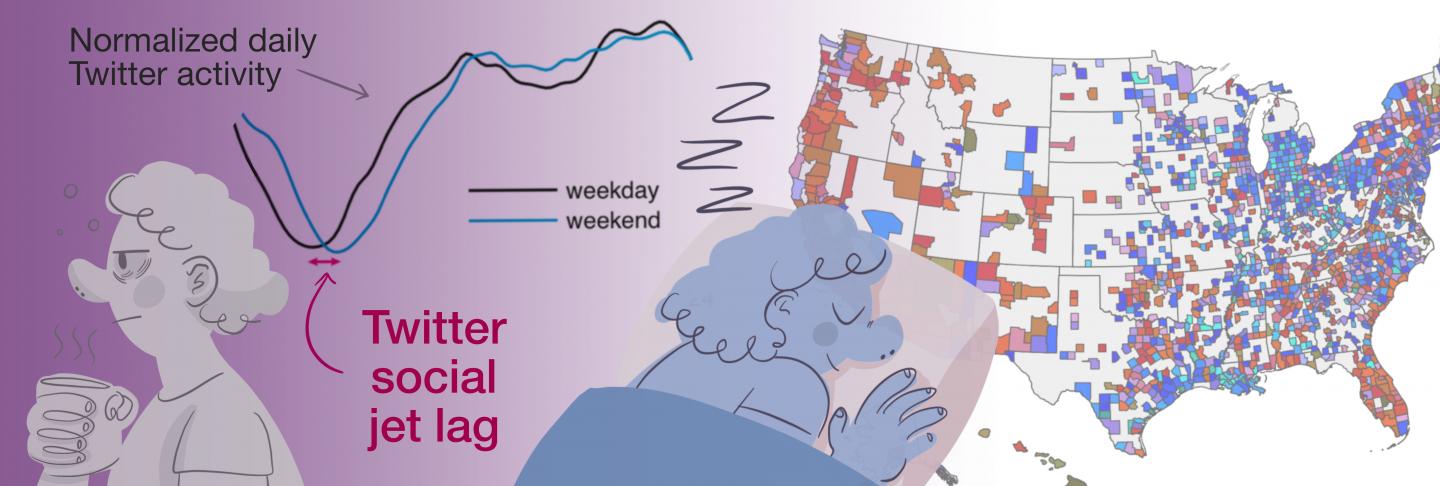
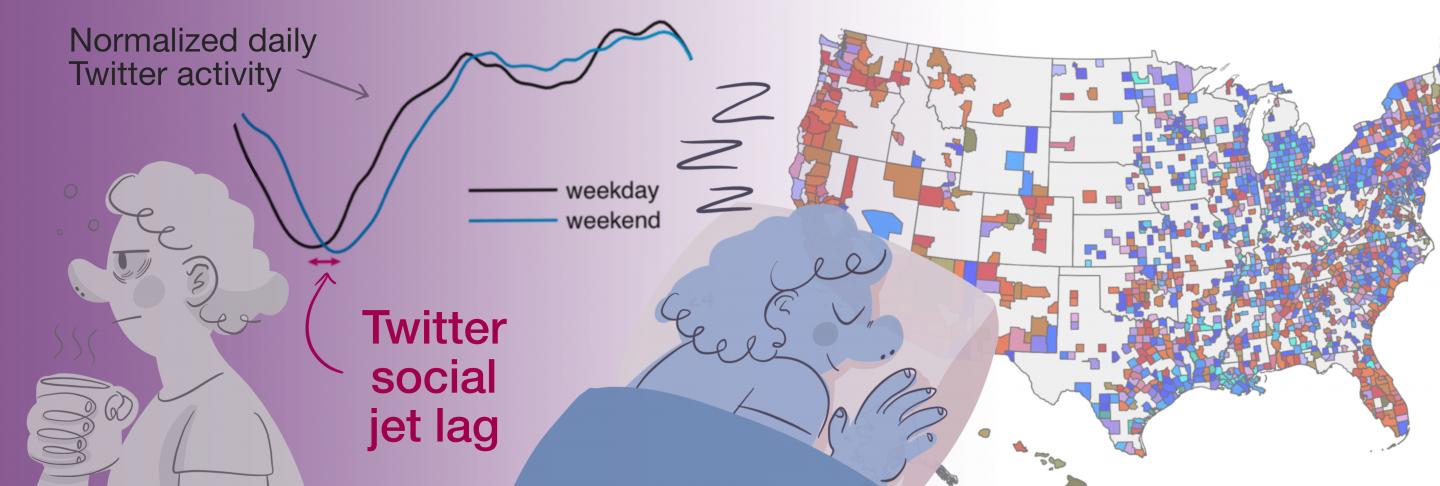
Social jet lag–a syndrome related to the mismatch between the body's internal clock and the realities of our daily schedules–has previously been tied to health problems. Now, researchers reporting in Current Biology on November 15 have found a way to measure social jet lag in people all over the country: by analyzing patterns of activity on the social media platform Twitter.
"When we look at how social jet lag changes throughout the year, we find that the dominant effect by far is the social calendar," says Michael Rust of The University of Chicago. "It suggests that humans in modern societies, at least people who used Twitter in 2013-2014, have biological rhythms that are somewhat disconnected from the changing hours of sunlight throughout the year."
Previous researchers have measured social jet lag by surveying for differences in wake and sleep times between weekdays and weekends and by using specialized activity monitors. Rust and his colleagues instead simply collected readily available Twitter data for more than 1,500 US counties throughout the 2012-2013 calendar years in 15-minute intervals. Those geographically tagged tweets represented about 240,000 people. The ability to monitor how Twitter activity patterns change season to season and county by county allowed them to separately assess the influences of the socially defined calendar and changes in daylight hours throughout the year.
The researchers found that sustained periods of low Twitter activity were correlated with sleep patterns as measured by conventional surveys. The nightly lull in Twitter activity shifted to later times on weekends relative to weekdays, an indication of social jet lag.
The magnitude of this "Twitter social jet lag" varied seasonally and geographically, with the West Coast experiencing less Twitter social jet lag compared to the central and eastern US. It was also correlated with average commuting schedules, including how many people do shift work, and disease risk factors such as obesity, the researchers report.
Most counties experienced the largest amount of Twitter social jet lag in February and the lowest in June or July. The evidence is consistent with the notion that those patterns are driven primarily by social pressures, including shifting school schedules, and less so by the direct seasonal effect of altered day length.
"For the limited number of counties with unified school schedules for which the calendars are readily available, social jet lag lines up almost perfectly with the calendars, even though the population of Twitter users is clearly not just students," Rust says. "This is consistent with some studies that suggest that the effect of the sun on our lives may be getting weaker over time, perhaps as we spend more time indoors looking at our phones."
The new findings help to confirm previously observed trends, including a link between social jet lag and obesity and that people get more sleep on the West Coast. It shows that such trends can be readily studied based on pre-existing data on social media use in place of questionnaires designed to target a specific hypothesis.
In the future, the researchers say they'd like to devise tools to help individual people learn about their body's internal circadian clock and improve their lives by looking at their own individual timing data. Rust reports that they're now "thinking about ways to do this."
###
This research was supported by an NIH Training Grant, NIH, a Howard Hughes Medical Institute Faculty Scholar award, the DARPA Big Mechanism program, and by a gift from Liz and Kent Dauten.
Current Biology, Leypunskiy et al.: "Geographically Resolved Rhythms in Twitter Use Reveal Social Pressures on Daily Activity Patterns" https://www.cell.com/current-biology/fulltext/S0960-9822(18)31345-9
Current Biology (@CurrentBiology), published by Cell Press, is a bimonthly journal that features papers across all areas of biology. Current Biology strives to foster communication across fields of biology, both by publishing important findings of general interest and through highly accessible front matter for non-specialists. Visit: http://www.cell.com/current-biology. To receive Cell Press media alerts, contact [email protected].
Media Contact
Carly Britton
[email protected]
617-335-6270
@CellPressNews
http://www.cellpress.com
Related Journal Article
http://dx.doi.org/10.1016/j.cub.2018.10.016