


Credit: IPBES
Demand for bioenergy to reduce CO2 emissions from fossil fuels could cause a 10- to 30-fold increase in green energy-related land use in years to come, adding crushing pressure on habitat for plants and animals and undermining the essential diversity of species on Earth.
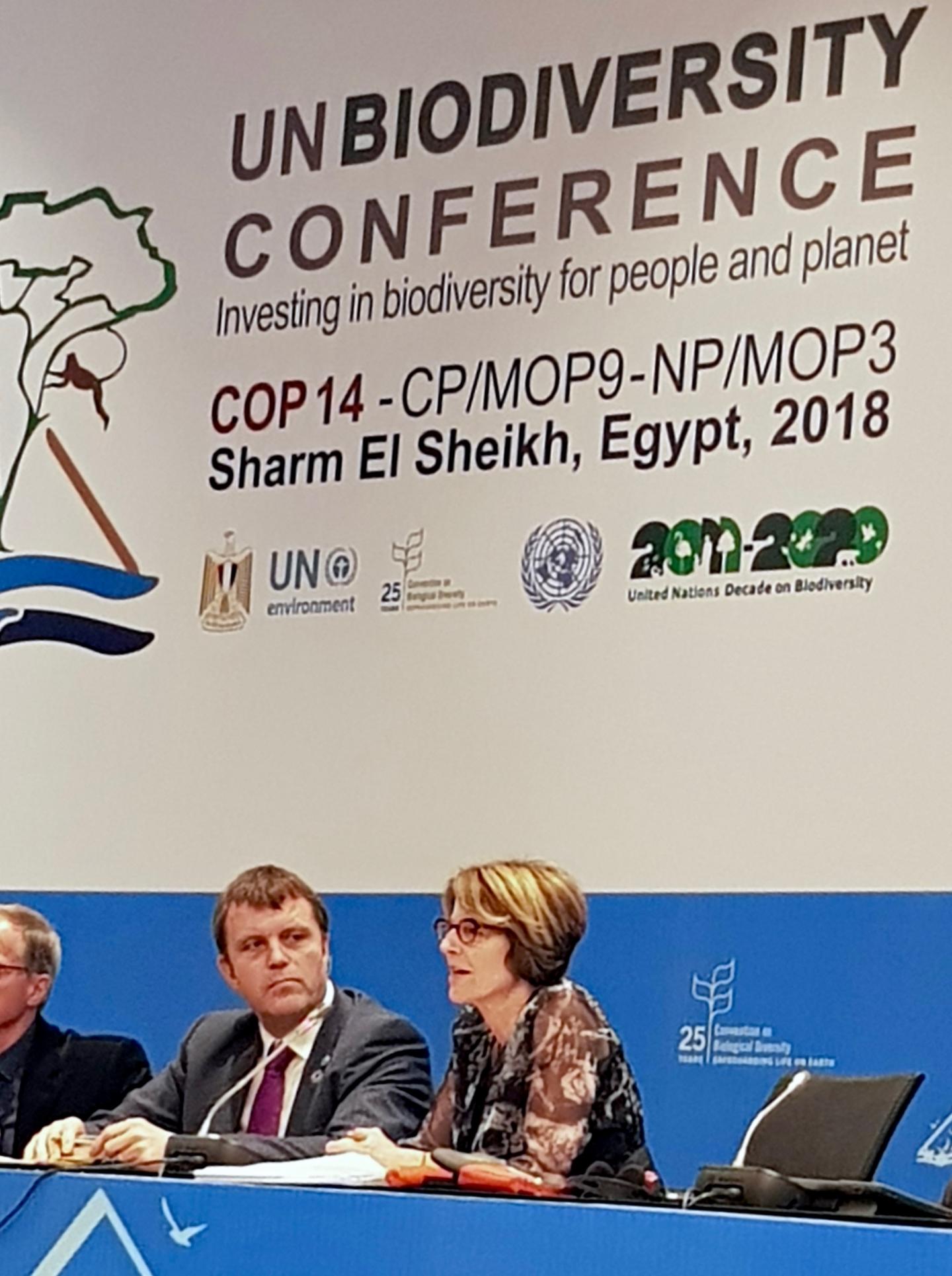
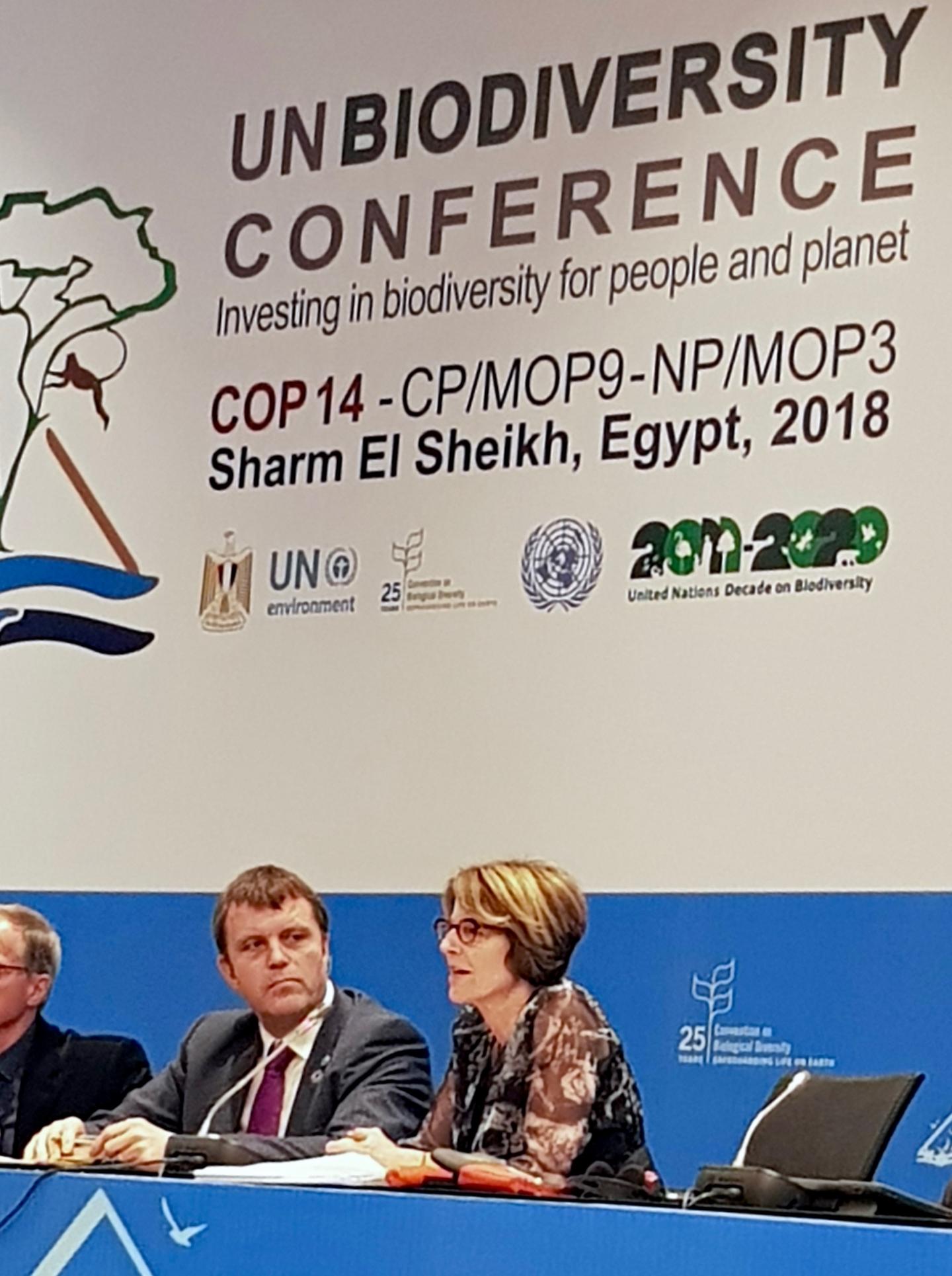
Speaking to government ministers and other high level representatives at a major UN biodiversity meeting in Egypt, Anne Larigauderie, Executive Secretary of the Intergovernmental Platform on Biodiversity and Ecosystem Services, said climate scientists foresee far more land needed for corn and other crops for bioenergy to mitigate climate change in decades to come.
Citing the latest report from the Intergovernmental Platform on Climate Change (on limiting climate warming to 1.5C), Dr. Larigauderie noted that most IPCC scenarios foresee a major increase in land area for cultivating bioenergy crops by 2050 – up to 724 million hectares in all, an area almost the size of Australia.
"The key issue here is: where would this huge amount of new land come from?" she asked. "Is there currently such a large amount of 'marginal land' available or would this compete with biodiversity? Some scientists argue that there is very little marginal land left."
"This important issue needs to be clarified, but the demand for land for energy will almost certainly increase, with negative consequences for biodiversity."
Dr. Larigauderie made the remarks at the start of the 14th meeting of the Conference of the Parties of the UN Convention on Biological Diversity (COP 14, https://www.cbd.int/conferences/2018), convened with the Government of Egypt in Sharm el Sheikh, 14-29 November.
Meeting strong climate mitigation goals without massive bioenergy is possible, she added, but scenarios indicate that this requires substantial reductions in energy use and rapid increases in low carbon energy production from wind, solar and nuclear sources.
Safeguarding plant and animal species diversity and the services nature provides is itself key to the mitigation of planetary warming, she said.
For example:
- Land ecosystems, with their diverse plants and soils, today sequester about one third of annual CO2 emissions.
- Similarly, the ocean sequesters about a quarter of annual carbon emissions.
- Reforestation is better at mitigating climate than most bioenergy crops. In temperate climates, one reforested hectare is four times more effective in climate mitigation than a hectare of corn used for biofuel.
"All methods that produce healthier ecosystems should be promoted as a way to combat climate change," she said. "This includes afforestation and reforestation, as well as restoration – implemented properly using native species, for example."
The latest IPCC report, she said, "has given a sense of extreme urgency for these exchanges on tradeoffs and synergies between climate, biodiversity and land degradation."
Efforts are underway to enhance much needed inter-disciplinary collaboration, she added, between the IPCC and IPBES, in the context of the second work programme of IPBES to be approved in 2019.
"In the background to all of these discussions is the need to elevate the topic of biodiversity much higher on the political agenda – to the same level as climate. I sense that we may be closer … but we have to intensify our efforts as a community even further over the next couple of years."
In separate remarks to business leaders at the UN meetings, Dr. Larigauderie said that COP 14 was expected to make a decision to request from IPBES a report on criteria, metrics and indicators of the impacts different business sectors have on biodiversity and ecosystem services, which could be undertaken in 2019 if approved by the next IPBES Plenary.
Businesses have several compelling reasons to protect and use biodiversity sustainably, she noted.
Among them:
- Many businesses depend directly or indirectly on biodiversity and the health of ecosystem services
- They are often responsible for the loss of biodiversity and ecosystem services and consumers will increasingly favour companies with a biodiversity policy, just as they make choices now that reflect climate and pollution concerns
- Proper management of the impact on biodiversity would not only minimise operational, regulatory, reputational and market risks, but also bring business opportunities for companies in the form of new markets, efficiencies in production, staff buy-in, and competitive advantage.
Recently published IPBES assessments of regional biodiversity and ecosystem services reports contain case studies, policy options and opportunities for mainstreaming biodiversity in different economic sectors, she noted.
"They show in particular that proactive environmental action by businesses is fundamental and needs to increase, but also that they must be supported by complementary regulatory measures as well as economic incentives / disincentives by governments."
A stronger emphasis on this is expected in a major global assessment of biodiversity and ecosystem services being prepared for release in Paris next May, said Dr. Larigauderie. It will be the first such report since the Millennium Ecosystem Assessment of 2005.
A primer detailing elements of the IPBES Global Assessment of Biodiversity will be released on Monday, 19 November.
About the 14th meeting of the Conference of the Parties of the UN Convention on Biological Diversity
High-Level Segment (14-15 November, https://www.cbd.int/meetings/COP-14-HLS). As many as 80 ministers of Environment, Infrastructure, Energy, Industry and other sectors are expected to join in discussions on mainstreaming biodiversity into their respective fields of work.
From 17-29 November, negotiations will be undertaken among 196 Parties to the CBD on the following main themes: Achieving the globally-agreed Aichi Biodiversity Targets (2010-2020); mainstreaming biodiversity issues; and the beginning of two years of negotiation of the post 2020 global framework for biodiversity, scheduled for final agreement at CBD COP15 in China in 2020.
###
About IPBES
Often described as the "IPCC for biodiversity" IPBES is an independent intergovernmental body comprising 130 member Governments. Established by governments in 2012, it provides policymakers with objective scientific assessments about the state of knowledge regarding the planet's biodiversity, ecosystems and the contributions they make to people, as well as the tools and methods to protect and sustainably use these vital natural assets. For more information about IPBES and its assessments: http://www.ipbes.net
IPBES side events at CBD COP14:
November 18th (Sunday): Presentations by the Co-chairs of the four IPBES Regional Assessment Reports issued in March, 2018 (one each for the Americas, Europe and Central Asia, Africa, Asia and the Pacific) and the Global Assessment Report on Land Degradation and Restoration.
November 19th (Monday): Launch of a message 'primer' detailing elements of the IPBES Global Assessment of Biodiversity, expected to be released in Paris in May 2019
Twitter: @IPBES / http://www.facebook.com/ipbes / http://www.youtube.com/ipbeschannel / http://www.linkedin.com/company/ipbes / http://www.instagram.com/ipbes
Follow the CBD conference on social media:
http://www.facebook.com/UNBiodiversity
http://www.facebook.com/UNBiodiversityConvention
http://www.instagram.com/unbiodiversity
http://www.linkedin.com/company/unbiodiversity
A series of live interviews will be broadcast on the CBD's Facebook page (http://www.facebook.com/UNBiodiversity).
All news conferences and briefings will be available via live webcast or video on demand via the UN Biodiversity Conference official website: http://www.cbd.int/webcast (available from 13 November 2018).
Additional information for media, including press briefs and the schedule of press conferences: http://www.cbd.int/conferences/2018/information/media
On-site media participation at CBD meetings is subject to accreditation by the Secretariat. Accreditation is strictly reserved for representatives of bona fide media organizations – print, photo, radio, TV, film, news agencies and online news sites. Accreditation: http://www.cbd.int/participation/2018/media
Media Contact
Terry Collins
20-011-289-19581
[email protected]
[email protected]
+49 (0) 228 815 0588

