

• HOME
  • NEWS
  • EXPLORE
    • CAREER
      • Companies
      • Jobs
    • EVENTS
    • iGEM
      • News
      • Team
    • PHOTOS
    • VIDEO
    • WIKI
  • BLOG
  • COMMUNITY
    • FACEBOOK
    • INSTAGRAM
    • TWITTER
Wednesday, April 22, 2026
BIOENGINEER.ORG
No Result
View All Result
  • Login
  • HOME
  • NEWS
  • EXPLORE
    • CAREER
      • Companies
      • Jobs
        • Lecturer
        • PhD Studentship
        • Postdoc
        • Research Assistant
    • EVENTS
    • iGEM
      • News
      • Team
    • PHOTOS
    • VIDEO
    • WIKI
  • BLOG
  • COMMUNITY
    • FACEBOOK
    • INSTAGRAM
    • TWITTER
  • HOME
  • NEWS
  • EXPLORE
    • CAREER
      • Companies
      • Jobs
        • Lecturer
        • PhD Studentship
        • Postdoc
        • Research Assistant
    • EVENTS
    • iGEM
      • News
      • Team
    • PHOTOS
    • VIDEO
    • WIKI
  • BLOG
  • COMMUNITY
    • FACEBOOK
    • INSTAGRAM
    • TWITTER
No Result
View All Result
Bioengineer.org
No Result
View All Result
Home NEWS Science News Biology

Scorpion venom to shuttle drugs into the brain

Bioengineer by Bioengineer
November 15, 2018
in Biology
Reading Time: 2 mins read
0
Share on FacebookShare on TwitterShare on LinkedinShare on RedditShare on Telegram
IMAGE

Credit: Source: IRB Barcelona

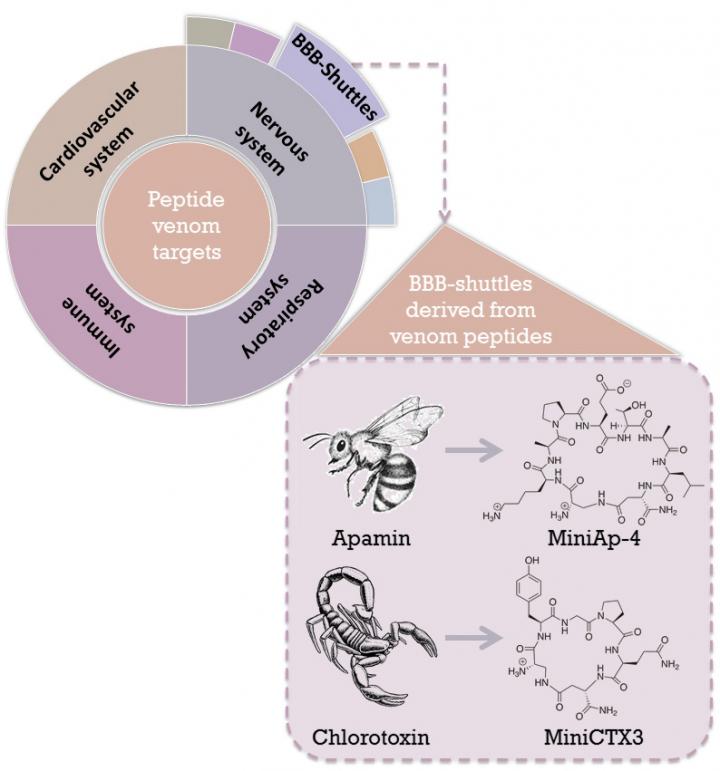
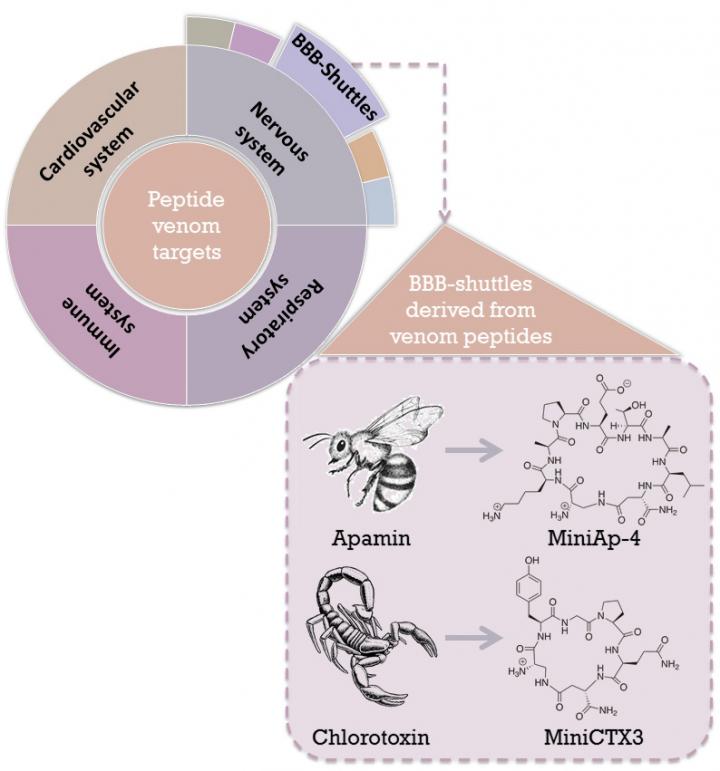
The Peptides and Proteins lab at the Institute for Research in Biomedicine (IRB Barcelona) has published a paper in Chemical Communications describing the capacity of a small protein (a peptide) derived from chlorotoxin, found in scorpion venom (Giant Yellow Israeli scorpion), to carry drugs across the blood-brain barrier (BBB).

The barrier serves to protect the brain from toxic substances, but it also prevents many potential drugs for the treatment of neurological diseases and tumours from entering this organ. "About 98% of drugs that could have therapeutic applications cannot be used because they cannot cross this barrier," explains the head of the lab, Ernest Giralt.

The researchers have chemically synthesised chlorotoxin and a series of analogues that retain some of the properties ofas the parent peptide. They have studied the efficiency of these compounds in cell models of the BBB and have demonstrated that the peptide called MiniCTX3 has the capacity to transport compounds of different nature across the BBB "with great efficiency". Animal venoms for the brain

In the same way that traditional medicine uses natural products such as plants and flowers to treat a range of diseases, the IRB Barcelona lab has sought inspiration from venoms with the objective of identifying peptide shuttles. "Our goal is to enable drugs to enter the brain and to do this we bind them to peptides specifically designed to cross the BBB. The conjugation of these drugs to the shuttles would improve their efficacy," says Meritxell Teixidó, co-leader of the research. "There are only two or three groups worldwide devoted to shuttle peptides. We are working on a number of strategies and one of them is venoms," says Giralt.

In previous studies, these scientists inspired in a peptide from bee venom, namely apamin, had made some chemical modifications and obtained a shuttle with BBB permeability.

After these positive results, the lab wanted to address whether venoms could provide a universal source of peptide shuttles. "Thousands of venoms that hold millions of peptides with the shuttle potential have been described. We chose chlorotoxin because it has already been reported that it acts like a toxin in the brain," explains Teixidó.

This study is another example of ground-breaking research finding inspiration in nature and it has produced another shuttle that can enhance drug transport into the brain.

###

The research was funded by the Ministry of Science, through ERDFs, and the Catalan Government.

Reference article:

Cristina Díaz-Perlas, Monica Varese, Salvador Guardiola, Jesús García, Macarena Sánchez-Navarro, Ernest Giralt and Meritxell Teixidó

From venoms to BBB-shuttles. MiniCTX3: a molecular vector derived from scorpion venom

Chemical Communications (2018) DOI: 10.1039/C8CC06725B

Media Contact

Sònia Armengou
[email protected]
34-934-037-255

http://www.irbbarcelona.org

Original Source

https://www.irbbarcelona.org/en/news/scorpion-venom-to-shuttle-drugs-into-the-brain http://dx.doi.org/10.1039/C8CC06725B

Share12Tweet8Share2ShareShareShare2

Related Posts

UCT Researchers Identify Molecular “Switch” Driving Cancer Progression

UCT Researchers Identify Molecular “Switch” Driving Cancer Progression

April 22, 2026
Decoding the Genetic Origins of Indigenous Peoples

Decoding the Genetic Origins of Indigenous Peoples

April 22, 2026

How Cells Convert Mechanical Forces into Biochemical Signals

April 22, 2026

Unraveling Mitochondrial Genomic Factors Behind Impaired Bone Healing in Aging

April 22, 2026
Please login to join discussion

POPULAR NEWS

  • Research Indicates Potential Connection Between Prenatal Medication Exposure and Elevated Autism Risk

    799 shares
    Share 320 Tweet 200
  • Scientists Investigate Possible Connection Between COVID-19 and Increased Lung Cancer Risk

    65 shares
    Share 26 Tweet 16
  • Salmonella Haem Blocks Macrophages, Boosts Infection

    59 shares
    Share 24 Tweet 15
  • NSF funds machine-learning research at UNO and UNL to study energy requirements of walking in older adults

    101 shares
    Share 40 Tweet 25

About

We bring you the latest biotechnology news from best research centers and universities around the world. Check our website.

Follow us

Recent News

New Study Reveals Gut Microbiome as Key Predictor of IBS Treatment Response

Study Finds Patients Experiencing Greater Marginalization More Likely to Use Emergency Departments for Concussion Care

Geoengineering Offers New Hope for Safeguarding the Amazon Rainforest Against Climate Change

Subscribe to Blog via Email

Success! An email was just sent to confirm your subscription. Please find the email now and click 'Confirm' to start subscribing.

Join 80 other subscribers
  • Contact Us

Bioengineer.org © Copyright 2023 All Rights Reserved.

Welcome Back!

Login to your account below

Forgotten Password?

Retrieve your password

Please enter your username or email address to reset your password.

Log In
No Result
View All Result
  • Homepages
    • Home Page 1
    • Home Page 2
  • News
  • National
  • Business
  • Health
  • Lifestyle
  • Science

Bioengineer.org © Copyright 2023 All Rights Reserved.