


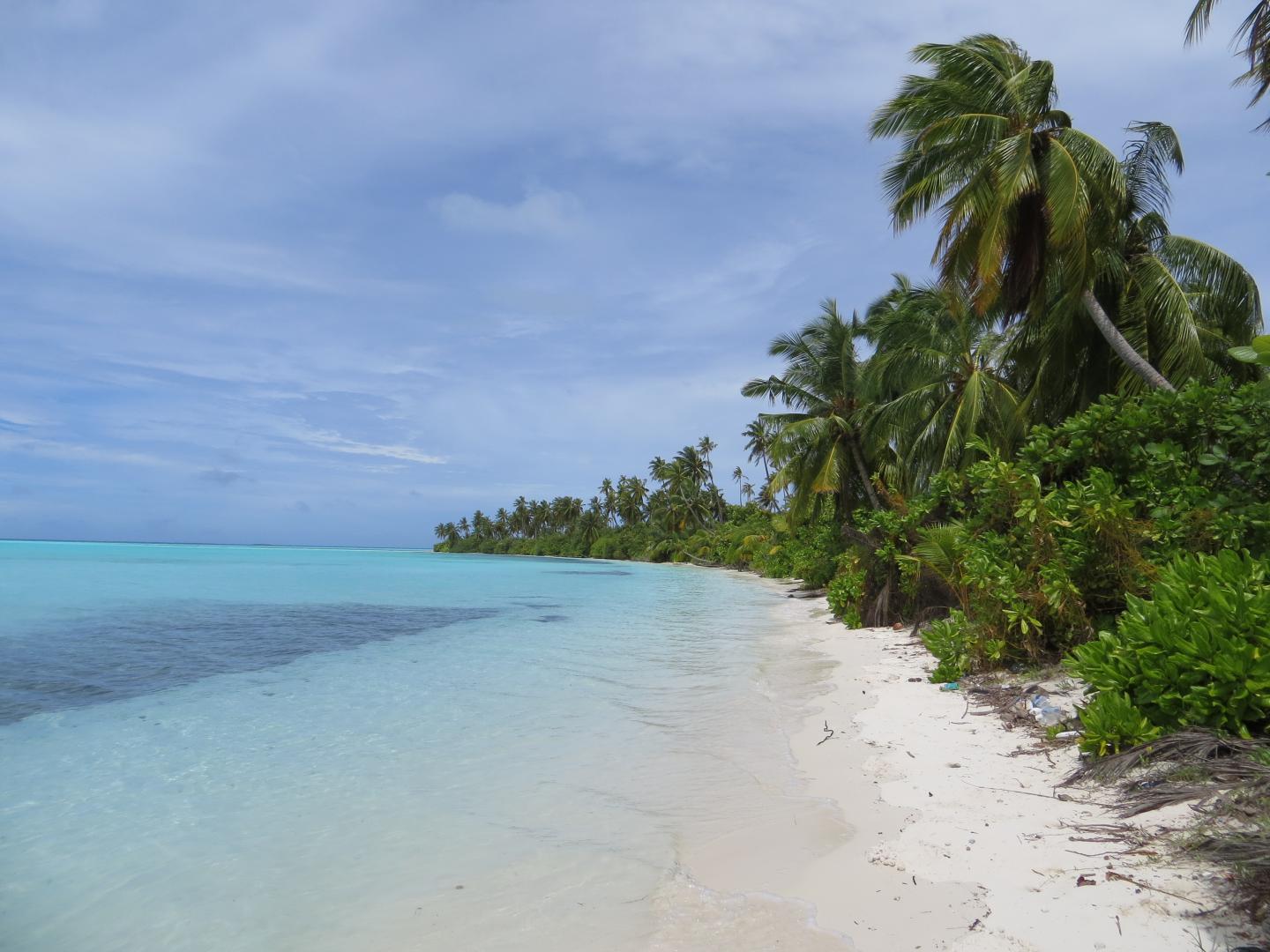
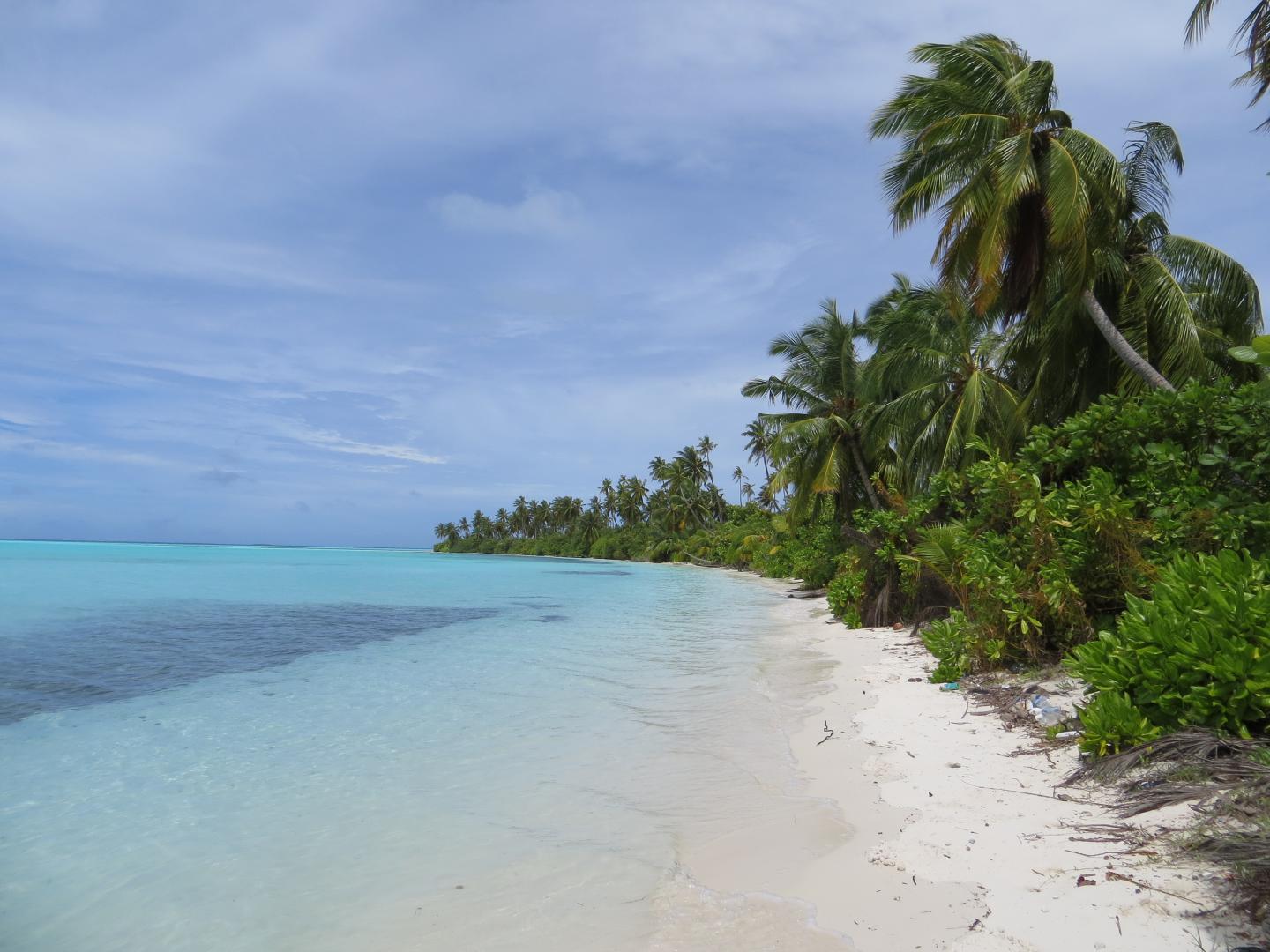
Credit: Holly East
Rising global sea levels may actually be beneficial to the long-term future of coral reef islands, such as the Maldives, according to new research published in Geophysical Research Letters.
Low-lying coral reef islands are typically less than three metres above sea level, making them highly vulnerable to rising sea levels associated with climate change. However, research has found new evidence that the Maldives – the world's lowest country – formed when sea levels were higher than they are today.
The evidence was discovered by researchers who studied the formation of five islands in the southern Maldives. Using a coring technique, they were able to reconstruct how and when the islands formed.
They found that large waves caused by distant storms off the coast of South Africa led to the formation of the islands approximately three to four thousand years ago. These large waves – known as high-energy wave events – broke coral rubble off the reef and transported it onto reef platforms creating the foundations for the reef islands.
At the time, sea levels were up to 0.5 metres higher than they are today, which gave the waves more energy. This means that higher sea levels and large wave events were critical to the construction of the islands.
The researchers say that under climate change, projected increases in sea level and the magnitude of large wave events could actually lead to the growth of reef islands, but only if the coral reef remains healthy to provide the building material.
The research was led by Dr Holly East of the Department of Geography and Environmental Sciences at Northumbria University, Newcastle. She explained: "Coral reef islands are typically believed to be highly vulnerable to rising sea levels. This is a major concern for coral reef island nations, in which reef islands provide the only habitable land.
"However, we have found evidence that the Maldivian rim reef islands actually formed under higher sea levels than we have at present. This gives us some optimism that if climate change causes rising sea levels and increases in the magnitude of high-energy wave events in the region, it may actually create the perfect conditions to reactivate the processes that built the reef islands in the first place, rather than drowning them."
However, Dr East stressed that this could only occur if healthy live coral was available in the region's reef communities.
"As these islands are mostly made from coral, a healthy coral reef is vital to provide the materials for island building," she said. "However, this could be problematic as corals face a range of threats under climate change, including increasing sea surface temperatures and ocean acidity. If the reef is unhealthy, we could end up with the perfect building conditions but not the bricks."
Dr East worked with academics from the University of Exeter (UK); Simon Fraser University (Canada); University of Auckland (New Zealand); Southern Institute of Technology (New Zealand) and the UK's Natural Environment Research Council (NERC) on this study.
Dr East added: "It is also important to note that the large wave events required for reef island building may devastate island infrastructure, potentially compromising the habitability of reef islands in their current form. A challenge for reef island nations may therefore be to develop infrastructure with the capacity to withstand, or be adaptable to, large wave events."
###
Their paper, Coral Reef Island Initiation and Development Under Higher Than Present Sea Levels is now available in Geophysical Research Letters.
Media Contact
Andrea Slowey
[email protected]
@NorthumbriaUni
http://www.northumbria.ac.uk
Original Source
https://www.northumbria.ac.uk/about-us/news-events/news/coral-reefs/ http://dx.doi.org/10.1029/2018GL079589

