


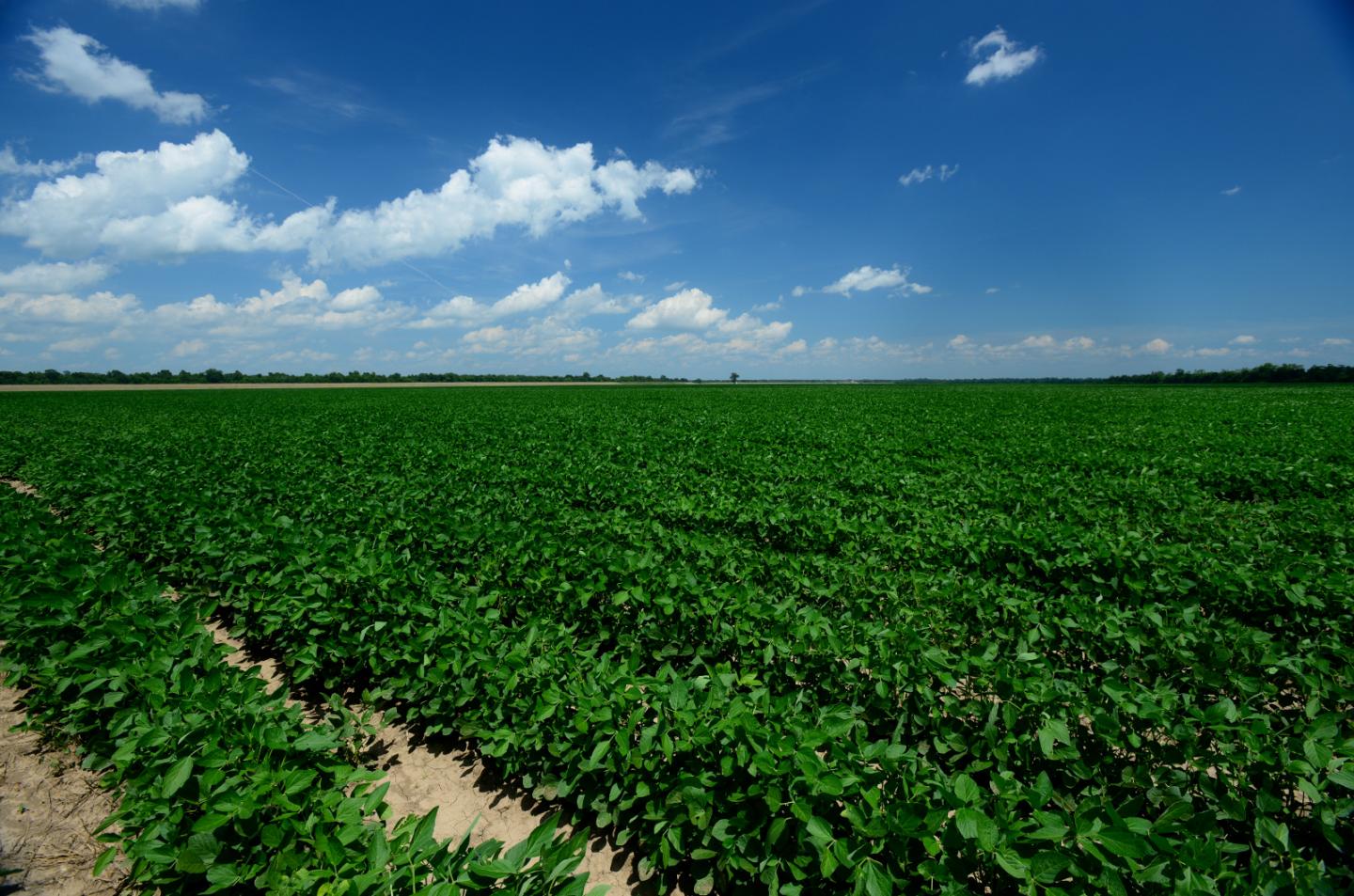
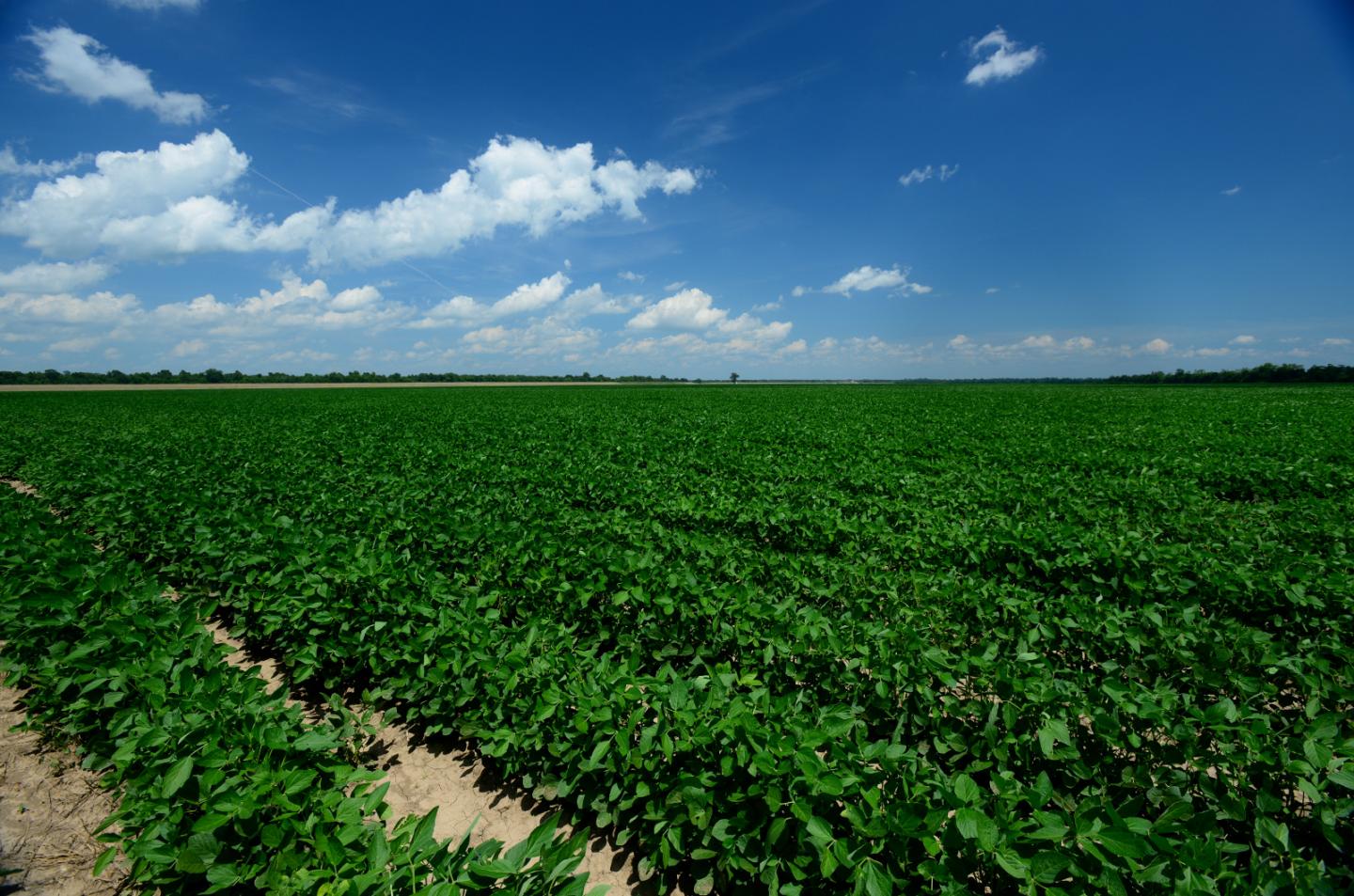
Credit: Stephen Kirkpatrick, USDA National Resource Conservation Service
By temporarily silencing the expression of a critical gene, researchers fooled soybean plants into sensing they were under siege, encountering a wide range of stresses. Then, after selectively cross breeding those plants with the original stock, the progeny "remember" the stress-induced responses to become more vigorous, resilient and productive plants, according to a team of researchers.
This epigenetic reprogramming of soybean plants, the culmination of a decade-long study, was accomplished not by introducing any new genes but by changing how existing genes are expressed. That is important because it portends how crop yields and tolerance for conditions such as drought and extreme heat will be enhanced in the future, according to lead researcher Sally Mackenzie, professor in the departments of Biology and Plant Science at Penn State.
Researchers identified a gene they call MSH1 that exists in all plants, and when they down-regulate or turn off its expression, the plant becomes "convinced" it is encountering multiple stresses, even though it is growing under perfect conditions. The plant senses it is dealing with drought, extreme cold, heat and high light levels, etc., simultaneously, Mackenzie explained, so it amplifies the expression of gene networks to respond to those stimuli.
Her research group discovered the MSH1 gene more than a decade ago while she was a faculty member at the University of Nebraska-Lincoln studying how the genes necessary for energy generation, photosynthesis and respiration communicate and coordinate. At the time, Mackenzie, now an endowed chair in plant genomics for Penn State's Huck Institutes, did not realize how important the gene is for modifying the way a plant expresses its genes.
"Recently, by serendipity, we discovered that after we replace the MSH1 gene, the plant has a 'memory' of that stress — and by memory I mean its growth features are very different from the plant we started with," she said. "And it will remember the stress generation after generation after generation, as long as we don't make any crosses and keep it in the same lineage."
As part of their recent research, lines derived from crossing with the "memory" plants were grown in large populations in four different field conditions at four widely separated locations in Nebraska, and they proved to be more vigorous, higher-yielding and better adapted to their environment than typical soybean plants.
Important for the political reality of these times, this is a technology that could be readily applied because it is not a genetically modified organism, so it doesn't require any special regulatory approval. It can go right into the field, Mackenzie pointed out, and be deployed in any crop, not just in soybean. Her research group has already demonstrated the approach works in tomatoes and sorghum.
"What it means is that we can take our very best crop varieties and possibly get more out of them and make them more resilient with a fairly straightforward manipulation," she said. "We saw a significant enhancement in yield and growth performance, which is unexpected because we didn't introduce any new genes. We just changed the way they are expressed. And all of a sudden, we had a 13-14 percent increase in the yield of soybeans."
Soybean was a logical crop on which to conduct the research. It is the most widely grown legume in the world, second only to grasses in economic importance. Advances in breeding and agronomic practices have steadily increased soybean yields in the past century, but further improvement will face challenges from climate instability and limited genetic diversity. That calls for the implementation of novel tools and methodologies to benefit soybean performance, researchers say.
The research findings, published recently online in Plant Biotechnology Journal, open the door to what epigenetics can offer in crop improvement. Mackenzie said the findings come "at a time when climate change is going to be the greatest challenge we will deal with over the next 20 to 30 years, and when food security will be very much in jeopardy." In places like Syria and Lebanon that have been hit so hard by climate change and war that they cannot produce their own food, this will be especially important, she noted.
"If you start adding up countries that really are not food secure, it is scary," she said. "Because if they can't feed their own people, who is going to do it? It is not reasonable to think that we can increase our food production on this continent to manage all of that. One way or another, we have to find ways to produce food in those recalcitrant, difficult environments."
###
Also involved in the research were Sunil Kenchanmane Raju, Mon-Ray Shao, Robersy Sanchez, Ying-Zhi Xu, Ajay Sandhu and George Graef, all with the Department of Agronomy and Horticulture, University of Nebraska?Lincoln.
This work was partially supported by grants from National Science Foundation and The Bill and Melinda Gates Foundation.
Media Contact
A'ndrea Elyse Messer
[email protected]
814-865-9481
@penn_state
http://live.psu.edu

