Credit: NIMS
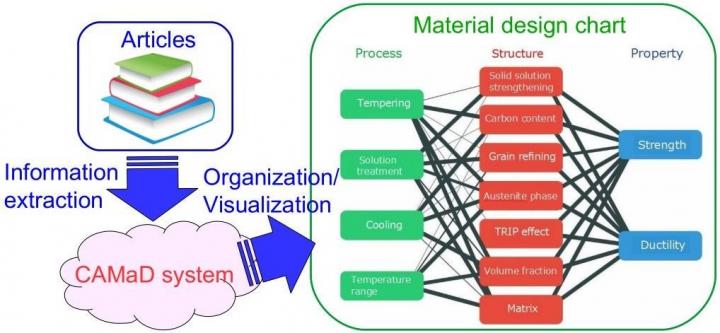
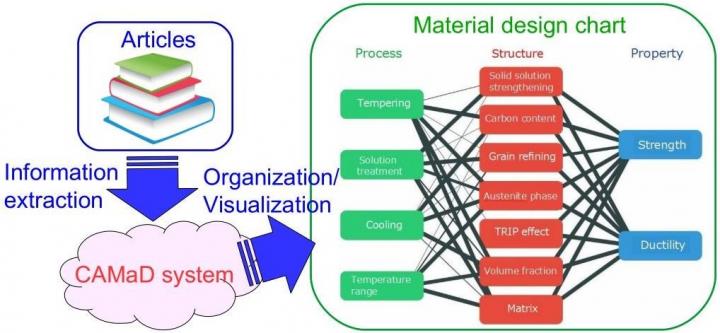
NIMS and the Toyota Technological Institute at Chicago have jointly developed a Computer-Aided Material Design (CAMaD) system capable of extracting information related to fabrication processes and material structures and properties–factors vital to material design–and organizing and visualizing the relationship between them. The use of this system enables information from thousands of scientific and technical articles to be summarized in a single chart, rationalizing and expediting material design.
The performance of a material is determined by its properties. Because a material's properties are greatly influenced by its structure and by the fabrication process that controls the structure, understanding the relationships between factors affecting material properties of interest and associated material structures and fabrication processes is vital to rationalizing and expediting the development of materials with desirable performance. Materials informatics–an information science-based approach to materials research–allows the relationships between these factors to be extracted from large amounts of data using deep learning. However, because the collection of large amounts of data on materials through experiments and database construction is labor-intensive, it had been difficult to use materials informatics to integrate process-structure-property-performance relationships into material design.
This research group has developed a system able to extract and identify relationships between factors related to processes, structures and properties vital to material design by instructing computers to read the text of scientific articles–rather than numerical data on materials–using natural language processing and weekly supervised deep learning. The material designers initially select several material properties relevant to desirable material performance. Based on these selections, the computer then extracts relevant information, determines the type and strength of relationships between material structures relevant to the desirable properties and factors related to structure-controlling fabrication processes and generates a chart to visualize these relationships. For example, if a steel designer selects "strength" and "ductility" as material properties of interest, the computer produces a chart illustrating the relationship between structural and process factors relevant to composite microstructures known to influence these two properties.
In this pioneering effort, we actively integrated natural language processing and deep learning into material design. We have publicized the AI source code developed in this study for use by others, free of charge, to promote related research.*
###
*Link to the source code: https://bitbucket.org/0024takeshi/pspp_relation
This research project was carried out by Ikumu Watanabe (Senior Researcher, RCSM, NIMS), Takuya Kadohira (Group Leader, MaDIS, NIMS) and Takeshi Onishi (Ph.D. student, Toyota Technological Institute at Chicago).
This study was published in Science and Technology of Advanced Materials on September 19, 2018.
Contacts
(Regarding this research)
Ikumu Watanabe
Senior Researcher,
High Strength Materials Group, Analysis and Evaluation Field,
Research Center for Structural Materials,
National Institute for Materials Science
TEL: +81-29-859-2118
E-Mail: [email protected] ">[email protected]
Takeshi Onishi
Ph.D. Student, Toyota Technological Institute at Chicago
Email: [email protected]">[email protected]
URL: http://0024takeshi.bitbucket.io
(For general inquiries)
Public Relations Office
National Institute for Materials Sciences
Tel: +81-29-859-2026
Fax: +81-29-859-2017
E-Mail: [email protected]">[email protected]
Media Contact
Yasufumi Nakamichi
[email protected]
81-298-592-105
http://www.nims.go.jp/eng/index.html
Original Source
http://www.nims.go.jp/eng/news/press/2018/09/201809250.html http://dx.doi.org/10.1080/14686996.2018.1500852