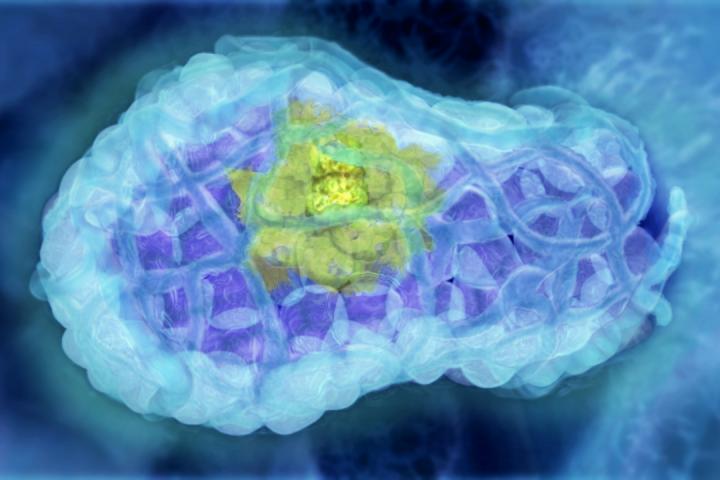
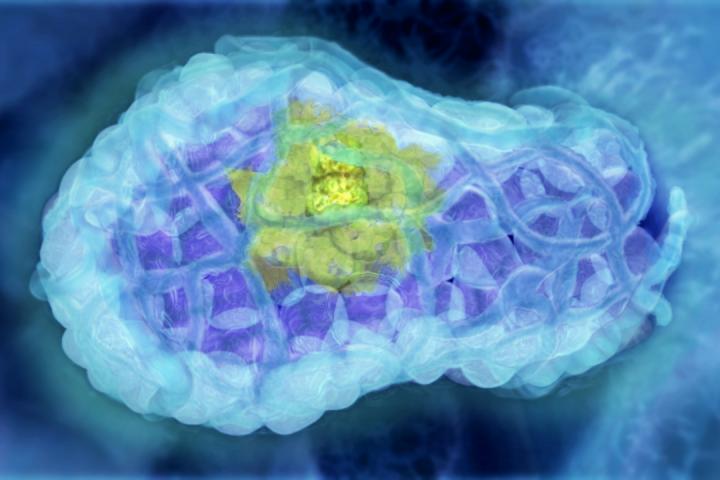
Credit: Drew Berry, Walter and Eliza Hall Institute
Melbourne scientists have discovered how tumour development is driven by mutations in the most important gene in preventing cancer, p53.
The research revealed that in the early stages of cancer, mutant p53 'tackles' the normal p53 protein and blocks it from carrying out its protective role. As a result, p53 can no longer activate natural defences against cancer – such as the body's DNA repair process – increasing the risk of cancer developing.
The research was led by Dr Brandon Aubrey, Professor Andreas Strasser and Dr Gemma Kelly together with bioinformaticians Professor Gordon Smyth and Dr Yunshun Chen. The findings are published in this month's edition of Genes and Development.
At a glance
- Researchers have discovered how mutations in p53 – found in half of all human cancers – drive cancer development.
- The mutant p53 protein 'tackles' the normal protein and prevents it from carrying out its protective role, while permitting it to activate genes driving tumour growth.
- The team is now examining whether the mutant p53 protein acts in the same way in established tumours, with important implications for cancer therapy.
Tackling DNA's guardian
p53 is known as the 'guardian of the genome' due to its role in protecting cells from cancer.
"p53 plays a critical role in many pathways that prevent cancer, such as repairing DNA or killing cells if they have irreparable DNA damage," Dr Kelly said.
"Genetic defects in p53 are found in half of all human cancers, but exactly how these changes disrupt p53 function has long been a mystery."
Dr Kelly said that cells normally have two copies of the p53 gene in every cell.
"Early during cancer development, one copy of the gene may undergo a sudden and permanent change through mutation, while the other copy of the gene remains normal. This results in the cell making a mixture of normal and mutant versions of the p53 protein.
"We found that the mutant p53 protein can bind to and 'tackle' the normal p53 protein, blocking it from performing protective roles such as DNA repair. This makes the cell more likely to undergo further genetic changes that accelerate tumour development."
The team expected the mutant proteins would block all normal p53 activity, so was surprised to find that only certain p53-dependent pathways were affected.
"The mutant proteins are cunning: while they stop p53 from activating pathways that protect against cancer, they still allow p53 to activate pathways that promote tumour growth. p53's role in cancer is clearly more complicated than we had expected," Dr Kelly said.
A mystery resolved
Professor Strasser said the findings inform a longstanding debate about mutant p53.
"Scientists have been debating how mutant p53 contributes to the development of cancer for decades.
"One camp argues that mutant p53 acts by 'tackling' the normal protein and blocking its natural protective roles. The other camp argues that mutant p53 goes 'rogue' and performs new roles that promote tumour development."
"Our work clearly shows that during cancer development, the 'tackling' of normal p53 is most significant. This selectively disables certain but not all normal functions of p53," Professor Strasser said.
Clinical implications
The team is now investigating whether the same is true for established tumours, with important implications for drug treatments.
"Established tumours have often lost the normal copy of their p53 gene and only produce mutant p53 protein," Dr Kelly said.
"If mutant p53 acts by tackling normal p53, then it may no longer play a role in established tumours where no normal p53 is produced. This would mean that drugs that block mutant p53 would have no clinical benefit," she said.
"Conversely, if mutant p53 has new, cancer-promoting activities of its own in established tumours, then a drug that specifically blocks mutant p53 could be beneficial for treating thousands of patients."
###
This work was supported by the Leukaemia Foundation, the Australian National Health and Medical Research Council, the Leukemia and Lymphoma Society of America, the Cancer Council of Victoria, the Victorian Cancer Agency, the Estate of Anthony (Toni) William Redstone OAM, the Craig Perkins Cancer Research Foundation, the Victorian State Government and the Australian Government.
Media Contact
Arunee Wilson
[email protected]
61-393-452-719
@WEHI_research
Related Journal Article
http://dx.doi.org/10.1101/gad.314286.118