Credit: (c) Uni Bonn
Hypotrichosis simplex leads to progressive hair loss already in childhood. A team of researchers led by human geneticists at the University Hospital of Bonn has now deciphered a new gene that is responsible for this rare form of hair loss. Changes in the LSS gene lead to impairment of an important enzyme that has a crucial function in cholesterol metabolism. The scientists now present their findings in the renowned journal the American Journal of Human Genetics.
In infancy, fine hair tends to sprout sparsely. With increasing age, hair loss progresses. Ultimately, only a few hairs are left on the head and body. Hypotrichosis simplex is a rare form of hair loss (alopecia). The condition is limited to a few hundred families worldwide. So far, only a few genes are known that are causally related to the disease. Under the leadership of the Institute of Human Genetics at the University Hospital of Bonn, a team of researchers from Germany and Switzerland has now deciphered mutations in another gene that are responsible for hair loss.
The scientists examined the coding genes of three families that are not related to each other and are of different ancestry. A total of eight relatives showed the typical symptoms of hair loss. All those affected had mutations in the LSS gene. "This gene encodes lanosterol synthase – LSS for short," said Prof. Dr. Regina C. Betz from the Institute of Human Genetics at the University Hospital of Bonn. "The enzyme plays a key role in cholesterol metabolism." However, the cholesterol blood values of those affected are not changed. Betz: "There is an alternative metabolic pathway for cholesterol, which plays an important role in the hair follicle and is not related to blood cholesterol levels."
Mutation leads to displacement of lanosterol synthase
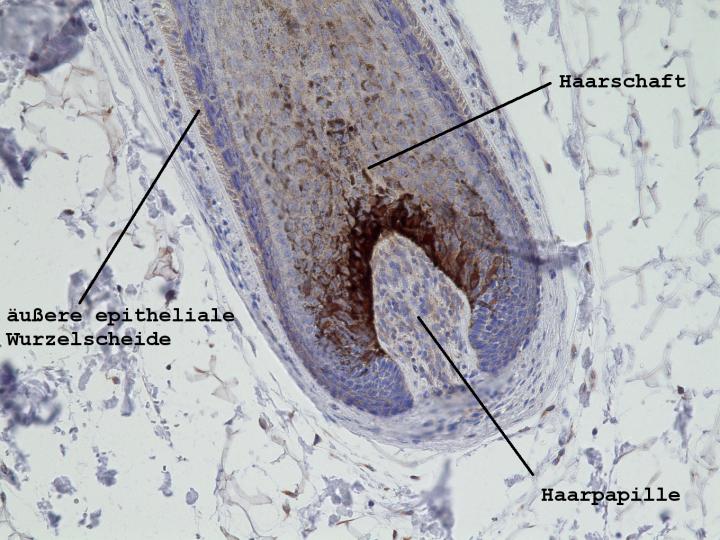
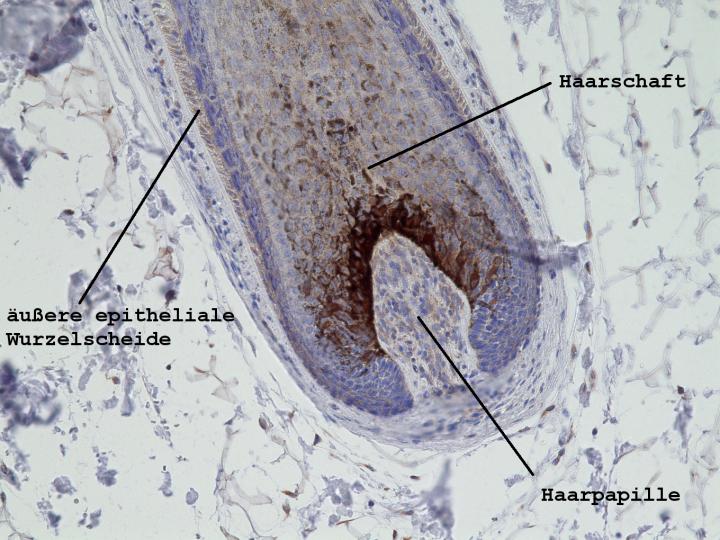
Using tissue samples, the scientists tried to find out exactly where the lanosterol synthase is located in the hair follicle cells. The hair roots are formed in the follicle. If the LSS gene is not mutated, the associated enzyme is located in a system of very fine channels in the follicle cells, the endoplasmic reticulum. If a mutation is present, the lanosterol synthase also spreads outside these channels into the adjacent substance, the cytosol. "We are not yet able to say why the hair is falling out," says lead author Maria-Teresa Romano, a doctoral student in Prof. Betz's team. "It is likely that the displacement of LSS from the endoplasmic reticulum results in a malfunction."
Prof. Dr. Matthias Geyer from the Department of Structural Immunology at the University of Bonn investigated the consequences of mutations for the structure of the enzyme lanosterol synthase. With him and Prof. Betz, there are now two principal investigators from the Cluster of Excellence ImmunoSensation of the University of Bonn, which was impressively endorsed in the latest round of the Excellence Competition and will receive further funding.
Improved diagnosis
For the scientists, the current study result is an important finding: Each further gene decoded is yet another part of the jigsaw and helps to complete the picture of the biological basis of the disease. "A better understanding of the causes of the disease may in future enable new approaches to the treatment of hair loss," said the human geneticist. But there is still a long way to go. However, the discovery of the gene already contributes to an improved diagnosis of the rare disease. Betz: "Those affected by hypotrichosis simplex only have to deal with hair loss. This is upsetting, but other organs are not affected."
###
Publication: Maria-Teresa Romano, Aylar Tafazzoli, Maximilian Mattern, Sugirthan Sivalingam, Sabrina Wolf, Alexander Rupp, Holger Thiele, Janine Altmüller, Peter Nürnberg, Jürgen Ellwanger, Reto Gambon, Alessandra Baumer, Nicolai Kohlschmidt, Dieter Metze, Stefan Holdenrieder, Ralf Paus, Dieter Lütjohann, Jorge Frank, Matthias Geyer, Marta Bertolini, Pavlos Kokordelis, Regina C. Betz: Bi-allelic mutations in LSS, encoding lanosterol synthase, cause autosomal recessive hypotrichosis simplex, the American Journal of Human Genetics, DOI: https://doi.org/10.1016/j.ajhg.2018.09.011
Media contact:
Univ.-Prof. Dr. med. Regina C. Betz
Institute of Human Genetics
University Hospital of Bonn
Tel. +49(0)228/28751023
E-Mail: [email protected]
Media Contact
Regina C. Betz
[email protected]
49-228-287-51023
@unibonn
http://www.uni-bonn.de
Related Journal Article
http://dx.doi.org/10.1016/j.ajhg.2018.09.011