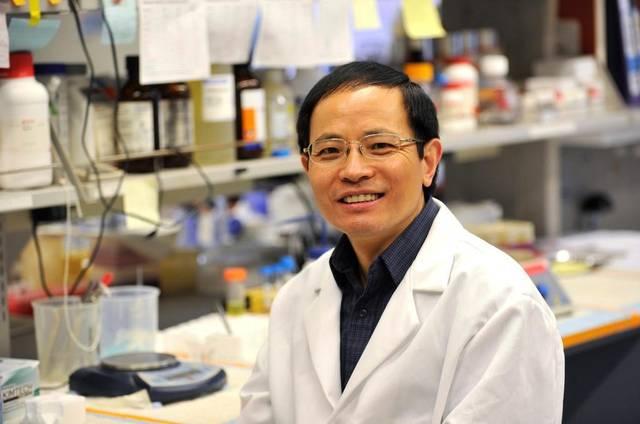
A new gene therapy can turn certain brain glial cells into functioning neurons, which in turn could help repair the brain after a stroke or during neurological disorders like Alzheimer’s or Parkinson’s diseases. In a series of studies in animals, a team of Penn State researchers led by Dr. Gong Chen developed a new gene therapy to reprogram glial cells — which surround each neuron and can be activated when neurons die — and turn them into healthy, functioning neuron cells.
Chen –professor and Verne M. Willaman Chair in Life Sciences, who presented the findings Nov. 4 at the annual meeting of the Society for Neuroscience in San Diego — said that while more research is needed, he hopes the innovative technology may eventually be able to help patients with brain injury and degenerative neurological disorders.
“There is a huge unmet medical need to treat severe neurological disorders such as stroke, Alzheimer’s disease and Parkinson’s disease, among others,” Chen said. “Neuronal loss is the common cause of these functional deficits in the brain and spinal cord. Therefore, simply targeting cell signaling pathways affected by these neurodegenerative disorders without regenerating new neurons will not be most effective to restore the lost brain functions.”
In addition to neurons, the human brain is also composed of glial cells, which surround each neuron and help support healthy brain function. Chen said each of these glial cells contains neural genes that are silenced, or switched off, during early brain development.
By creating a new in vivo cell conversion technology, Chen said he and his team were able to inject a neural transcription factor called NeuroD1– a protein that activates neuronal genes and silences glial genes — within injured parts of the brain to infect glial cells. The NeuroD1 then binds with the glial cell’s DNA and activates the neuron genes, turning the glial cell into a functioning neuron.
“This is an economic way of internal neuroregeneration without the need to transplant external cells,” Chen said. “Because glial cells are abundant throughout human brains, every patient is equipped with such potential for internal neuroregeneration that has not been fully realized yet.”
Chen said that in their animal studies, they were able to not only regenerate neurons with the new technique, but also restore motor and cognitive functions, as well.
“Current treatments for stroke patients, for example, have to be administered within hours, because the medication is trying to protect the neurons before they are injured and die,” Chen said. “Our new technique is different in that it actually regenerates neurons after they’ve already died, and can be used days, weeks, or months after injury.”
While the technology has only been tested in animals, Chen said he and the other researchers are hoping to eventually test the technology in a human clinical trial.
When a patient experiences an injury like a stroke, or develops a neurological disorder like Alzheimer’s, neurons in parts of the brain die, creating a decline in brain function. Chen said that because adults do not have the ability to regenerate neurons on their own, developing a treatment to help patients make new neurons would benefit a large number of patients experiencing neurological disorders that are currently incurable.
In addition to developing the gene therapy, Chen and his team are also working on a drug therapy that converts human glial cells into neurons. The researchers have had success with the drug therapy in vitro in cell cultures, and Chen said they hope to move to animal studies in vivo and eventually to help human patients.
###
This work was supported by the National Institutes of Health, Alzheimer’s Association and the Charles H. Skip Smith Endowment Fund.
Chen’s team members on this presentation include Ziyuan Guo, Zheng Wu, Yue Wang, Jiuchao Yin, Lei Zhang, Yuchen Chen, all from Penn State; and Longjiao Ge, from the Chinese Academy of Sciences.
Media Contact
Katie Bohn
[email protected]
@penn_state
http://live.psu.edu