Credit: UT Arlington
Distributing information through quantum communication is an extremely secure method because it relies on the quantum nature of single photons, or fundamental particles of light, to make it impossible for anyone to eavesdrop and extract information.
However, quantum communication is also much slower than traditional means of communication and is difficult to deploy on a large scale.
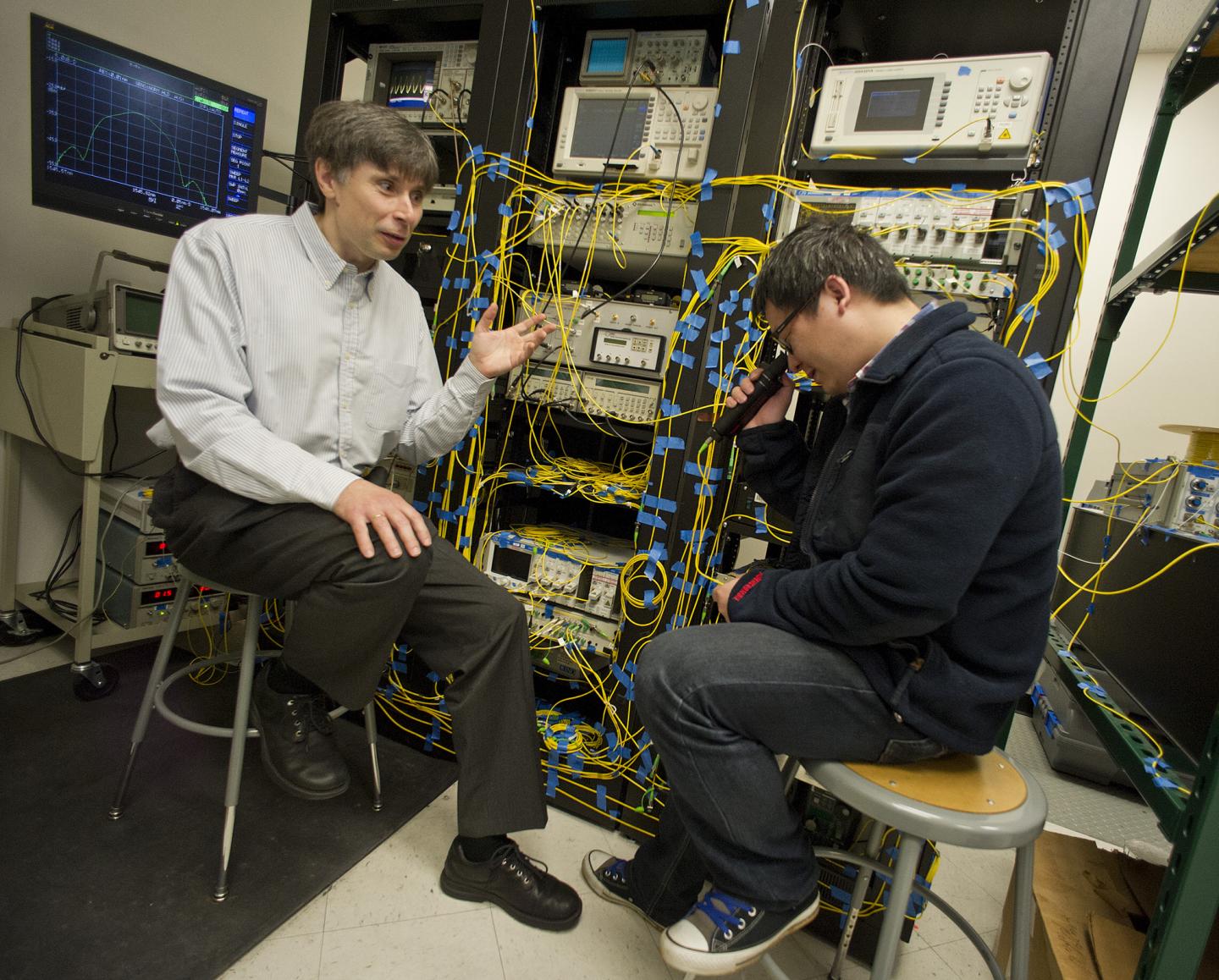
Michael Vasilyev, a UTA professor of electrical engineering, and his research partner, Professor Yuping Huang of the Stevens Institute of Technology, recently received a three-year, $750,000 National Science Foundation grant to address the challenges of large-scale deployment of quantum communication systems by developing chip-integrated devices and sub-systems for preparation and detection of quantum photonic signals.
The award is part of $31 million that the NSF awarded for fundamental quantum research. Six million was earmarked for eight projects such as Vasilyev's that enable scalable quantum communications systems by demonstrating proof-of-concept technologies that encompass novel devices, circuits, information processing techniques and integration platforms in a quantum communication system, according to the NSF.
Vasilyev and Huang previously have collaborated on research to develop photonic device technology that could significantly speed up quantum communications.
For this grant, the team will integrate linear and nonlinear optical devices on a lithium-niobate thin film platform, making it possible to shrink an entire system down to a single chip. This will enable fast, robust and photon-efficient quantum communications over both traditional telecom fibers and free space. Free space, or line-of-sight, systems allow quantum communication via satellite, while fiber systems support communication through buried optical cables.
Classical communications systems are able to transmit information at hundreds of terabytes per second, but quantum communications are many orders of magnitude slower because they rely on single photons and cannot apply amplifiers to the signal without compromising the secure nature of the transmission. This project will attempt to create an integrated quantum transceiver capable of both sending and receiving the quantum information over many temporal modes represented by various waveforms that overlap in time.
On the transmitter side, the researchers will encode information on a single photon using lossless shaping of the photon waveform on a picosecond – or one trillionth of a second – timescale. Lossless property means that the waveform does not lose any energy during the process.
This transmission system will permit the photon a lot of freedom in the choice of its waveform traveling through the system, and each of these degrees of freedom can be used to carry the information.
The receiver side will use mode-discriminating photon detection, which can dynamically choose the mode from which the information will be extracted with a very high accuracy.
"Creating a quantum transceiver will yield the most important building block for future quantum communications systems that are robust against poor weather conditions, ultra-efficient for encoding and decoding of single photons and optimized for use over both free space and optical fiber," Vasilyev said. "If we are successful, it could be an important step in building large-scale quantum communication networks."
Vasilyev's research is an example of data-driven discovery, one of four themes of UTA's Strategic Plan 2020: Bold Solutions | Global Impact, said Jonathan Bredow, chair of the Electrical Engineering Department.
"Dr. Vasilyev has conducted extensive research into efficient, secure quantum communications, and his discoveries will fit well in the scope of this new grant. If successful, this team's work would ensure the United States' continued leadership in quantum communication technology," Bredow said.
###
— Written by Jeremy Agor
Media Contact
Herb Booth
[email protected]
817-272-7075
@utarlington
http://www.uta.edu
Original Source
https://www.uta.edu/news/releases/2018/10/Vasilyev-quantum-communications-NSF.php