• HOME
  • NEWS
  • EXPLORE
    • CAREER
      • Companies
      • Jobs
    • EVENTS
    • iGEM
      • News
      • Team
    • PHOTOS
    • VIDEO
    • WIKI
  • BLOG
  • COMMUNITY
    • FACEBOOK
    • INSTAGRAM
    • TWITTER
Saturday, February 7, 2026
BIOENGINEER.ORG
No Result
View All Result
  • Login
  • HOME
  • NEWS
  • EXPLORE
    • CAREER
      • Companies
      • Jobs
        • Lecturer
        • PhD Studentship
        • Postdoc
        • Research Assistant
    • EVENTS
    • iGEM
      • News
      • Team
    • PHOTOS
    • VIDEO
    • WIKI
  • BLOG
  • COMMUNITY
    • FACEBOOK
    • INSTAGRAM
    • TWITTER
  • HOME
  • NEWS
  • EXPLORE
    • CAREER
      • Companies
      • Jobs
        • Lecturer
        • PhD Studentship
        • Postdoc
        • Research Assistant
    • EVENTS
    • iGEM
      • News
      • Team
    • PHOTOS
    • VIDEO
    • WIKI
  • BLOG
  • COMMUNITY
    • FACEBOOK
    • INSTAGRAM
    • TWITTER
No Result
View All Result
Bioengineer.org
No Result
View All Result
Home NEWS Science News

NASA’s CloudSat gets a slice of Typhoon Yutu’s eye

Bioengineer by Bioengineer
October 31, 2018
in Science News
Reading Time: 2 mins read
0
Share on FacebookShare on TwitterShare on LinkedinShare on RedditShare on Telegram
IMAGE

Credit: Credit: Colorado State/Natalie Tourville

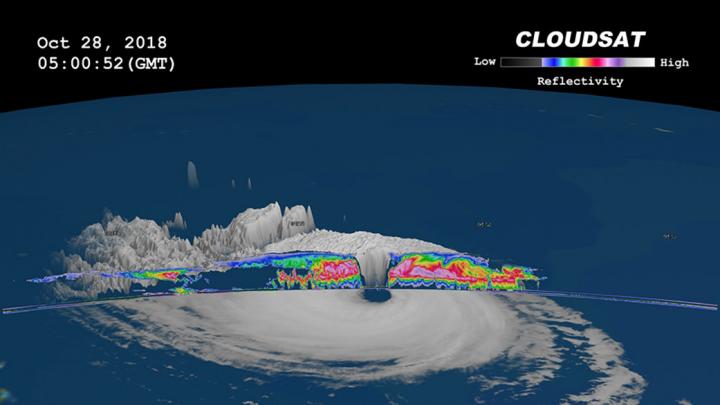
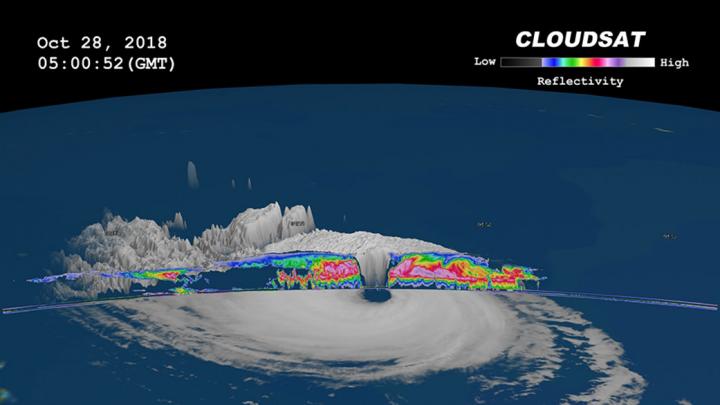
NASA's CloudSat satellite captured a stunning image of Typhoon Yutu as it passed over the eye of the storm. The storm has since weakened to a tropical storm.

CloudSat flew over the eye of Typhoon Yutu on October 28, 2018 at 12:58 a.m. EDT (0458 UTC) as the storm was approaching the Philippines in the Western North Pacific. At the time of the CloudSat overpass, Typhoon Yutu was beginning a period of weakening as the storm was moving info less favorable atmospheric conditions (lower sea surface temperatures). Typhoon Yutu contained estimated sustained winds of 120 knots (138 mph) with a minimum pressure of 933 millibars (the equivalent of a Category 4 strength storm). Typhoon Yutu left a trail of destruction through Saipan, Tinian and the Mariana Islands on October 24 and 25, 2018 as a Super Typhoon (category 5 strength storm).

Natalie Tourville of Colorado State University who produced the images, said "CloudSat's 94 GHz cloud profiling radar (CPR) passed directly over the eye of Typhoon Yutu revealing the cirrus free eye with an outward sloping eyewall, a feature typically found in intense tropical systems. The southern portion of the eyewall appears more disorganized as the thicker cloud tops are starting to disintegrate from the top down.

The CloudSat overpass reveals the inner details beneath the storms cloud tops. Intense areas of convection with moderate to heavy rainfall, cloud-free areas (moats) underneath the northern portion of the cirrus canopy and cloud top height's estimated at 14 kilometers (8.7 miles). Lower values of reflectivity denote smaller ice and water particle sizes typically located at top of the system (in the anvil area). The CloudSat CPR signal attenuates in heavy rainfall when cloud droplets become larger than 3 millimeters (.11 inch) which dampen the strength of the CPR signal. This is evident by the lack of signal typically occurring beneath the melting level when frozen particles transform into liquid."

On Oct. 31 at 5 a.m. EDT (0900 UTC) Yutu had weakened to a tropical storm with maximum sustained winds near 45 knots (52 mph/83 kph). Tropical storm Yutu was centered near 18.1 degrees north latitude and 117.5 degrees east longitude, about 291 nautical miles northwest of Manila, Philippines.

As Yutu moves toward China, Hong Kong has posted Stand-by signal #1. The Joint Typhoon Warning Center expects Yutu to re-strengthen as it moves north. The storm is forecast to dissipate off the Chinese mainland, east of Hong Kong.

###

Media Contact

Rob Gutro
[email protected]
@NASAGoddard

http://www.nasa.gov/goddard

Original Source

https://blogs.nasa.gov/hurricanes/tag/yutu-2018/

Share12Tweet8Share2ShareShareShare2

Related Posts

Phage-Antibiotic Combo Beats Resistant Peritoneal Infection

February 7, 2026

Boosting Remote Healthcare: Stepped-Wedge Trial Insights

February 7, 2026

Barriers and Boosters of Seniors’ Physical Activity in Karachi

February 7, 2026

Evaluating Pediatric Emergency Care Quality in Ethiopia

February 7, 2026
Please login to join discussion

POPULAR NEWS

  • Robotic Ureteral Reconstruction: A Novel Approach

    Robotic Ureteral Reconstruction: A Novel Approach

    82 shares
    Share 33 Tweet 21
  • Digital Privacy: Health Data Control in Incarceration

    63 shares
    Share 25 Tweet 16
  • Study Reveals Lipid Accumulation in ME/CFS Cells

    57 shares
    Share 23 Tweet 14
  • Breakthrough in RNA Research Accelerates Medical Innovations Timeline

    53 shares
    Share 21 Tweet 13

About

We bring you the latest biotechnology news from best research centers and universities around the world. Check our website.

Follow us

Recent News

Phage-Antibiotic Combo Beats Resistant Peritoneal Infection

Boosting Remote Healthcare: Stepped-Wedge Trial Insights

Barriers and Boosters of Seniors’ Physical Activity in Karachi

Subscribe to Blog via Email

Enter your email address to subscribe to this blog and receive notifications of new posts by email.

Join 73 other subscribers
  • Contact Us

Bioengineer.org © Copyright 2023 All Rights Reserved.

Welcome Back!

Login to your account below

Forgotten Password?

Retrieve your password

Please enter your username or email address to reset your password.

Log In
No Result
View All Result
  • Homepages
    • Home Page 1
    • Home Page 2
  • News
  • National
  • Business
  • Health
  • Lifestyle
  • Science

Bioengineer.org © Copyright 2023 All Rights Reserved.