Credit: Daisuke Watanabe
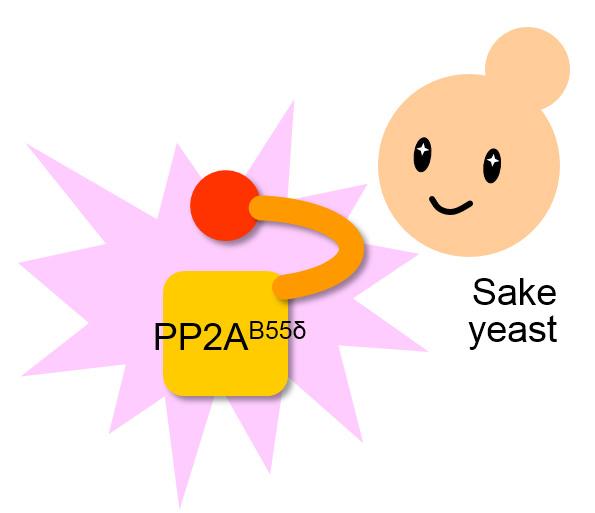
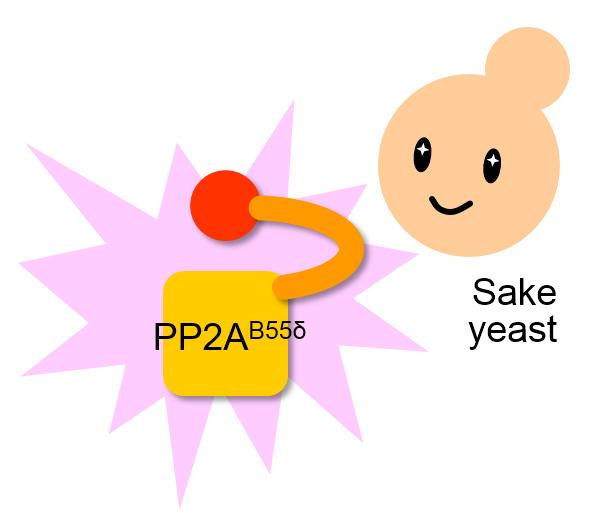
Alcohol has been celebrated for all of history. The Ancient Greeks worshipped Dionysus for their spirits, while the Chinese recognized Yidi as the creator of libertine drink. Of course, unknowingly, both were actually servants of the true alcohol master, yeast. In Japan, some of the best sake are the result of a single mutation in yeast. Researchers at the Nara Institute of Science and Technology (NAIST) report in a new study seen in Applied and Environmental Microbiology the key molecule released from this mutation, PP2AB55δ, allows yeast to ferment alcohol.
NAIST Assistant Professor Daisuke Watanabe and Professor Hiroshi Takagi have devoted their careers to studying yeast mutations to identify why some are better at fermentation than others. One example of this is the RIM15 gene in the sake yeast breed Kyokai number 7.
"RIM15 codes for RIM15p, and RIM15p inhibits alcohol fermentation. However, even after correcting the mutation, Kyokai number 7 can still ferment," says Watanabe.
This fact suggested to him that other molecules working with RIM15p are also involved in the fermentation. A deeper analysis revealed that Kyokai number 7 has two unusual molecular features besides the RIM15 mutation.
"We found high TORC1 activity," says Watanabe. TORC1 is known to inhibit RIM15p.
Ironically, fermentation causes stress on yeast which can cause the cells to die. To conserve energy, yeast stop growing, which includes lowering fermentation activity. "This elevated TORC1 activity seems novel to sake yeast cells," Watanabe says.
Where TORC1 is a molecule that suppresses RIM15p, the second factor is a molecule released by RIM15p inhibition.
"CDC55 encodes B55δ, a regulatory subunit, on PP2A [PP2AB55δ]. Mutating this gene resulted in yeast that could no longer ferment alcohol," notes Watanabe. This was true even when RIM15p was inhibited, suggesting that PP2AB55δ is a major regulator of alcohol fermentation by yeast.
By understanding all the molecules involved in alcohol fermentation and how they interact with each other, Watanabe is optimistic that it will be possible to improve fermentation by targeting individual steps in the process.
"We hypothesize that the high TORC1 activity and the loss of RIM15p contribute to the activation of PP2AB55δ. This finding suggests a critical molecular pathway for alcohol fermentation by yeast. By studying the individual steps, we can identify ways to chemically enhance production," he says.
###
Resource
Title: Nutrient signaling via the TORC1-Greatwall-PP2AB55δ pathway responsible for the high initial rates of alcoholic fermentation in sake yeast Strains of Saccharomyces cerevisiae
Authors: Daisuke Watanabe, Takuma Kajihara, Yukiko Sugimoto, Kenichi Takagi, Megumi Mizuno, Yan Zhou, Jiawen Chen, Kojiro Takeda, Hisashi Tatebe, Kazuhiro Shiozaki, Nobushige Nakazawa, Shingo Izawa, Takeshi Akao, Hitoshi Shimoi, Tatsuya Maeda & Hiroshi Takagi
Publication: Applied and Environmental Microbiology
DOI: 10.1128/AEM.02083-18
Information about Prof. Takagi lab can be found at the following website: http://bsw3.naist.jp/takagi/?cate=183
Media Contact
Takahito Shikano
[email protected]
81-743-725-644
@NAIST_MAIN_EN
http://www.naist.jp/en/
Related Journal Article
http://dx.doi.org/10.1128/AEM.02083-18