• HOME
  • NEWS
  • EXPLORE
    • CAREER
      • Companies
      • Jobs
    • EVENTS
    • iGEM
      • News
      • Team
    • PHOTOS
    • VIDEO
    • WIKI
  • BLOG
  • COMMUNITY
    • FACEBOOK
    • INSTAGRAM
    • TWITTER
Wednesday, June 3, 2026
BIOENGINEER.ORG
No Result
View All Result
  • Login
  • HOME
  • NEWS
  • EXPLORE
    • CAREER
      • Companies
      • Jobs
        • Lecturer
        • PhD Studentship
        • Postdoc
        • Research Assistant
    • EVENTS
    • iGEM
      • News
      • Team
    • PHOTOS
    • VIDEO
    • WIKI
  • BLOG
  • COMMUNITY
    • FACEBOOK
    • INSTAGRAM
    • TWITTER
  • HOME
  • NEWS
  • EXPLORE
    • CAREER
      • Companies
      • Jobs
        • Lecturer
        • PhD Studentship
        • Postdoc
        • Research Assistant
    • EVENTS
    • iGEM
      • News
      • Team
    • PHOTOS
    • VIDEO
    • WIKI
  • BLOG
  • COMMUNITY
    • FACEBOOK
    • INSTAGRAM
    • TWITTER
No Result
View All Result
Bioengineer.org
No Result
View All Result
Home NEWS Science News Biology

Brainwave activity reveals potential biomarker for autism in children

Bioengineer by Bioengineer
October 26, 2018
in Biology
Reading Time: 2 mins read
0
Share on FacebookShare on TwitterShare on LinkedinShare on RedditShare on Telegram
IMAGE

Credit: Kanazawa University

Kanazawa, Japan – Autism spectrum disorder (ASD) is a neurodevelopmental disorder that can impair communication ability, socialization, and verbal and motor skills. It generally starts in early childhood and is diagnosed through behavior observation. This means of assessment can be imprecise, which is especially problematic when early identification is vital for developmental follow up. A strong need exists for objective and measurable clinical indicators, known as biomarkers.

Now, a team of researchers at Kanazawa University in Japan have made an important step towards identifying a biomarker based on motor-related brain activity. Their work followed on from the key hypothesis that autism results from an excitatory and inhibitory imbalance in the brain, which is associated with repetitive brainwaves called gamma oscillations. A reduction in this type of brain activity has been seen during visual, auditory, and tactile stimulation in individuals with ASD.

The researchers set out to further explore motor-induced gamma oscillations in children with ASD, and recently reported their findings in The Journal of Neuroscience.

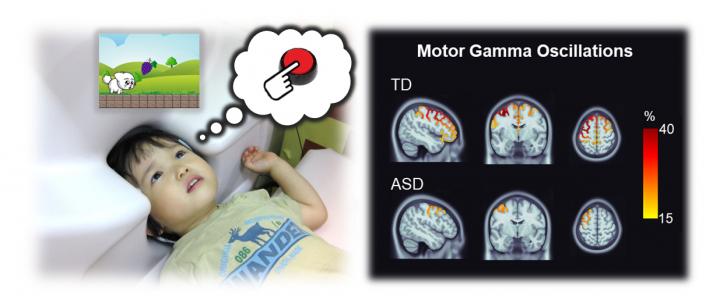
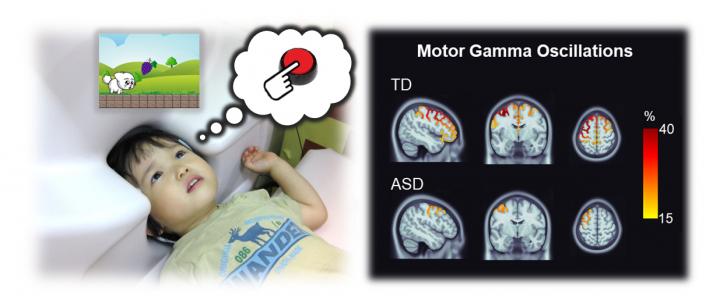
They formed two groups of children who were 5-7 years old. Those in the first group were conventionally diagnosed with ASD, while the second group was made up of children classed as developing typically. The children each performed a video-game-like task where they had to press a button with their right finger, while in a relaxed environment. Magnetoencephalography, which records magnetic activity from neurons, was used to monitor the children's brainwaves during the task.

"We measured the button response time, motor-evoked magnetic fields, and motor-related gamma oscillations," study corresponding author Mitsuru Kikuchi says. "As found in other studies, the ASD children's response time was slightly slower and the amplitude in their magnetic fields was a bit decreased. The gamma oscillations were where we saw significant and interesting differences."

There was a considerably lower peak frequency of the gamma oscillations in the ASD group. A lower peak frequency of motor-related gamma oscillations also signaled low concentration of the inhibitory neurotransmitter GABA, which has also been found associated with ASD. The findings additionally suggest delayed development of motor control in young children with ASD. Collectively the behavioral performance and brainwave findings offer promise for ASD diagnosis.

"Early diagnosis of ASD is highly important so that we can actively manage the disorder as soon as possible," first author Kyung-min An says. "These findings may prove to be extremely useful in helping us understand the neurophysiological mechanism behind social and motor control development in children with ASD. Using magnetoencephalography in this way gives us a noninvasive and quantifiable biomarker, which is something we are in great need of."

###

Media Contact

Tomoya Sato
[email protected]
81-762-645-076

http://www.kanazawa-u.ac.jp/e/index.html

Related Journal Article

http://dx.doi.org/10.1523/JNEUROSCI.1229-18.2018
Share12Tweet8Share2ShareShareShare2

Related Posts

Unveiling the Structure of Human M-Channels: Decoding the Stoichiometry and Gating Mechanism Behind Neuronal Firing Thresholds — Biology

Unveiling the Structure of Human M-Channels: Decoding the Stoichiometry and Gating Mechanism Behind Neuronal Firing Thresholds

June 3, 2026
How Our Biological Clock Begins and Keeps Ticking — Biology

How Our Biological Clock Begins and Keeps Ticking

June 3, 2026

Fossil Find Sheds Light on Missing Links in Modern Fish Evolution

June 3, 2026

Intuitive Software Suite Revolutionizes DNA Structure Generation and Analysis

June 3, 2026
Please login to join discussion

POPULAR NEWS

  • ESMO 2025: mRNA COVID Vaccines Enhance Efficacy of Cancer Immunotherapy

    321 shares
    Share 128 Tweet 80
  • Multi-Hospital Study Reveals Long Covid Burden Is Twice as High as Current Estimates

    87 shares
    Share 34 Tweet 22
  • Saying Goodbye to PGY-6: Pediatric Fellowship Realities

    69 shares
    Share 28 Tweet 17
  • Common Food Preservatives Associated with Elevated Blood Pressure and Increased Heart Disease Risk

    57 shares
    Share 23 Tweet 14

About

We bring you the latest biotechnology news from best research centers and universities around the world. Check our website.

Follow us

Recent News

Epigenetic Changes Drive Pancreatic Adaptation to Aging, Diabetes

New Study Uncovers Key Values Influencing Black and Hispanic Parents’ COVID-19 Vaccination Choices for Their Children

Reprogramming the Immune System: A New Approach to Treat Type 1 Diabetes

Subscribe to Blog via Email

Enter your email address to subscribe to this blog and receive notifications of new posts by email.

Join 83 other subscribers
  • Contact Us

Bioengineer.org © Copyright 2023 All Rights Reserved.

Welcome Back!

Login to your account below

Forgotten Password?

Retrieve your password

Please enter your username or email address to reset your password.

Log In
No Result
View All Result
  • Homepages
    • Home Page 1
    • Home Page 2
  • News
  • National
  • Business
  • Health
  • Lifestyle
  • Science

Bioengineer.org © Copyright 2023 All Rights Reserved.