

• HOME
  • NEWS
  • EXPLORE
    • CAREER
      • Companies
      • Jobs
    • EVENTS
    • iGEM
      • News
      • Team
    • PHOTOS
    • VIDEO
    • WIKI
  • BLOG
  • COMMUNITY
    • FACEBOOK
    • INSTAGRAM
    • TWITTER
Saturday, February 7, 2026
BIOENGINEER.ORG
No Result
View All Result
  • Login
  • HOME
  • NEWS
  • EXPLORE
    • CAREER
      • Companies
      • Jobs
        • Lecturer
        • PhD Studentship
        • Postdoc
        • Research Assistant
    • EVENTS
    • iGEM
      • News
      • Team
    • PHOTOS
    • VIDEO
    • WIKI
  • BLOG
  • COMMUNITY
    • FACEBOOK
    • INSTAGRAM
    • TWITTER
  • HOME
  • NEWS
  • EXPLORE
    • CAREER
      • Companies
      • Jobs
        • Lecturer
        • PhD Studentship
        • Postdoc
        • Research Assistant
    • EVENTS
    • iGEM
      • News
      • Team
    • PHOTOS
    • VIDEO
    • WIKI
  • BLOG
  • COMMUNITY
    • FACEBOOK
    • INSTAGRAM
    • TWITTER
No Result
View All Result
Bioengineer.org
No Result
View All Result
Home NEWS Science News Biology

Loss of work productivity in a warming world

Bioengineer by Bioengineer
October 26, 2018
in Biology
Reading Time: 2 mins read
0
Share on FacebookShare on TwitterShare on LinkedinShare on RedditShare on Telegram
IMAGE

Credit: YU Shuang

In recent years, surveys based on social-science studies have been well applied to quantify the impact of heat stress on the work capacity. However, previous surveys were mainly for developed countries. The number of samples was usually very small (hundreds or even tens) and not suitable for identifying the regional differences across the world. The worldwide pattern of heat-related work productivity loss (WPL) remained unclear.

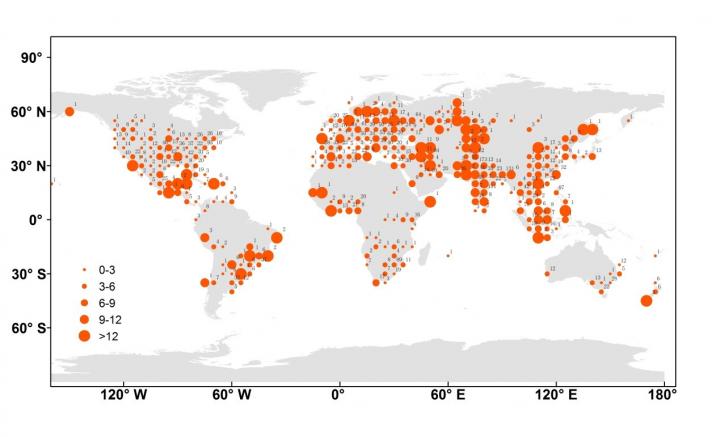
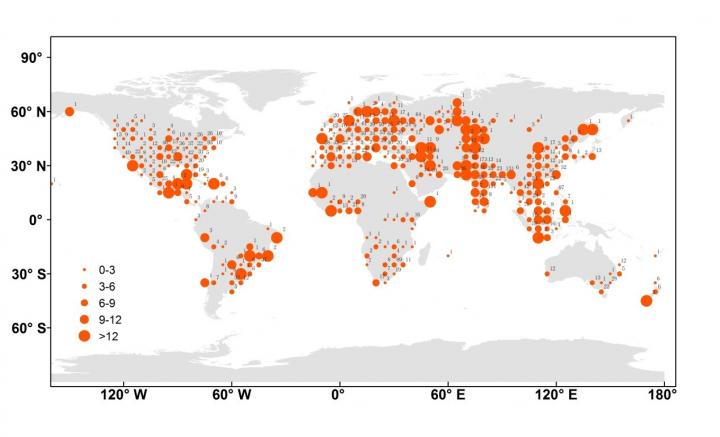
Recently, YU Shuang, XIA Jiangjiang and YAN Zhongwei from the Institute of Atmospheric Physics, Chinese Academy of Sciences, together with colleagues from China and UK, synthesized 4363 responses to a global online survey in 2016, the most extensive global survey about the effect of heat stress on the WPL currently available, in order to quantify the effects of heat stress on work productivity in different countries for the year.

The survey results show that the heat-related WPL for the year was 6.6 days for developing countries and 3.5 days for developed countries. The heat-related WPL has significant negative correlation with GDP Per Capita (cc=-0.63), indicating that the WPL is inversely proportional to the level of development. They identified the regions of vulnerability to heat waves that might have been overlooked in the past, especially the regions such as Central Asia and northern Europe due to relatively low adaptability to heat.

They further estimated the WPL for the future in the Representative Concentration Pathways (RCPs) scenarios( greenhouse gas concentration trajectory adopted by the IPCC and aims to represent the different atmospheric concentration change and climate futures). When global warming reaches 1.5, 2, 3 and 4°C respectively, the average WPL will be 9 (19), 12 (31), 22 (61) and 33 (94) days for developed (developing) countries. Countries in Southeast Asia in a 1.5°C-warming world would suffer the same loss as the developed countries would in a 4°C-warming world. This quantitatively addressed the severe situation that developing countries would face under global warming.

"Heat waves surely impact more seriously the developing countries in general, but our study quantitatively estimated how much heatwaves would reduce the productivity and identified the most vulnerable regions over the world." YU Shuang said, "Our results call for attention to the need of adaptation to increasing heatwaves by improving protective infrastructure especially for the developing regions in the Belt and Road."

The paper was published in Journal of Cleaner Production.

###

Media Contact

Zheng Lin
[email protected]
86-108-299-5053
@aasjournal

http://english.iap.cas.cn/

Original Source

http://english.iap.cas.cn/RE/201810/t20181026_200507.html http://dx.doi.org/10.1016/j.jclepro.2018.10.067


Share12Tweet8Share2ShareShareShare2

Related Posts

New Study Uncovers Mechanism Behind Burn Pit Particulate Matter–Induced Lung Inflammation

New Study Uncovers Mechanism Behind Burn Pit Particulate Matter–Induced Lung Inflammation

February 6, 2026

DeepBlastoid: Advancing Automated and Efficient Evaluation of Human Blastoids with Deep Learning

February 6, 2026

Navigating the Gut: The Role of Formic Acid in the Microbiome

February 6, 2026

AI-Enhanced Optical Coherence Photoacoustic Microscopy Revolutionizes 3D Cancer Model Imaging

February 6, 2026
Please login to join discussion

POPULAR NEWS

  • Robotic Ureteral Reconstruction: A Novel Approach

    Robotic Ureteral Reconstruction: A Novel Approach

    82 shares
    Share 33 Tweet 21
  • Digital Privacy: Health Data Control in Incarceration

    63 shares
    Share 25 Tweet 16
  • Study Reveals Lipid Accumulation in ME/CFS Cells

    57 shares
    Share 23 Tweet 14
  • Breakthrough in RNA Research Accelerates Medical Innovations Timeline

    53 shares
    Share 21 Tweet 13

About

We bring you the latest biotechnology news from best research centers and universities around the world. Check our website.

Follow us

Recent News

Oxygen-Enhanced Dual-Section Microneedle Patch Improves Drug Delivery and Boosts Photodynamic and Anti-Inflammatory Treatment for Psoriasis

Scientists Identify SARS-CoV-2 PLpro and RIPK1 Inhibitors Showing Potent Synergistic Antiviral Effects in Mouse COVID-19 Model

Neg-Entropy: The Key Therapeutic Target for Chronic Diseases

Subscribe to Blog via Email

Enter your email address to subscribe to this blog and receive notifications of new posts by email.

Join 73 other subscribers
  • Contact Us

Bioengineer.org © Copyright 2023 All Rights Reserved.

Welcome Back!

Login to your account below

Forgotten Password?

Retrieve your password

Please enter your username or email address to reset your password.

Log In
No Result
View All Result
  • Homepages
    • Home Page 1
    • Home Page 2
  • News
  • National
  • Business
  • Health
  • Lifestyle
  • Science

Bioengineer.org © Copyright 2023 All Rights Reserved.
