Credit: American Journal of Preventive Medicine
Ann Arbor, October 24, 2018 – According to a new study in the American Journal of Preventive Medicine, almost 75 percent of US adults do not comply with public health guidelines recommending two or more muscle-strengthening exercise (MSE) sessions a week, with nearly 60 percent of the population doing no MSE at all. Using the data from a nationally representative sample of US adults, the investigators also linked low-to-moderately frequent MSE with fewer reported health conditions such as diabetes, obesity, and cancer.
"This study is among the first to show that most US adults do not engage in MSE. We also demonstrate that as few as one or two MSE sessions a week result in fewer reported health conditions such as diabetes, obesity, and cancer, even after accounting for aerobic exercise levels," explained lead investigator Jason A. Bennie, PhD, Physically Active Lifestyles Research Group (USQ PALs), Institute for Resilient Regions, University of Southern Queensland, Springfield, QLD, Australia.
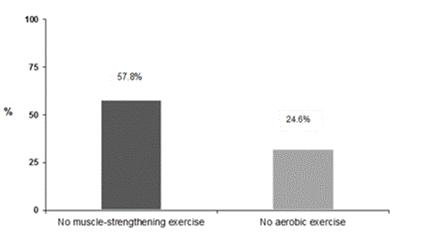
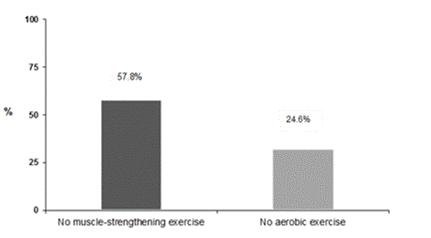
To assess the weekly frequency of MSE among US adults, the investigators analyzed data on more than 397,000 participants (18-80 years old) in the 2015 Behavioral Risk Factor Surveillance System (BRFSS). Over 30 percent met the MSE recommendations (two or more times per week), while approximately 58 percent reported no MSE activity at all, which was more than twice as many respondents who reported no aerobic exercise (24.6 percent).
BRFSS was initiated in 1984 to collect state-specific data on preventive health practices and risk behaviors that are relevant to public health in the US adult population. As a result, the investigators were able to segment the findings by sociodemographic and lifestyle factors. They found that black and multi-racial respondents were more likely than others to meet or exceed the minimum MSE recommendations. People who did not adhere tended to be older, female, overweight/obese, did less aerobic activity, had lower income and education, and rated their own health as poor.
While MSE is an important component of physical activity-related health, it has been largely ignored in public health approaches for the prevention and management of chronic diseases. When performed regularly, MSE increases skeletal muscle strength, power, endurance, and mass. Previous research has shown that MSE has multiple health benefits including improved glucose and lipid metabolism, blood pressure, bone density, balance/physical function, and self-esteem and reduces anxiety.
The investigators caution that the study design did not allow them to infer causality or reverse causality. For example, the reduced odds of adverse health conditions may be due to the fact that individuals with such conditions may be more likely to avoid MSE.
Public health action is warranted to support MSE uptake/adherence. However, contrasted with moderate-to-vigorous intensity aerobic physical activity, MSE has unique health promotion challenges. MSE requires a rudimentary understanding of specific nomenclature (e.g., sets, repetitions, large muscle groups) and access to some basic equipment (e.g., resistance bands, dumbbells). Also, negative social norms associated with MSE might be impeding its uptake, as this activity might be associated with excessive muscle gain, risk of injury, and hyper-masculine settings.
The investigators hope that this study will provide a stimulus for future public health approaches to get greater proportions of the population engaged in MSE. "We hope that these findings put MSE front and center on the agenda as a key health behavior in the prevention and management of chronic diseases," Dr. Bennie added, noting that the World Health Organization's 2010 Global Recommendations on Physical Activity for Health states that adults (aged 18-64) should participate in MSE involving large muscle groups at least two days a week, in addition to 150 minutes or more of vigorous aerobic exercise.
###
Media Contact
Jillian B. Morgan
[email protected]
734-936-1590
@elseviernews
http://www.elsevier.com
Related Journal Article
http://dx.doi.org/10.1016/j.amepre.2018.07.022