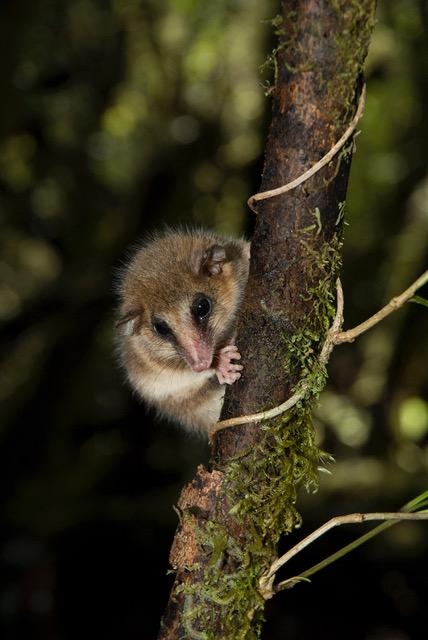
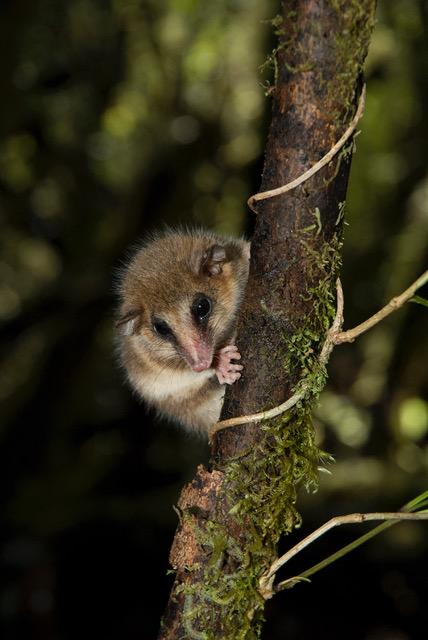
Credit: Photo courtesy of Andres Charrier.
October 18, 2018
In the Andean forests along the border of Chile and Argentina, there have long been speculations that the mouse-sized marsupial monito del monte (Dromiciops gliroides) climbs to lofty heights in the trees. Yet, due to the lack of knowledge about the region's biodiversity in the forest canopies, no previous records exist documenting such arboreal habits for this creature.
Some tree-climbing researchers are changing that.
Javier Godoy-Güinao and colleagues set motion-sensing camera traps in the tree canopy to capture photographic evidence confirming the high-climbing theories surrounding this miniature mammal. The findings are published in a new study in the Ecological Society of America's journal Ecosphere.
The monito del monte (Spanish for "little monkey of the bush," although not a monkey at all) is a small, inarguably cute marsupial that is found solely in the temperate rainforests of Argentina and Chile. It eats mostly insects with some fruit and seeds and nuts, and it also hibernates, which is unusual for marsupials. Females can carry up to five young in a pouch, and a prehensile tail makes it adept at climbing. It is listed as "Near Threatened" by the International Union for Conservation of Nature.
Researchers thought this marsupial may live in the canopy because of its mobility in the vegetation above the forest floor, called the understory. "However," Godoy-Güinao writes, "all previous studies on D. gliroides have been conducted from the ground, with no documentation of this species' ability to climb trees, or how high they may reach." Following the clues from reported sightings, he and his colleagues found the mystery intriguing and decided it worth finding out first hand just how high they climb.
Along with Ivan Díaz, professor in charge of the Laboratory of Canopy Ecology and Biodiversity (CanopyLab) of the Universidad Austral de Chile, and Juan Luis Celis-Diez, professor at P. Universidad Católica de Valparaíso, Godoy-Güinao began studies in 2017 in Bosque Pehuén Park. The park is a protected area owned by the Mar Adentro Foundation, a non-profit dedicated to promoting conservation of and education on biodiversity, and to cultural development in the region.
Researchers climbed high (12-21 m) into the treetops to install the camera traps and patiently waited to capture images of this elusive marsupial. After months of waiting and collecting data, the tiny creatures appeared within the highest camera trap's view, and it snapped hundreds of photos.
Armed with proof that it is a frequent climber to the highest point of the tallest trees, Godoy-Güinao argues that the role of the monito del monte in the canopy is much more relevant to the biodiversity of the ecosystem than originally thought.
One of its large role lies in seed germination and dispersal. In the treetops of Chilean forests, previous studies by the CanopyLab showed a great variety of air plants such as orchids, bromeliads, lichens, mosses, and ferns that grow within the trees. The monito del monte is a seed disperser of most of these plants; it eats wild fruits and swallows the seeds whole, which then pass through its digestive track and are ready to germinate upon excretion. Given the frequency with which the species visits these high places, it could be the main sower of the plants that make up this vertical garden. Additionally, it is an avid consumer of the insects that attack the foliage of these trees.
Godoy-Güinao hopes that continued study will shed light on the importance of the monito del monte in the treetops, as well learn more about the species. For now, he says, "this evidence suggests that [it] is perhaps the main or only mammal of the region that ventures into the heights of trees, and it can have a very influential role in the biodiversity of the southern South American temperate rainforests."
###
Journal Article:
Javier Godoy-Güinao, et al. (2018) "Confirmation of arboreal habits in Dromiciops gliroides: a key role in Chilean Temperate Rainforests." Ecosphere. DOI: 10.1002/ecs2.2424.
Authors:
Javier Godoy-Güinao, Laboratory of Canopy Ecology and Biodiversity (CanopyLab), Universidad Austral de Chile, Chile
Iván Díaz, Laboratory of Canopy Ecology and Biodiversity (CanopyLab), Universidad Austral de Chile, Chile
Juan Luis Celis-Diez, Pontifica Universidad Católica de Valparaíso, Chile
Author contact:
Javier Godoy-Güinao [email protected]
The Ecological Society of America (ESA), founded in 1915, is the world's largest community of professional ecologists and a trusted source of ecological knowledge, committed to advancing the understanding of life on Earth. The 9,000 member Society publishes five journals and a membership bulletin and broadly shares ecological information through policy, media outreach, and education initiatives. The Society's Annual Meeting attracts 4,000 attendees and features the most recent advances in the science of ecology. Visit the ESA website at http://www.esa.org.
Contact: Zoe Gentes, 202-833-8773 ext. 211, [email protected]
Media Contact
Zoe Gentes
[email protected]
202-833-8773
@ESA_org
http://www.esa.org
Original Source
https://www.esa.org/esa/south-american-marsupials-discovered-to-reach-new-heights http://dx.doi.org/10.1002/ecs2.2424