• HOME
  • NEWS
  • EXPLORE
    • CAREER
      • Companies
      • Jobs
    • EVENTS
    • iGEM
      • News
      • Team
    • PHOTOS
    • VIDEO
    • WIKI
  • BLOG
  • COMMUNITY
    • FACEBOOK
    • INSTAGRAM
    • TWITTER
Saturday, February 7, 2026
BIOENGINEER.ORG
No Result
View All Result
  • Login
  • HOME
  • NEWS
  • EXPLORE
    • CAREER
      • Companies
      • Jobs
        • Lecturer
        • PhD Studentship
        • Postdoc
        • Research Assistant
    • EVENTS
    • iGEM
      • News
      • Team
    • PHOTOS
    • VIDEO
    • WIKI
  • BLOG
  • COMMUNITY
    • FACEBOOK
    • INSTAGRAM
    • TWITTER
  • HOME
  • NEWS
  • EXPLORE
    • CAREER
      • Companies
      • Jobs
        • Lecturer
        • PhD Studentship
        • Postdoc
        • Research Assistant
    • EVENTS
    • iGEM
      • News
      • Team
    • PHOTOS
    • VIDEO
    • WIKI
  • BLOG
  • COMMUNITY
    • FACEBOOK
    • INSTAGRAM
    • TWITTER
No Result
View All Result
Bioengineer.org
No Result
View All Result
Home NEWS Science News Health

UTA awarded US/international patents on material that attacks multiple cancers

Bioengineer by Bioengineer
October 16, 2018
in Health
Reading Time: 2 mins read
0
Share on FacebookShare on TwitterShare on LinkedinShare on RedditShare on Telegram
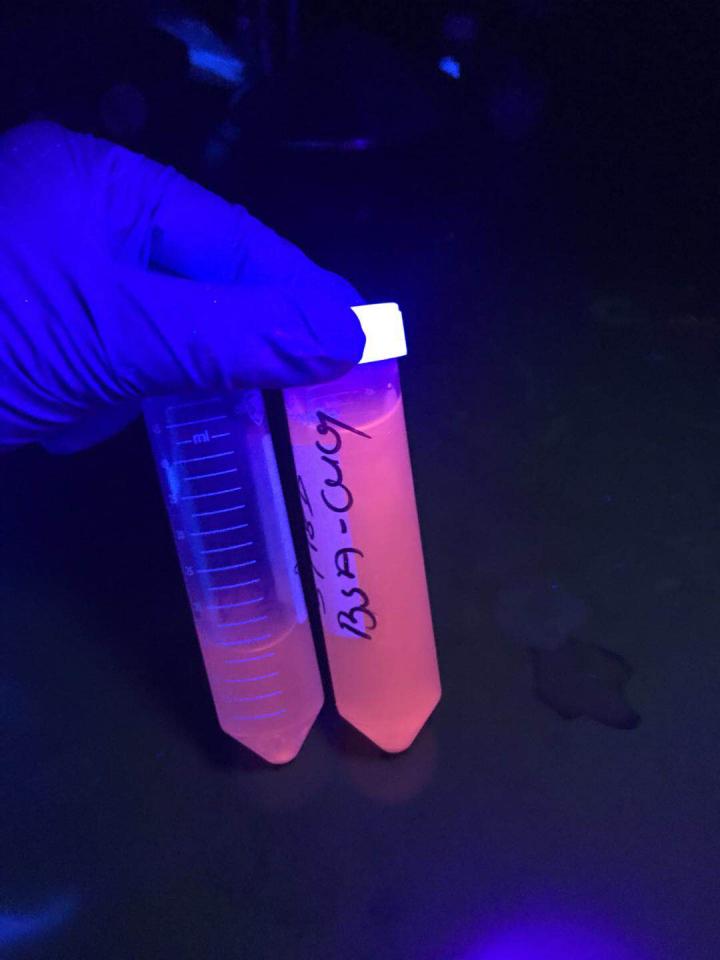
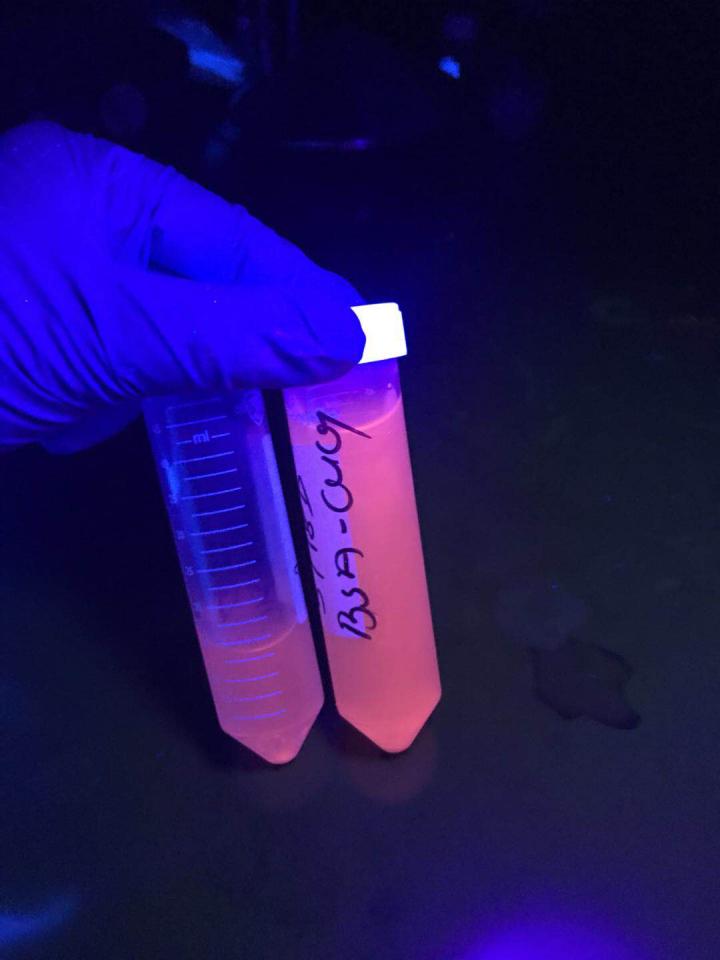
IMAGE

Credit: UTA

The University of Texas at Arlington has been awarded U.S. and international patents on a nanoparticle material that can be activated by light, microwave, X-ray, or ultrasound to kill multiple kinds of cancers.

"This new nanoparticle material has many properties that improve upon traditional photodynamic cancer therapies, where light is used to activate a particle that kills cancer cells," said UTA physics professor and inventor Wei Chen.

The principal advantages are:

  • Fewer side effects for patients as healthy cells are not affected by treatment
  • Low cost and ease of manufacture of the material
  • Applicability to multiple cancers as it can be effective from the skin surface to 25 centimeters below skin level
  • Possibility to treat the patient immediately applying the sensitizer rather than waiting several hours for treatment to be effective
  • Decreased sensitivity to sunlight, a problem of earlier photodynamic therapies
  • Emits intense luminescence, which means it can also be used as an imaging agent as well as for cancer treatment

Traditional photodynamic therapy kills cancer cells when a nanoparticle introduced into tumor tissue generates toxic singlet oxygen after being exposed to light. Singlet oxygen is a highly reactive type of oxygen species that irreversibly damages cell mitochondria and eventually causes cell death.

Over multiple studies, the UTA researchers were able to identify a new type of nanoparticle, copper-cysteamine or Cu-Cy, that can be activated not only by light, but also by X-rays, microwaves, or ultrasound, to directly target tumors without harming surrounding tissue.

"The material provides an excellent solution to the issue of how to penetrate cancer tumors found at different levels in the body – light is effective for skin cancers and cancers near the skin surface, microwaves for cancers between 5-7 centimeters below skin level, X-rays for deeper cancers and ultrasound for cancers between 15-25 centimeters below the skin surface," Chen said.

"The material is also much less toxic and can selectively kill cancer cells without harming healthy tissue, which is an important step forward for photodynamic therapies," he added.

Alex Weiss, chair of UTA's Physics Department, was among the first to congratulate Chen and his team on this new U.S. and international patent issue.

"Dr. Chen's research into nanoparticle activation has led to important discoveries that could potentially transform cancer treatment," Weiss said. ""If Dr. Chen's new materials can be developed into inexpensive, easy-to-manufacture nanoparticle based pharmaceuticals that are effective on multiple cancers on and below skin level it would be an extraordinary achievement. Dr. Chen's work in this area demonstrates how important it is to support the commercialization of the new discoveries being made here at UTA."

###

Chen came to UTA in 2006 following an international career in the United States, Canada, Sweden and China. He received his doctorate in chemistry from Peking University in Beijing, China.

Media Contact

Louisa Kellie
[email protected]
817-524-8926
@utarlington

http://www.uta.edu

Original Source

https://www.uta.edu/news/releases/2018/10/Wei-Chen-cancer-patent.php

Share12Tweet7Share2ShareShareShare1

Related Posts

Exploring Decision-Making in Dementia Caregivers’ Mobility

February 7, 2026

Succinate Receptor 1 Limits Blood Cell Formation, Leukemia

February 7, 2026

Palmitoylation of Tfr1 Drives Platelet Ferroptosis and Exacerbates Liver Damage in Heat Stroke

February 7, 2026

Oxygen-Enhanced Dual-Section Microneedle Patch Improves Drug Delivery and Boosts Photodynamic and Anti-Inflammatory Treatment for Psoriasis

February 7, 2026
Please login to join discussion

POPULAR NEWS

  • Robotic Ureteral Reconstruction: A Novel Approach

    Robotic Ureteral Reconstruction: A Novel Approach

    82 shares
    Share 33 Tweet 21
  • Digital Privacy: Health Data Control in Incarceration

    63 shares
    Share 25 Tweet 16
  • Study Reveals Lipid Accumulation in ME/CFS Cells

    57 shares
    Share 23 Tweet 14
  • Breakthrough in RNA Research Accelerates Medical Innovations Timeline

    53 shares
    Share 21 Tweet 13

About

We bring you the latest biotechnology news from best research centers and universities around the world. Check our website.

Follow us

Recent News

Exploring Decision-Making in Dementia Caregivers’ Mobility

Succinate Receptor 1 Limits Blood Cell Formation, Leukemia

Palmitoylation of Tfr1 Drives Platelet Ferroptosis and Exacerbates Liver Damage in Heat Stroke

Subscribe to Blog via Email

Enter your email address to subscribe to this blog and receive notifications of new posts by email.

Join 73 other subscribers
  • Contact Us

Bioengineer.org © Copyright 2023 All Rights Reserved.

Welcome Back!

Login to your account below

Forgotten Password?

Retrieve your password

Please enter your username or email address to reset your password.

Log In
No Result
View All Result
  • Homepages
    • Home Page 1
    • Home Page 2
  • News
  • National
  • Business
  • Health
  • Lifestyle
  • Science

Bioengineer.org © Copyright 2023 All Rights Reserved.