Credit: Lobachevsky University
Biological neurons are coupled unidirectionally through a special junction called a synapse. An electrical signal is transmitted along a neuron after some biochemical reactions initiate a chemical release to activate an adjacent neuron. These junctions are crucial for cognitive functions, such as perception, learning and memory.
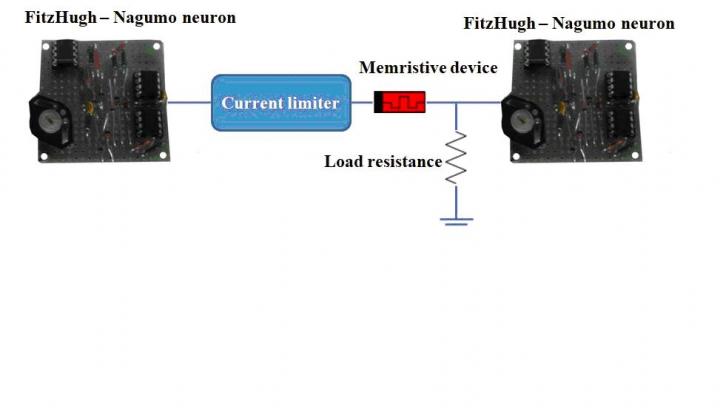
A group of researchers from Lobachevsky University in Nizhny Novgorod investigates the dynamics of an individual memristive device when it receives a neuron-like signal as well as the dynamics of a network of analog electronic neurons connected by means of a memristive device. According to Svetlana Gerasimova, junior researcher at the Physics and Technology Research Institute and at the Neurotechnology Department of Lobachevsky University, this system simulates the interaction between synaptically coupled brain neurons while the memristive device imitates a neuron axon.
A memristive device is a physical model of Chua's memristor, which is an electric circuit element capable of changing its resistance depending on the electric signal received at the input. The device based on a Au/ZrO2(Y)/TiN/Ti structure demonstrates reproducible bipolar switching between the low and high resistance states. Resistive switching is determined by the oxidation and reduction of segments of conducting channels (filaments) in the oxide film when voltage with different polarity is applied to it. In the context of the present work, the ability of a memristive device to change conductivity under the action of pulsed signals makes it an almost ideal electronic analog of a synapse.
Lobachevsky University scientists and engineers supported by the Russian Science Foundation (project No.16-19-00144) have experimentally implemented and theoretically described the synaptic connection of neuron-like generators using the memristive interface and investigated the characteristics of this connection.
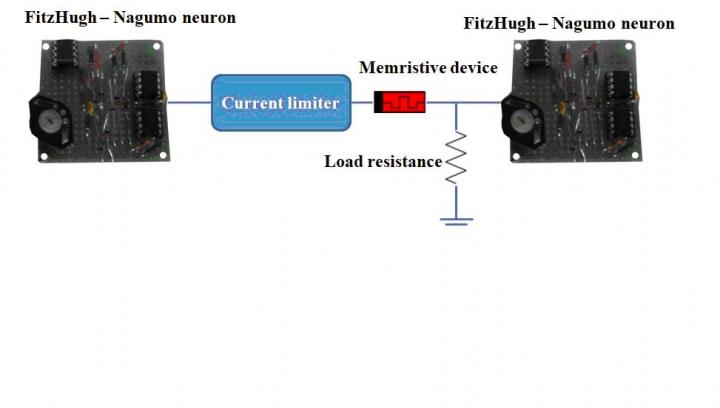
"Each neuron is implemented in the form of a pulse signal generator based on the FitzHugh-Nagumo model. This model provides a qualitative description of the main neurons' characteristics: the presence of the excitation threshold, the presence of excitable and self-oscillatory regimes with the possibility of a changeover. At the initial time moment, the master generator is in the self-oscillatory mode, the slave generator is in the excitable mode, and the memristive device is used as a synapse. The signal from the master generator is conveyed to the input of the memristive device, the signal from the output of the memristive device is transmitted to the input of the slave generator via the loading resistance. When the memristive device switches from a high resistance to a low resistance state, the connection between the two neuron-like generators is established. The master generator goes into the oscillatory mode and the signals of the generators are synchronized. Different signal modulation mode synchronizations were demonstrated for the Au/ZrO2(Y)/TiN/Ti memristive device," – says Svetlana Gerasimova.
UNN researchers believe that the next important stage in the development of neuromorphic systems based on memristive devices is to apply such systems in neuroprosthetics. Memristive systems will provide a highly efficient imitation of synaptic connection due to the stochastic nature of the memristive phenomenon and can be used to increase the flexibility of the connections for neuroprosthetic purposes. Lobachevsky University scientists have vast experience in the development of neurohybrid systems. In particular, a series of experiments was performed with the aim of connecting the FitzHugh-Nagumo oscillator with a biological object, a rat brain hippocampal slice. The signal from the electronic neuron generator was transmitted through the optic fiber communication channel to the bipolar electrode which stimulated Schaffer collaterals (axons of pyramidal neurons in the CA3 field) in the hippocampal slices. "We are going to combine our efforts in the design of artificial neuromorphic systems and our experience of working with living cells to improve flexibility of prosthetics," concludes S. Gerasimova.
The results of this research were presented at the 38th International Conference on Nonlinear Dynamics (Dynamics Days Europe) at Loughborough University (Great Britain).
###
The list of authors: S.A. Gerasimova, A.N. Mikhaylov, A.I. Belov, D.S. Korolev, D.V. Guseinov, A.V. Lebedeva, O.N. Gorshkov, V.B. Kazantsev.
Media Contact
Nikita Avralev
[email protected]
http://www.unn.ru/eng/