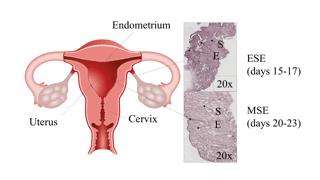
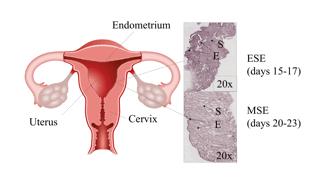
Credit: Figure by M. Suhorutšenko
Scientists from Tartu have discovered a simple way how to improve infertility treatment in the future. The results of the study, published in Human Reproduction, a top journal in the field, can be used in precision medicine to account for the variability in each female patient's menstrual cycle. This personalised approach will first and foremost benefit those couples, who have experienced repeated IVF failure.
In 2017, more than 2800 in vitro fertilization (IVF) procedures were carried out in Estonia, resulting in the birth of 430 babies, which accounts for 3% of all births. The low 15% success rate of IVF can be caused by problems in several stages of the treatment. One of such stages is embryo implantation, which marks the beginning of the pregnancy. However, if the embryo is transferred into the uterus on the wrong day, even the best embryos cannot overcome this, resulting in a negative pregnancy test.
The task of the infertility treatment specialist is to recommend the best treatment for each patient. Female infertility can be caused by problems with endometrial (the inner uterine lining) receptivity. While in natural conception the developing embryo can "sit and wait" until the endometrium matures to peak receptivity, in IVF treatment it is of utmost importance to transfer the embryo on the correct day to increase the chances of pregnancy. Different methods are used to assess endometrial receptivity, the most accurate of which is a test measuring the expression patterns of different genes in an endometrial biopsy. For this, a minimally invasive endometrial biopsy is taken in the cycle preceding the IVF cycle on the day the endometrium is supposedly the most receptive. Analysis of the expression patterns of specific marker genes provides vital information to decide whether the "right genes are expressed at the right time". If needed, the time of the embryo transfer is adjusted, providing an example of precision medicine in infertility treatment.
The study, published in Human Reproduction, a leading journal in the field of reproductive medicine, is based on the well-known fact that the inner uterine lining consists of several different cell types. The novelty of the study lies in the fact that previous studies have not considered the effect of cell type proportions on endometrial gene expression profiles. This novel approach makes gene expression profile analysis more specific, thus also improving the performance of tests based on gene expression patterns. The paper has also been highlighted by the editor-in-chief of Human Reproduction, meaning that it is considered to be a remarkable improvement in this field.
The study was a collaboration between scientists from Estonia and Spain, and a natural progression to the earlier work of the research group in Tartu, which allows to improve IVF efficiency. Marina Suhorutšenko, the first author of the paper and a PhD student at the Institute of Clinical Medicine, University of Tartu, explains: "It is common knowledge that the inner uterine lining includes different cell types; however, all the previous studies have consistently ignored this fact. Our work shows how to account for this variability in cellular composition, and thus considerably improve the accuracy of biomarker discovery". In the clinical setting, only the whole tissue gene expression profile is usually analysed, as analysing cellular fractions separately is labour-intensive and expensive. "We have developed a pipeline that allows to skip this step, and instead uses a different data analysis approach to improve the accuracy without extra costs," added Suhorutšenko.
Dr. Triin Laisk, a Research Fellow at the Estonian Genome Center, who coordinated the data analysis of the study adds that the confounding effect of biopsy cellular composition has been largely ignored in the past, and not only in the field of reproductive medicine. "By taking it into account we can decrease the amount of random and false positive findings, and eventually improve our knowledge on the biology behind different conditions, as well as facilitate the discovery of novel biomarkers," said Dr. Laisk.
The results of the study have immediate practical value, and the research team is currently working on how to integrate these findings into a genetic test that is used in infertility treatment clinics to select the best day for embryo transfer. The Competence Centre on Health Technologies (CCHT), where the study in question was carried out, has developed an endometrial receptivity test called beREADY.
"We have done some important basic science, such as this study, that eventually will improve the efficiency of IVF treatment," explains Professor Andres Salumets, the coordinator of the study. "Tests and methods applied in the clinical setting are never the result of only one discovery. There are smaller and greater breakthroughs, but the elegant data analysis solution applied in this study is a good addition to the beREADY personalised treatment tool currently being tested by several clinics. From a technological point of view, we can use patented solutions in the beREADY test, but we also need to use smarter data analysis approaches to stand out among the competitors," said Prof. Salumets.
###
Media Contact
Andres Salumets
[email protected]
372-562-04004
Related Journal Article
http://dx.doi.org/10.1093/humrep/dey301