Credit: Virginia Tech
The National Institute of Neurological Disorders and Stroke (NINDS) of the National Institutes of Health has awarded Andrea Bertke, an assistant professor of infectious diseases in the Department of Population Health Sciences in the Virginia-Maryland College of Veterinary Medicine at Virginia Tech, $1.7 million to study the neuron-specific regulation of herpes simplex viruses 1 and 2 (HSV1 and HSV2).
HSV1 and HSV2 are highly contagious and incurable. The viruses establish latency in sensory and autonomic neurons (nerve cells), from which they can reactivate to cause recurrent disease, affecting more than 250 million people in the U.S. alone, according to Bertke.
HSV1 is typically associated with cold sores, also known as oral herpes, and HSV2 with genital herpes, although either one can be transmitted to either site. In addition to skin lesions and pain, they can cause blinding ocular infection, meningitis, and encephalitis. In fact, HSV1 is one of the leading causes of infectious corneal blindness in the world and, according to World Health Organization estimates, over half a billion people between the ages of 15-49 years have genital infection caused by either HSV1 or HSV2.
Some types of neurons support HSV replication upon entry, while other types naturally inhibit replication, resulting in latency. HSV only reactivates from a portion of the latently infected neurons, causing recurrent disease and viral shedding. In addition, the subtypes of neurons that support these different outcomes of infection are different for HSV1 and HSV2.
"The goal of this project is to figure out how some neurons naturally shut down virus replication initially and what intrinsic inhibitory mechanisms in those neurons shut it down," Bertke said. "If we can find those mechanisms, we can exploit them to prevent replication in all neurons."
Previous studies of HSV regulatory mechanisms have relied on whole tissues, cell lines, or embryonic neuronal cultures, which do not permit analysis of neuron type-specific mechanisms.
"How these mechanisms differ between HSV1 and HSV2, leading to different patterns and frequencies of recurrent disease, is grossly understudied," Bertke said. "Understanding how different types of mature neurons regulate viral infections represents a significant gap in knowledge, one that is of critical importance, since neurons are long-lived terminally differentiated cells not easily replaced in adults."
Bertke's research team previously determined that in adult sensory neurons, continuous presence of certain neurotrophic factors maintains HSV in a latent state, and deprivation of these factors selectively induces viral reactivation. With the new five-year grant, the team will build on their work to identify what they call the "latency lock" – the development of a molecule or antiviral that can latch onto the virus and permanently lock it in a latent state incapable of reactivation, in any type of neuron.
"In these studies, we will identify specific neuron signaling pathways that allow the virus to reactivate and determine if there are inhibitors that will prevent the reactivation process," said Bertke. "If we can put those mechanisms together, we may be able to permanently shut down the virus. Then, we'll never have recurrent disease or viral shedding, and we'll never have it spreading to other hosts."
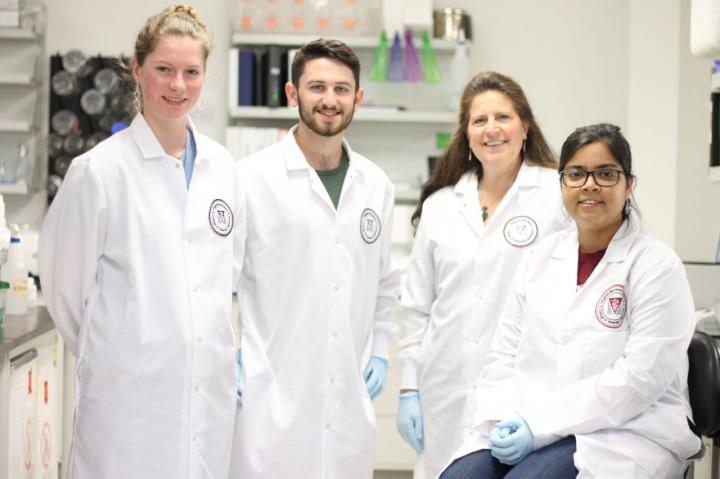
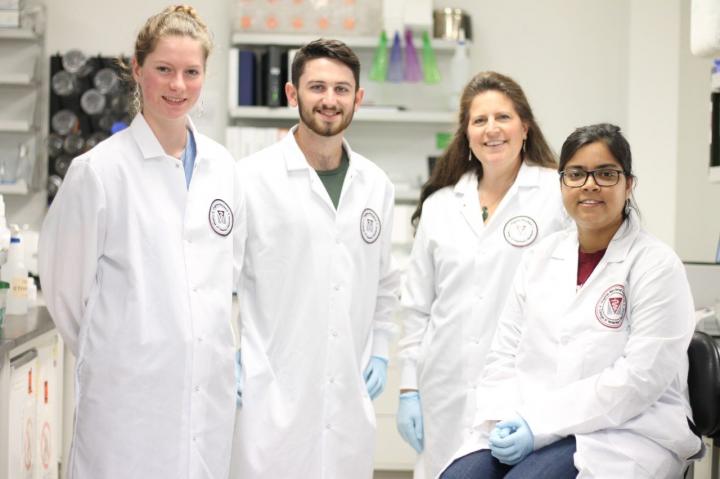
Other Virginia Tech scholars on the project team include Telvin Harrell, Ph.D. student in the veterinary college's biomedical and veterinary sciences program and former Multicultural Academic Opportunities Program mentee in the Bertke lab; Poorna Goswami, Ph.D. student in translational biology, medicine, and health; Lindsey Henry, master's student in public health; and two undergraduate students, Amber Abbott, junior in microbiology, and Dominique Ngo, senior in biology and Spanish. Jack Thompson, senior in biochemistry, helped to develop preliminary data for the project.
Other collaborators on the project include Seth Frietze, assistant professor at the University of Vermont College of Nursing and Health Sciences and co-investigator on the grant, and Anna Cliffe, assistant professor at the University of Virginia School of Medicine.
This is Bertke's second grant from NINDS this year; the first was a two-year grant awarded in April. She and co-investigator David Davido, associate professor at the University of Kansas, are working to identify the role of an HSV1 protein, ICP0, in latency and reactivation in neurons.
###
Media Contact
Alison Elward
[email protected]
540-231-7969
@vtnews
http://www.vtnews.vt.edu
Original Source
https://vtnews.vt.edu/articles/2018/10/vetmed-bertke-grant.html