• HOME
  • NEWS
  • EXPLORE
    • CAREER
      • Companies
      • Jobs
    • EVENTS
    • iGEM
      • News
      • Team
    • PHOTOS
    • VIDEO
    • WIKI
  • BLOG
  • COMMUNITY
    • FACEBOOK
    • INSTAGRAM
    • TWITTER
Saturday, February 7, 2026
BIOENGINEER.ORG
No Result
View All Result
  • Login
  • HOME
  • NEWS
  • EXPLORE
    • CAREER
      • Companies
      • Jobs
        • Lecturer
        • PhD Studentship
        • Postdoc
        • Research Assistant
    • EVENTS
    • iGEM
      • News
      • Team
    • PHOTOS
    • VIDEO
    • WIKI
  • BLOG
  • COMMUNITY
    • FACEBOOK
    • INSTAGRAM
    • TWITTER
  • HOME
  • NEWS
  • EXPLORE
    • CAREER
      • Companies
      • Jobs
        • Lecturer
        • PhD Studentship
        • Postdoc
        • Research Assistant
    • EVENTS
    • iGEM
      • News
      • Team
    • PHOTOS
    • VIDEO
    • WIKI
  • BLOG
  • COMMUNITY
    • FACEBOOK
    • INSTAGRAM
    • TWITTER
No Result
View All Result
Bioengineer.org
No Result
View All Result
Home NEWS Science News Health

A pheromone-sensing gene that predates land-dwelling vertebrates

Bioengineer by Bioengineer
October 9, 2018
in Health
Reading Time: 2 mins read
0
Share on FacebookShare on TwitterShare on LinkedinShare on RedditShare on Telegram
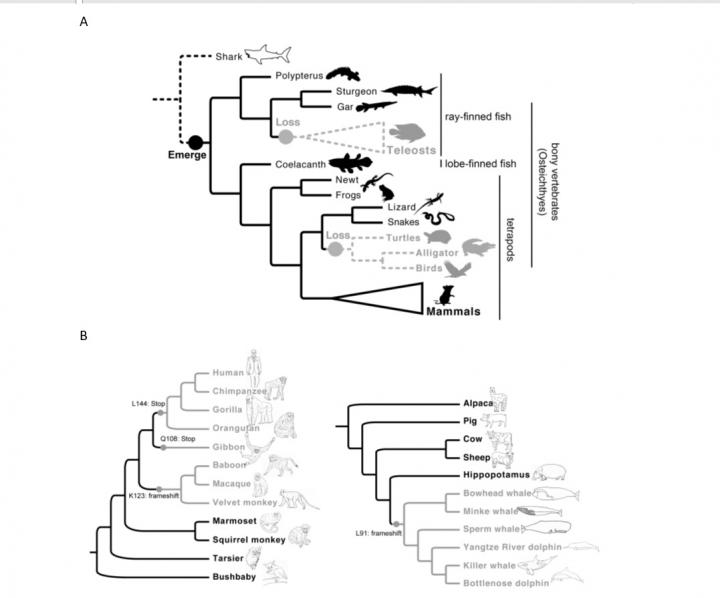
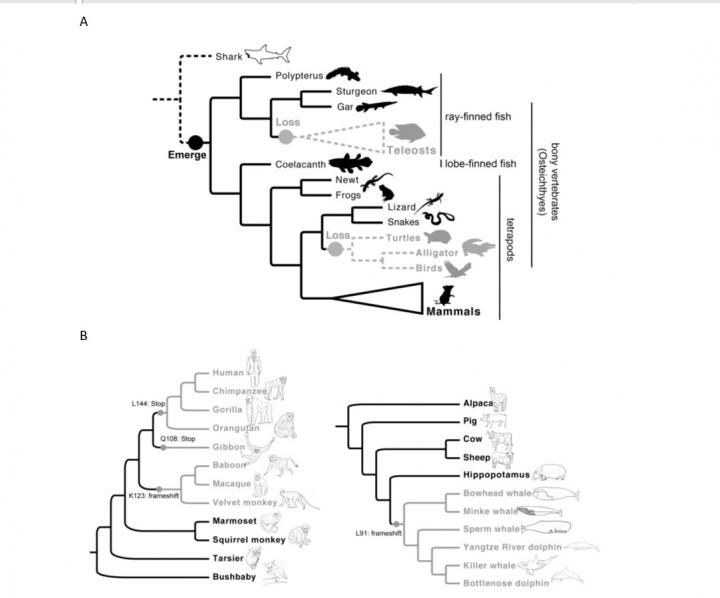
IMAGE

Credit: Molecular Biology and Evolution

Scientists at Tokyo Institute of Technology (Tokyo Tech) have discovered a gene that appears to play a vital role in pheromone sensing. The gene is conserved across fish and mammals and over 400 million years of vertebrate evolution, indicating that the pheromone sensing system is much more ancient than previously believed. This discovery opens new avenues of research into the origin, evolution, and function of pheromone signaling.

Most land-dwelling vertebrates have both an olfactory organ that detects odors and a vomeronasal organ that detects pheromones, which elicit social and sexual behaviors. It has traditionally been believed that the vomeronasal organ evolved when vertebrates transitioned from living in water to living on land. New research by Masato Nikaido and colleagues at Tokyo Tech, however, suggests that this organ may be much older than previously believed.

The vomeronasal organ contains receptors in the V1R protein family that are crucial for pheromone detection. Nikaido et al. identified a gene, ancV1R, that encodes a previously unknown member of the V1R family. However, unlike other V1R genes, ancV1R is present not only in land-dwelling vertebrates but also in some fish lineages, indicating that it has been conserved over 400 million years of vertebrate evolution. According to Nikaido, this finding was "quite surprising, as this represents the first discovery of a V1R family gene shared between fish and mammals."

The authors identified ancV1R in 56 of 115 vertebrate genomes. Interestingly, the loss of ancV1R in some vertebrate lineages, such as higher primates (including humans, chimpanzees, and gorillas), cetaceans (including whales and dolphins), birds, and crocodiles, corresponds with the loss of the vomeronasal organ in these lineages (Fig. 1). The findings suggest not only that ancV1R may be a vital component of the vomeronasal organ, but also that this organ predates the transition of vertebrates to land, opening a new avenue of research into its origin.

ancV1R is also unusual in that it is expressed in most vomeronasal sensory neurons. In contrast, other V1R proteins follow a "one neuron-one receptor" rule, with only a single receptor being expressed in each neuron. This further demonstrates the importance of ancV1R in pheromone sensing. As noted by Nikaido, "It will be fascinating to further investigate how these patterns of expression are regulated and to determine their functional role in chemosensory signaling."

###

Media Contact

Emiko Kawaguchi
[email protected]
81-357-342-975

http://www.titech.ac.jp/english/index.html

Related Journal Article

http://dx.doi.org/10.1093/molbev/msy186

Share12Tweet7Share2ShareShareShare1

Related Posts

Evaluating Pediatric Emergency Care Quality in Ethiopia

February 7, 2026

TPMT Expression Predictions Linked to Azathioprine Side Effects

February 7, 2026

Improving Dementia Care with Enhanced Activity Kits

February 7, 2026

Decoding Prostate Cancer Origins via snFLARE-seq, mxFRIZNGRND

February 7, 2026
Please login to join discussion

POPULAR NEWS

  • Robotic Ureteral Reconstruction: A Novel Approach

    Robotic Ureteral Reconstruction: A Novel Approach

    82 shares
    Share 33 Tweet 21
  • Digital Privacy: Health Data Control in Incarceration

    63 shares
    Share 25 Tweet 16
  • Study Reveals Lipid Accumulation in ME/CFS Cells

    57 shares
    Share 23 Tweet 14
  • Breakthrough in RNA Research Accelerates Medical Innovations Timeline

    53 shares
    Share 21 Tweet 13

About

We bring you the latest biotechnology news from best research centers and universities around the world. Check our website.

Follow us

Recent News

Evaluating Pediatric Emergency Care Quality in Ethiopia

TPMT Expression Predictions Linked to Azathioprine Side Effects

Improving Dementia Care with Enhanced Activity Kits

Subscribe to Blog via Email

Success! An email was just sent to confirm your subscription. Please find the email now and click 'Confirm' to start subscribing.

Join 73 other subscribers
  • Contact Us

Bioengineer.org © Copyright 2023 All Rights Reserved.

Welcome Back!

Login to your account below

Forgotten Password?

Retrieve your password

Please enter your username or email address to reset your password.

Log In
No Result
View All Result
  • Homepages
    • Home Page 1
    • Home Page 2
  • News
  • National
  • Business
  • Health
  • Lifestyle
  • Science

Bioengineer.org © Copyright 2023 All Rights Reserved.