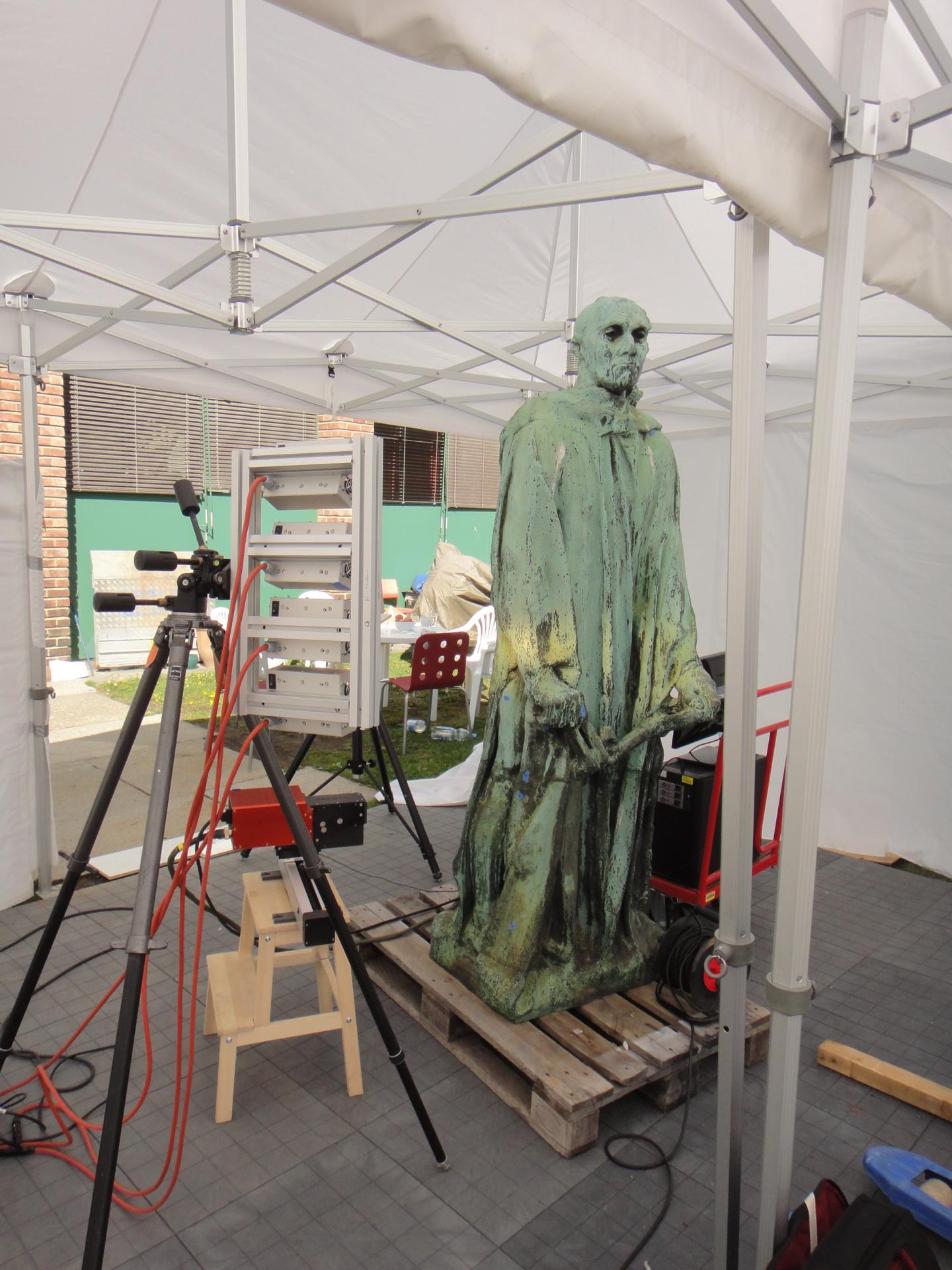
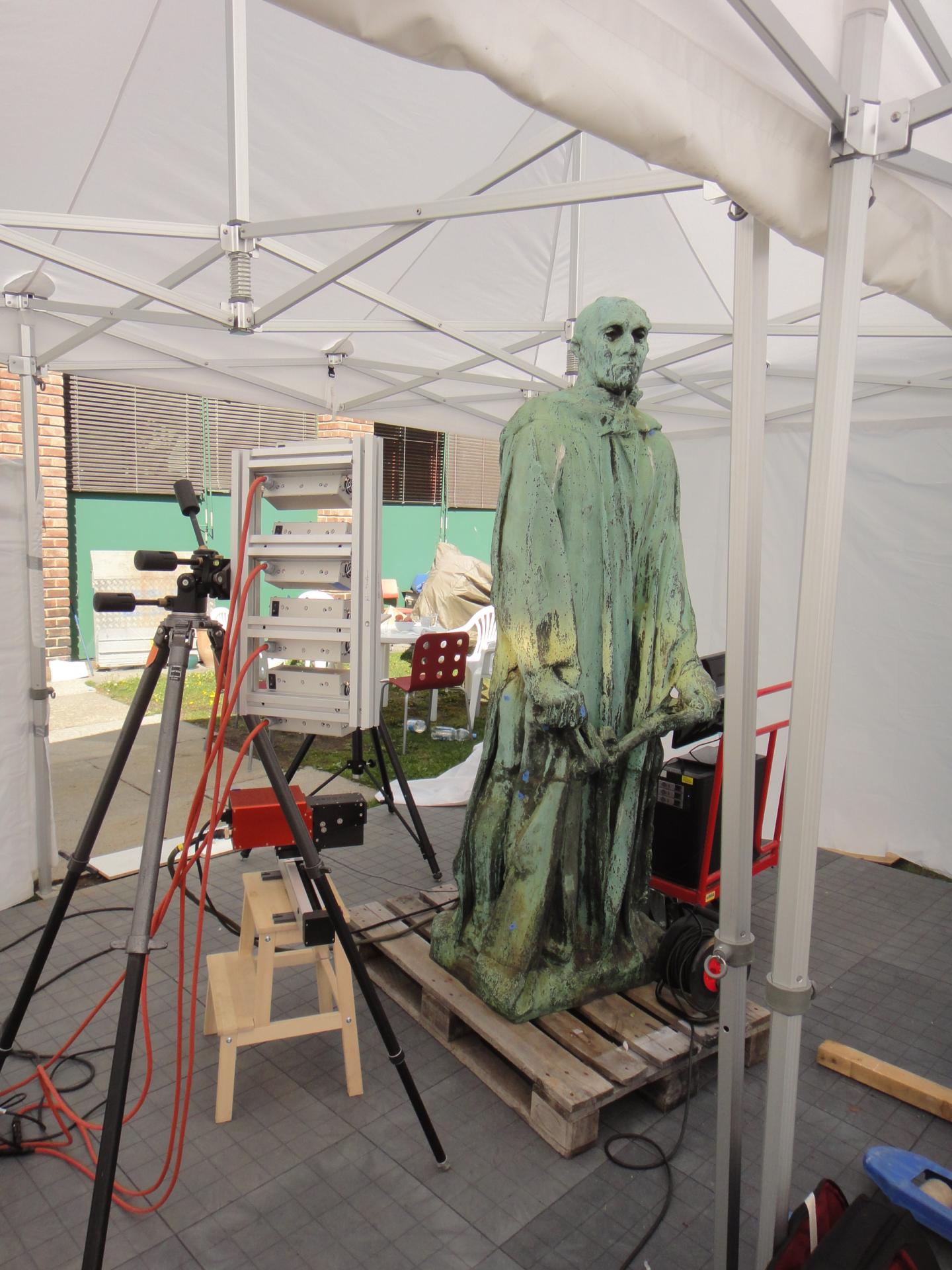
Credit: Oslo kommunes kunstsamling (City of Oslo Art Collection).
Outdoor bronze statues make an important contribution to the culture of our cities. However, the urban atmosphere is corrosive to them, with sulfur oxides and acid rain causing the formation of the copper sulfates, brochantite and antlerite. Both compounds are green, giving the corroded bronze its typical hue, and are formed through complex electrochemical processes. Detection of these two compounds provides valuable information on the general condition of bronze sculptures and guides their preservation.
Usually, a number of samples taken from different areas of a statue are analysed in the laboratory. However, whilst sampling from a limited number of discrete spots provides detailed characterisation of corrosion products, information on their spatial distribution is limited. Further, areas of corrosion may be missed, and this is important since different corrosion mechanisms may operate on different areas due to micro-environmental conditions. For instance, hollows and other sheltered areas may have different corrosion products than more prominent features.
Scientists from Norway, Sweden and Italy have investigated the use of hyperspectral imaging (HSI) to detect the corrosion products brochantite and antlerite in two selected areas of a bronze statue, the results of which are reported in the peer-review, open access Journal of Spectral Imaging (doi: https://doi.org/10.1255/jsi.2018.a10) published by IM Publications Open. The statue investigated was The Man with the Key. It represents Jean d'Aire and it is the first individual figure cast in bronze from the famous group Les Bourgeois de Calais (The Burghers of Calais) by Auguste Rodin. The sculpture was cast by Jacques Petermann in Brussels, Belgium. Since 1902 it has been displayed at "Solli plass", a traffic-congested area in the city centre of Oslo, Norway, which is likely to have been subjected to high levels of SO2 pollution and acidic rain conditions. The sculpture was in a state of advanced degradation and was relocated to the courtyard of the Vigeland Museum for conservation. The HSI investigation was performed there.
Short wavelength infrared (SWIR) HSI (960-2500 nm) was used, since both brochantite and antlerite have characteristic spectral absorbances in that wavelength region. SWIR HSI proved to be able to determine the spatial distribution of brochantite and antlerite on selected areas on the statue. None of the above compounds can be recognised by visual observation, but HSI data revealed the occurrence of each of them in certain areas. Moreover, non-uniform distribution of the above compounds was clearly shown by HSI, but it could easily be missed by an investigation of discrete spots.
Being non-destructive and allowing in situ analysis of large corroded areas, SWIR HSI can represent an important new tool for the investigation of bronze statuary. To the best of the authors' knowledge, this is the first in situ application of SWIR HSI to the assay of atmospheric corrosion of bronze statuary. Further development can be made by exploring the possibility to map other corrosion products that can be detected in this wavelength range. The technique may also find useful application in other corrosion-related fields. Devices that allow the hyperspectral camera to follow the topography of the sculpture can be developed for investigating broader monument areas.
"Hyperspectral imaging is a versatile and powerful technique. It is non-contact and non-destructive, and allows us to see the spectral fingerprint of a material in great detail. This means that we can reveal information that cannot be seen with the naked eye", said Professor Lise L. Randeberg.
###
Details of the paper
Emilio Catelli, Lise Lyngsnes Randeberg, Helena Strandberg, Bjørn Kåre Alsberg,† Assimo Maris and Lily Vikki, "Can hyperspectral imaging be used to map corrosion products on outdoor bronze sculptures?", J. Spectral Imaging 7, a10 (2018). https://doi.org/10.1255/jsi.2018.a10
†Passed away 27 December 2017
Image
Auguste Rodin "Jean d'Aire" (1901). Oslo kommunes kunstsamling (City of Oslo Art Collection).
Download from https://www.impoen.com/sites/default/files/IMP_PR_8-10-2018.JPG
About the Journal of Spectral Imaging
JSI–Journal of Spectral Imaging is an, open access, peer review journal published by IM Publications Open (https://www.impopen.com/jsi). JSI publishes high-quality papers in the rapidly growing fields of spectral, hyperspectral and chemical imaging.
Media Contact
Emilio Catelli
[email protected]
@impjsi
http://www.impublications.com
Original Source
https://www.impopen.com/pr/hyperspectral-imaging-helps-conservation-outdoor-bronze-statue-auguste-rodin http://dx.doi.org/10.1255/jsi.2018.a10