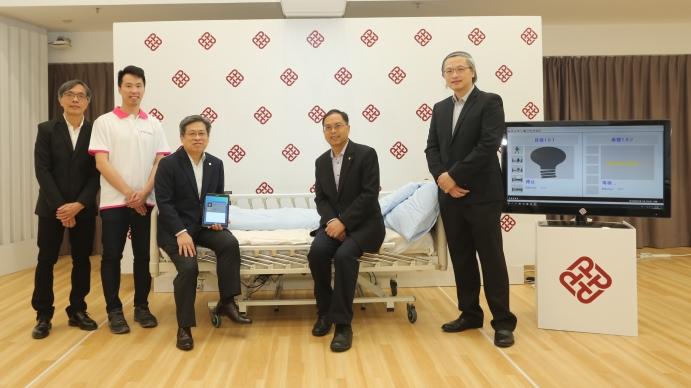
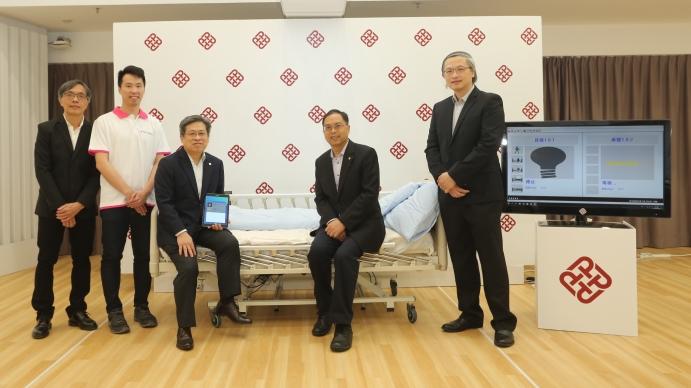
Credit: The Hong Kong Polytechnic University
The Hong Kong Polytechnic University (PolyU) has developed eNightLog, a multi-function nighttime monitoring system for elderly with dementia, to track their respiration and activities in bed for preventing fall or wandering away. The safe and non-restraint system, particularly designed for coping with the typical environment of nursing homes in Hong Kong, will help greatly improve the elderly's quality of life, while enhancing the efficiency and lessening the workload of healthcare personnel.
It is projected that the number of people aged 65 and above in Hong Kong will reach around 2.5 million by 2040, about one-third of the overall population then. Among the elderly at that time, around 332,700, or one out of 10, would suffer from dementia, triple of the figure in 2009. The most common type of dementia is Alzheimer's Disease, characterized by gradual deterioration in one's mental capacities including memory, judgment and communication ability, as well as usual symptoms of depression, agitation and sleep disturbances.
The eNightLog system, developed by a research team led by Ir Professor Zheng Yongping, Head of the Department of Biomedical Engineering (BME) at PolyU and Henry G. Leong Professor in Biomedical Engineering, was awarded Gold Medal at the 46th International Exhibition of Inventions of Geneva this year. Members of the research team include Dr Eric Tam, Dr James Cheung, Mr Will Lai and Mr Alex Mak.
"PolyU has profound history of applying the assistive and rehabilitation health technologies developed by our faculty members to cope with social needs. By helping various nursing homes to set up the eNightLog system we developed, we hope to contribute our expertise for helping create an age-friendly society," said Professor Zheng.
He is glad that the government has pledged support towards constructing "Smart Living" for all citizens especially for the disadvantaged, and planned to roll out a HK$1 billion fund this year for subsidizing elderly service units to make good use of gerontechnology. He hopes that with such support, eNightLog can bring benefits to not only more elderly with dementia, but also other elderly in need and other disabled groups.
eNightLog system provides safe and non-restraint monitoring
The non-contact and non-invasive eNightLog system is embedded with event sequence tracking and different kinds of remote sensing and imaging technologies, based on innovative algorithm developed by the BME team of PolyU. This innovative technique has already been patented.
Seventeen systems have been installed and tested in a nursing home for 2 months this year for nighttime monitoring. During this period, 380 incidences of elderly leaving bed alone were recorded, with all them being successfully detected (100%), and only 2 times of false alarm occurred (0.5%). In addition, the system recorded 525 events of caregivers visiting elderly and accompanying the elderly leaving, and accuracy rate is 100%.
The eNightLog system includes following sensors to detect different activities of the elderly in bed:
- 1. Near Infrared 3D sensor tracts the resident's positions and postures (lying down, sitting on bed or bedside, standing beside the bed, bed-leaving) and caregivers' visits. It thus helps prevent the resident from falling and wandering, and improve staff response time. The algorithm can also detect caregivers paying night visits to the elderly, thus avoiding false alarm.
2. Ultra-Wideband (UWB) Impulse Radar sensor detects small motions even under quilt, including respiration rate, to identify the resident's health condition and sleep quality.
3. Environment sensor provides various ambient measurements and controls, such as room temperature and light control.
The activity status and alarm of multiple residents are transmitted in the form of text, icons or processed infrared image, to display on the caregivers' computer stations or mobile devices. Signals detected beyond the pre-set normality range will trigger alarm for caregivers to take immediate actions.
The research team will soon extend the functions of eNightLog system to detecting heart rate and body temperature, and connect the system with different kinds of smart devices such as electronic diaper. In addition, the system can also link with an ultrasound bladder volume detector to facilitate caregivers to take better care of their residents, especially in handling urinary incontinence. The team is exploring big data analysis to provide more preventive information for health care of elderly.
"Being a multi-sensing system and platform, eNightLog is greatly scalable in connecting with other devices, including wearable, non-contact or remote-control ones. The further applications and development of eNightLog with advancing rehabilitation health technologies can be very promising," said Dr Eric Tam.
###
Media Contact
Christina Wu
[email protected]
852-340-02130
http://www.polyu.edu.hk
Original Source
https://www.polyu.edu.hk/web/en/media/media_releases/index.html