Credit: Kessler Foundation
East Hanover, NJ – October 5, 2018. The key economic indicators for Americans with disabilities resumed their upward trend, according to today's National Trends in Disability Employment – Monthly Update (nTIDE), issued by Kessler Foundation and the University of New Hampshire's Institute on Disability (UNH-IOD).
Each October, the US Department of Labor celebrates the contributions of Americans with disabilities to the labor force that drives our nation's economy. The theme for National Disability Employment Awareness Month 2018 is "America's Workforce: Empowering All." Fostering empowerment requires environments that are truly inclusive. Applying the concept of universal design to buildings and transportation systems has improved inclusivity in the workplace. Expanding this concept beyond the bounds of infrastructure to encompass workplace processes and procedures will expand how inclusion is defined, and empower greater numbers of people with disabilities to achieve their employment goals.
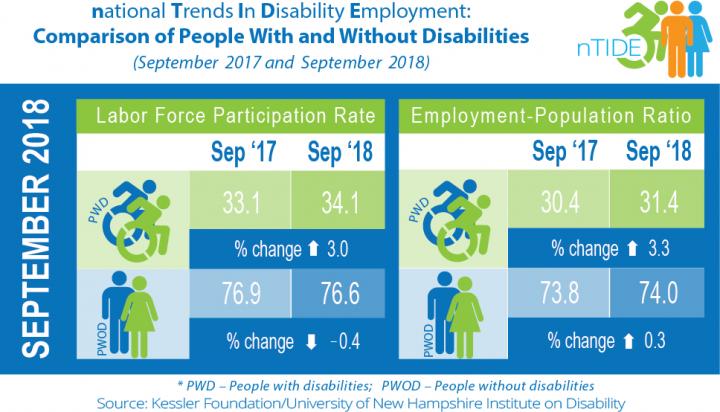
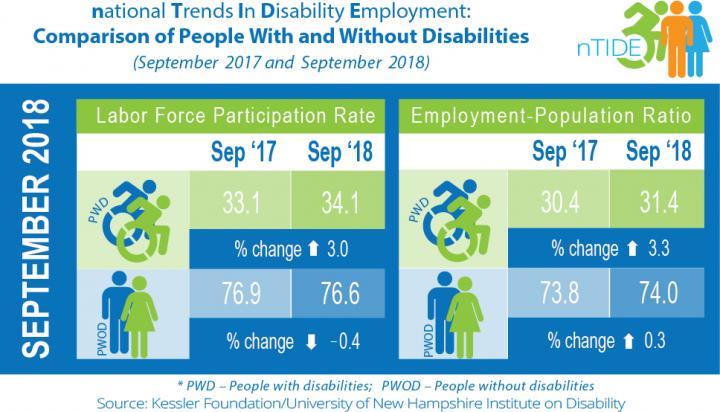
In the Bureau of Labor Statistics (BLS) Jobs Report released Friday, October 5, the employment-to-population ratio for working-age people with disabilities increased from 30.4 percent in September 2017 to 31.4 percent in September 2018 (up 3.3 percent or 1 percentage point). For working-age people without disabilities, the employment-to-population ratio also increased from 73.8 percent in September 2017 to 74.0 percent in September 2018 (up 0.3 percent or 0.2 percentage points).
The employment-to-population ratio, a key indicator, reflects the percentage of people who are working relative to the total population (the number of people working divided by the number of people in the total population multiplied by 100).
In addition, the labor force participation rate for working-age people with disabilities increased from 33.1 percent in September 2017 to 34.1 percent in September 2018 (up 3.0 percent or 1 percentage point). For working-age people without disabilities, the labor force participation rate decreased from 76.9 percent in September 2017 to 76.6 percent in September 2018 (down 0.4 percent or 0.3 percentage points).
The labor force participation rate is the percentage of the population that is working or actively looking for work.
"September data continues the uptick in economic indicators that we saw last month," said Debra Brucker, PhD, research assistant professor at the UNH Institute on Disability. "A few more months of good news will reestablish the strong positive trend we saw from February 2016 to May 2018, where there was continuous improvement in the employment situation for people with disabilities," she noted.
Incorporating the principles of universal design in plans for office buildings, terminals, hotels, stadiums, and other facilities, promotes integration and inclusion for people with disabilities. "To improve inclusivity, universal design can and should be defined in a much broader way, to include 'soft' as well as 'hard' elements," according to John O'Neill, PhD, director of employment and disability research at Kessler Foundation. "Workplace processes and practices are 'soft' elements that can be designed to be equally effective for people with and without disabilities," he explained.
Multiple examples of the use of "soft" universal design were evident from the 2017 Kessler Foundation National Employment and Disability Survey: Supervisor Perspectives, the first survey to look at the effectiveness of workplace practices from the perspective of supervisors of employees with and without disabilities. "Many organizations, for example, have on-boarding and accommodation strategies, such as job shadowing, short-term outside assistance, flexible work schedules, and working from home, that are provided to all employees," noted Dr. O'Neill. "Supervisors reported that many of these processes and practices, which promote retention and productivity, were as effective for employees with and without disabilities."
From the survey, it was apparent that opportunities exist to expand the concept of universal design to these 'soft' elements of the workplace. "Conceptualizing universal design in this much broader context eases the integration of people of all abilities into all types of workplaces. Participating in a truly inclusive environment empowers all workers, including individuals with disabilities, to achieve their employment goals," added Dr. Brucker.
In September 2018, among workers ages 16-64, the 4,864,000 workers with disabilities represented 3.3 percent of the total 146,258,000 workers in the U.S.
The next nTIDE will be issued on Friday, November 2, 2018.
Each nTIDE release is followed by a noon nTide Lunch & Learn Webinar. This live broadcast, hosted via Zoom Webinar, offers attendees Q&A on the latest nTIDE findings, and provides news and updates from the field, as well as invited panelists to discuss current disability-related findings and events. For the October 5 webinar, Sally Rogers, ScD, Executive Director of the Center for Psychiatric Rehabilitation and Research Professor at Boston University, joins Dr. Brucker, Dr. O'Neill, and Denise Rozell, policy strategist at AUCD, to discuss the state of vocational services and practices for individuals with psychiatric disabilities in the US. Join live, or access the archives at: http://www.ResearchonDisability.org/nTIDE.
NOTE: The statistics in the nTIDE are based on Bureau of Labor Statistics numbers, but are not identical. They are customized by UNH to combine the statistics for men and women of working age (16 to 64). NTIDE is funded, in part, by grants from the National Institute on Disability, Independent Living and Rehabilitation Research (NIDILRR) (9ORT5022 and 90RT5017) and Kessler Foundation.
###
About Kessler Foundation
Kessler Foundation, a major nonprofit organization in the field of disability, is a global leader in rehabilitation research that seeks to improve cognition, mobility, and long-term outcomes — including employment — for people with neurological disabilities caused by diseases and injuries of the brain and spinal cord. Kessler Foundation leads the nation in funding innovative programs that expand opportunities for employment for people with disabilities. For more information, visit http://www.KesslerFoundation.org.
About the Institute on Disability at the University of New Hampshire
The Institute on Disability (IOD) at the University of New Hampshire (UNH) was established in 1987 to provide a coherent university-based focus for the improvement of knowledge, policies, and practices related to the lives of persons with disabilities and their families. For information on the NIDILRR-funded Employment Policy and Measurement Rehabilitation Research and Training Center, visit http://www.ResearchonDisability.org.
For more information, or to interview an expert, contact: Carolann Murphy, 973.324.8382, [email protected].
Media Contact
Carolann Murphy
[email protected]
973-324-8382
@KesslerFdn
http://www.KesslerFoundation.org