• HOME
  • NEWS
  • EXPLORE
    • CAREER
      • Companies
      • Jobs
    • EVENTS
    • iGEM
      • News
      • Team
    • PHOTOS
    • VIDEO
    • WIKI
  • BLOG
  • COMMUNITY
    • FACEBOOK
    • INSTAGRAM
    • TWITTER
Saturday, February 7, 2026
BIOENGINEER.ORG
No Result
View All Result
  • Login
  • HOME
  • NEWS
  • EXPLORE
    • CAREER
      • Companies
      • Jobs
        • Lecturer
        • PhD Studentship
        • Postdoc
        • Research Assistant
    • EVENTS
    • iGEM
      • News
      • Team
    • PHOTOS
    • VIDEO
    • WIKI
  • BLOG
  • COMMUNITY
    • FACEBOOK
    • INSTAGRAM
    • TWITTER
  • HOME
  • NEWS
  • EXPLORE
    • CAREER
      • Companies
      • Jobs
        • Lecturer
        • PhD Studentship
        • Postdoc
        • Research Assistant
    • EVENTS
    • iGEM
      • News
      • Team
    • PHOTOS
    • VIDEO
    • WIKI
  • BLOG
  • COMMUNITY
    • FACEBOOK
    • INSTAGRAM
    • TWITTER
No Result
View All Result
Bioengineer.org
No Result
View All Result
Home NEWS Science News Biology

Nanopore technology with DNA computing easily detects microRNA patterns of lung cancer

Bioengineer by Bioengineer
October 5, 2018
in Biology
Reading Time: 2 mins read
0
Share on FacebookShare on TwitterShare on LinkedinShare on RedditShare on Telegram
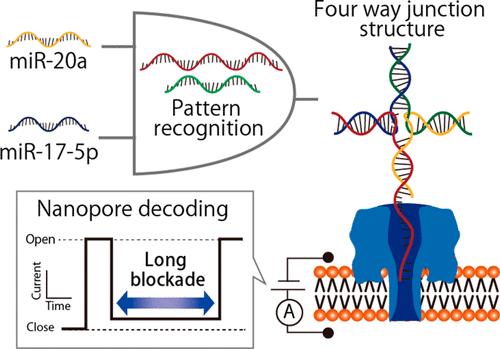
IMAGE

Credit: Figure adapted with permission from Anal. Chem., 2018, 90 (14), pp 8531-8537. Copyright © 2018 American Chemical Society

Small Cell Lung Cancer (SCLC) is very aggressive, since the cancer cells not only quickly grow but also easily spread to entire body. Often SCLC can be diagnosed using several common tests unfortunately after spread of cancer cells, resulting in poor survival.

Now researchers at Tokyo University of Agriculture and Technology (TUAT) in Japan have developed a simple technique to sufficiently identify SCLC earlier. This work, published in the July print issue of the journal Analytical Chemistry in ACS, presented how nanopore technology was combined with DNA computing technology to catch the early biomarkers for SCLC, which were two independent microRNAs.

"DNA computing technology allows DNA molecules to autonomously recognize the pattern of microRNA molecules (input) and to convey (output) the information, which this case electric current was generated", said senior author Dr. Ryuji Kawano, Associate Professor, Department of Biotechnology and Life Science, TUAT.

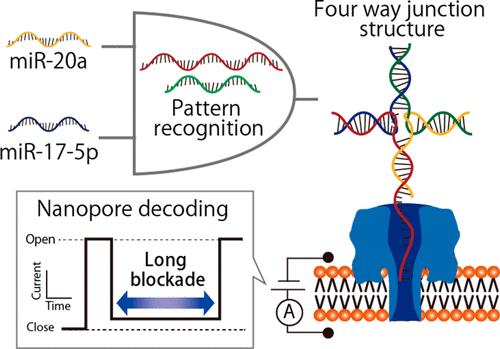
Those microRNAs (miR-20a and miR-17-5p) are known to be the biomarkers for SCLC and are secreted in patients. "We designed diagnostic DNAs artificially and developed a nanopore device that independently recognized those microRNAs through microdroplets," said Dr. Kawano. The diagnostic DNAs recognized the two microRNAs and formed the complex structure of microRNA and diagnostic DNA autonomously (See Image). In the case of the both miR-20a and miR-17-5p are simultaneously present, or there is only one, or when neither exists, (1 1), (1 0) or (0 1), or (0 0), respectively, all different cases were discriminated by the duration of the blocking current signals without labeling. This measurement can be conducted around for 1 hour.

Compared to cell biopsy, liquid biopsy has been recently more attracted due to minimally invasive method for early cancer detection. This result gives the possibility of next generation diagnosis for cancer-specific diagnosis from body fluids. The researchers are applying this technique to real body fluids.

###

For more information about the Kawano laboratory, please visit http://web.tuat.ac.jp/~rjkawano/en.html

This work was partially supported by Grant-in-Aid for Young Scientists (A), KAKENHI, 16H06043, from MEXT Japan.

Original publication:

Moe Hiratani and Ryuji Kawano. "DNA Logic Operation with Nanopore Decoding To Recognize MicroRNA Patterns in Small Cell Lung Cancer", Analytical Chemistry, 2018, 90(14), 8531-8537, DOI: 10.1021/acs.analchem.8b01586

About The Tokyo University of Agriculture and Technology:

The Tokyo University of Agriculture and Technology (TUAT) is a distinguished university in Japan dedicated to science and technology. TUAT focuses on agriculture and engineering that form the foundation of industry, and promotes education and research fields that incorporate them. Boasting a history of over 140 years since our founding in 1874, TUAT continues to boldly take on new challenges and steadily promote fields. For more information, please visit http://www.tuat.ac.jp/en/.

Media Contact

Yutaka Nibu, PhD
[email protected]
81-423-887-550

http://www.tuat.ac.jp/en/

Related Journal Article

http://dx.doi.org/10.1021/acs.analchem.8b01586

Share12Tweet8Share2ShareShareShare2

Related Posts

Florida Cane Toad: Complex Spread and Selective Evolution

Florida Cane Toad: Complex Spread and Selective Evolution

February 7, 2026
New Study Uncovers Mechanism Behind Burn Pit Particulate Matter–Induced Lung Inflammation

New Study Uncovers Mechanism Behind Burn Pit Particulate Matter–Induced Lung Inflammation

February 6, 2026

DeepBlastoid: Advancing Automated and Efficient Evaluation of Human Blastoids with Deep Learning

February 6, 2026

Navigating the Gut: The Role of Formic Acid in the Microbiome

February 6, 2026
Please login to join discussion

POPULAR NEWS

  • Robotic Ureteral Reconstruction: A Novel Approach

    Robotic Ureteral Reconstruction: A Novel Approach

    82 shares
    Share 33 Tweet 21
  • Digital Privacy: Health Data Control in Incarceration

    63 shares
    Share 25 Tweet 16
  • Study Reveals Lipid Accumulation in ME/CFS Cells

    57 shares
    Share 23 Tweet 14
  • Breakthrough in RNA Research Accelerates Medical Innovations Timeline

    53 shares
    Share 21 Tweet 13

About

We bring you the latest biotechnology news from best research centers and universities around the world. Check our website.

Follow us

Recent News

Phage-Antibiotic Combo Beats Resistant Peritoneal Infection

Boosting Remote Healthcare: Stepped-Wedge Trial Insights

Barriers and Boosters of Seniors’ Physical Activity in Karachi

Subscribe to Blog via Email

Enter your email address to subscribe to this blog and receive notifications of new posts by email.

Join 73 other subscribers
  • Contact Us

Bioengineer.org © Copyright 2023 All Rights Reserved.

Welcome Back!

Login to your account below

Forgotten Password?

Retrieve your password

Please enter your username or email address to reset your password.

Log In
No Result
View All Result
  • Homepages
    • Home Page 1
    • Home Page 2
  • News
  • National
  • Business
  • Health
  • Lifestyle
  • Science

Bioengineer.org © Copyright 2023 All Rights Reserved.