Credit: Richard Griffiths
A pioneering study by the University of Kent on the effects of relocating adders due to development has found that males will disperse from their release site – with one even going so far as to return to his original home.
All native reptiles are protected by law, which means that animals found to be present on sites scheduled for development are often moved to alternative habitats. Reptiles are frequently the targets of these translocations but there is little information on their fate or how their behaviour compares to individual animals that are left where they are.
For the study, researchers Darryn Nash and Professor Richard Griffiths from Kent's Durrell Institute of Conservation and Ecology, tracked adders (Vipera berus) translocated from a development site in Essex (UK) in 2014.
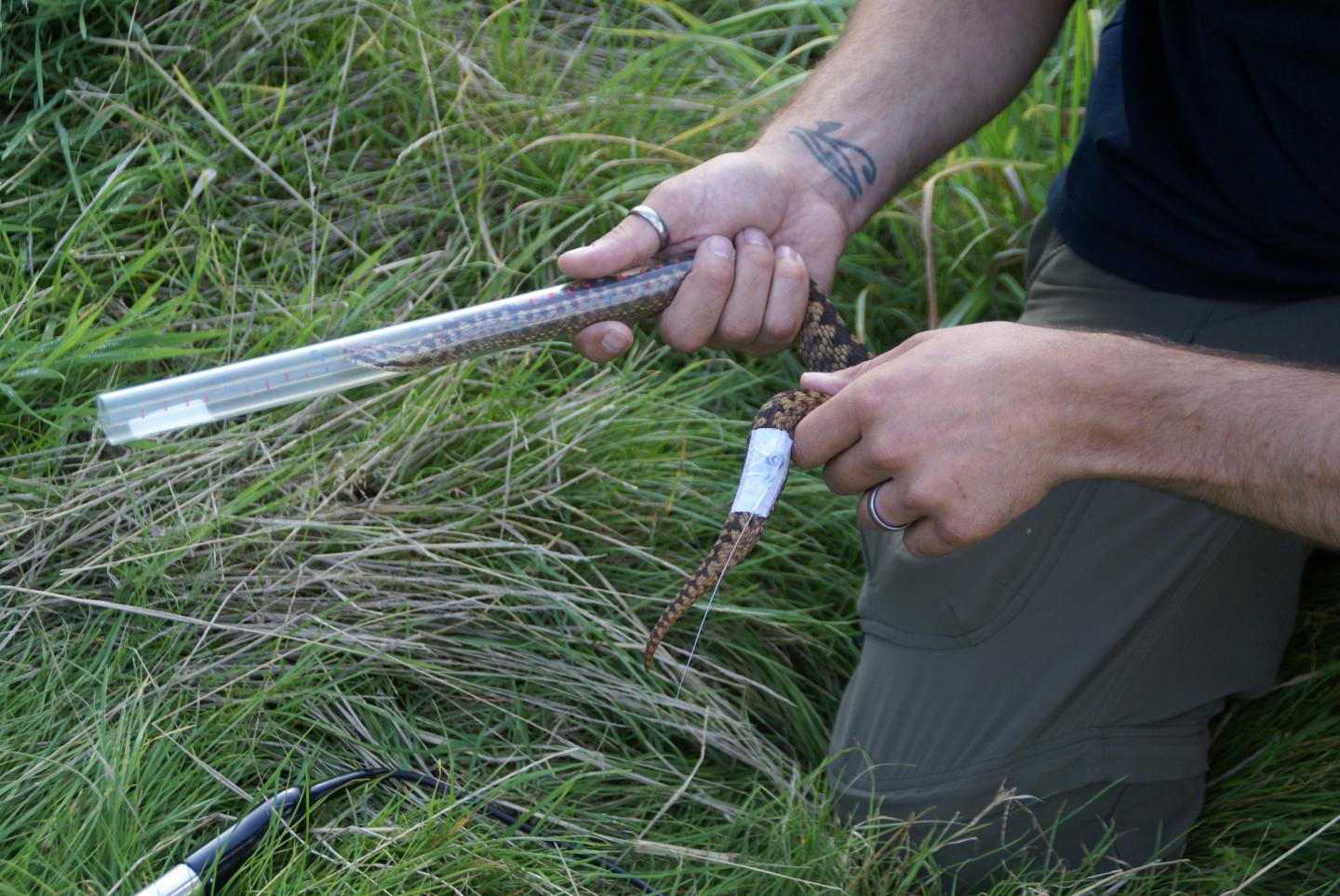
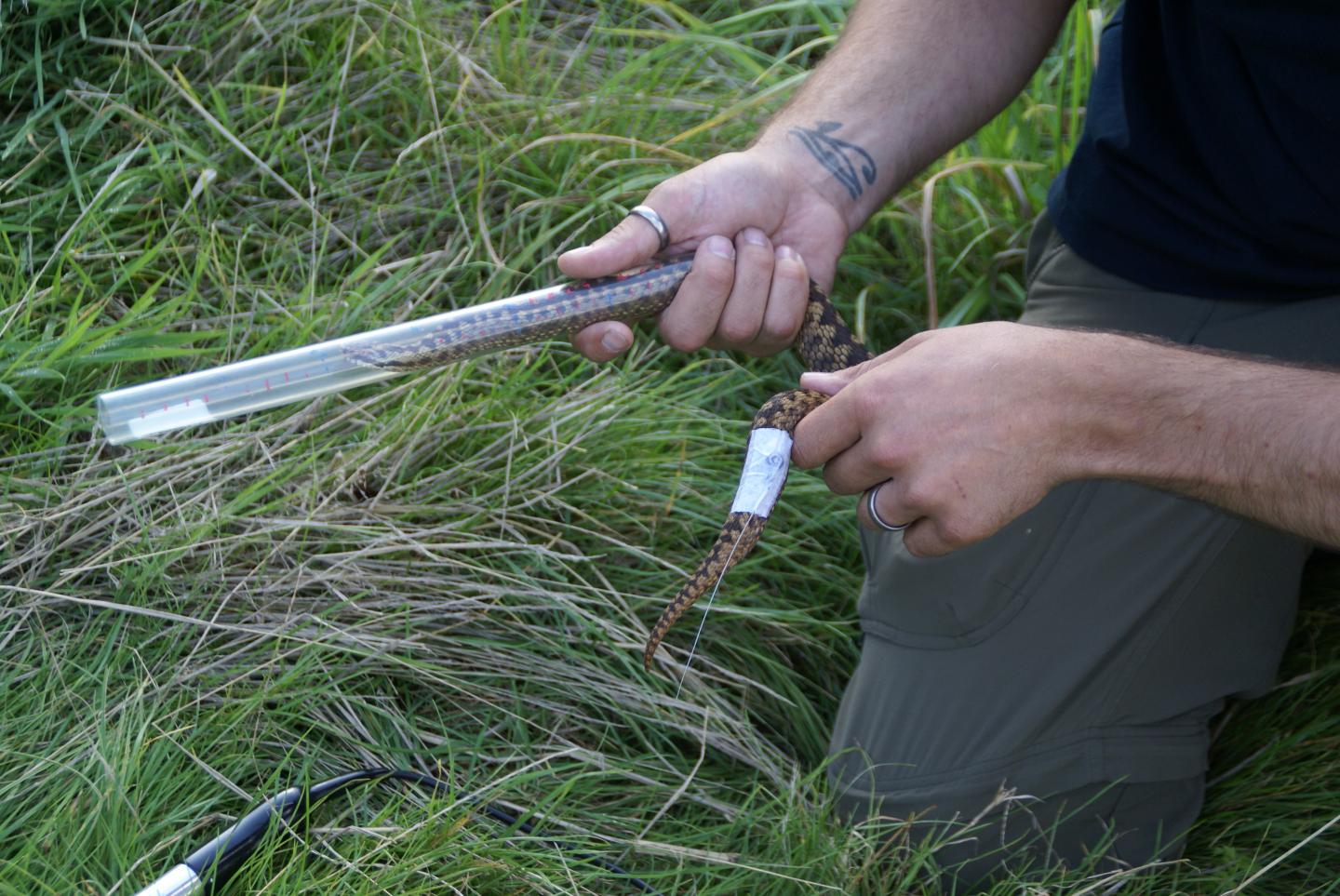
Some of the snakes were fitted with external radio tags and tracked for a period of 10 days during the spring and summer. The movements of the translocated adders were compared to those of 'resident' snakes already present at the release site.
Translocated males exhibited significantly greater average daily movements than the resident ones. Furthermore, all translocated males undertook long-distance, unidirectional movements away from the release site.
One of the males even returned to the site from which it had been moved, a distance of over half a kilometer which involved crossing large areas of unsuitable short grassland habitat. This could have exposed the snake to predators.
Furthermore, the research also showed a significant difference between how male and female adders reacted to being moved. Translocated males had significantly larger total ranges of movement than resident animals. In contrast, all translocated females remained within 50 m of the point of release.
Professor Griffiths said: 'It is clear that moving adders due to development is not as helpful to their conservation as people think. Our research suggests the dispersal of male snakes from the release site may increase the risk of mortality of snakes that have been moved from development sites and reduces the likelihood of establishing a new population. It may be time for a new approach. Encouraging the establishment of new home ranges within the boundaries of release sites may need mechanisms to prevent dispersal immediately following release.'
###
Ranging behaviour of adders (Vipera berus) translocated from a development site by Darryn J. Nash & Richard A. Griffiths, Durrell Institute of Conservation and Ecology, School of Anthropology and Conservation, is published in the Herpetological Journal:
https://www.thebhs.org/publications/the-herpetological-journal/volume-28-number-4-october-2018/1852-04-ranging-behaviour-of-adders-i-vipera-berus-i-translocated-from-a-development-site
For further information or interview requests contact Sandy Fleming at the University of Kent Press Office.
Tel: 01227 823581
Email: [email protected]
News releases can also be found at http://www.kent.ac.uk/news
University of Kent on Twitter: http://twitter.com/UniKent
Notes for editors
Established in 1965, the University of Kent – the UK's European university – now has almost 20,000 students across campuses or study centres at Canterbury, Medway, Tonbridge, Brussels, Paris, Athens and Rome.
It has been ranked 22nd in the Guardian University Guide 2018 and in June 2017 was awarded a gold rating, the highest, in the UK Government's Teaching Excellence Framework (TEF).
In the Times Higher Education (THE) World University Rankings 2015-16, it is in the top 10% of the world's leading universities for international outlook and 66th in its table of the most international universities in the world. The THE also ranked the University as 20th in its 'Table of Tables' 2016.
Kent is ranked 17th in the UK for research intensity (REF 2014). It has world-leading research in all subjects and 97% of its research is deemed by the REF to be of international quality.
In the National Student Survey 2016, Kent achieved the fourth highest score for overall student satisfaction, out of all publicly funded, multi-faculty universities.
Along with the universities of East Anglia and Essex, Kent is a member of the Eastern Arc Research Consortium (http://www.kent.ac.uk/about/partnerships/eastern-arc.html).
The University is worth £0.7 billion to the economy of the south east and supports more than 7,800 jobs in the region. Student off-campus spend contributes £293.3m and 2,532 full-time-equivalent jobs to those totals.
Kent has received two Queen's Anniversary prizes for Higher and Further Education.
Media Contact
Sandy Fleming
[email protected]
44-012-278-23581
@UniKent
http://www.kent.ac.uk