

• HOME
  • NEWS
  • EXPLORE
    • CAREER
      • Companies
      • Jobs
    • EVENTS
    • iGEM
      • News
      • Team
    • PHOTOS
    • VIDEO
    • WIKI
  • BLOG
  • COMMUNITY
    • FACEBOOK
    • INSTAGRAM
    • TWITTER
Friday, April 17, 2026
BIOENGINEER.ORG
No Result
View All Result
  • Login
  • HOME
  • NEWS
  • EXPLORE
    • CAREER
      • Companies
      • Jobs
        • Lecturer
        • PhD Studentship
        • Postdoc
        • Research Assistant
    • EVENTS
    • iGEM
      • News
      • Team
    • PHOTOS
    • VIDEO
    • WIKI
  • BLOG
  • COMMUNITY
    • FACEBOOK
    • INSTAGRAM
    • TWITTER
  • HOME
  • NEWS
  • EXPLORE
    • CAREER
      • Companies
      • Jobs
        • Lecturer
        • PhD Studentship
        • Postdoc
        • Research Assistant
    • EVENTS
    • iGEM
      • News
      • Team
    • PHOTOS
    • VIDEO
    • WIKI
  • BLOG
  • COMMUNITY
    • FACEBOOK
    • INSTAGRAM
    • TWITTER
No Result
View All Result
Bioengineer.org
No Result
View All Result
Home NEWS Science News Health

New wristband provides personalised and real-time tracking of UV exposure

Bioengineer by Bioengineer
October 4, 2018
in Health
Reading Time: 2 mins read
0
Share on FacebookShare on TwitterShare on LinkedinShare on RedditShare on Telegram
IMAGE

Credit: University of Granada and RMIT University of Merlbourne

Researchers from the University of Granada and RMIT University in Melbourne have developed personalised and low-cost wearable ultraviolet (UV) sensors that warn users when their exposure to the sun has become dangerous.

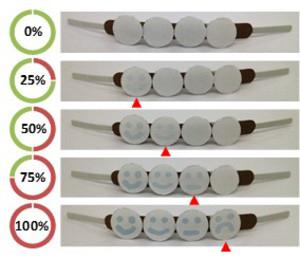
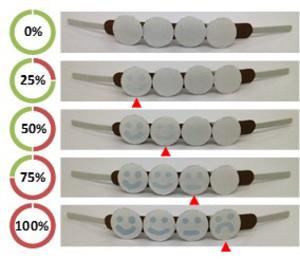
The paper-based sensor, which can be worn as a wristband, features happy and sad emoticon faces –drawn in an invisible UV-sensitive ink–that successively light up as you reach 25%, 50%, 75% and finally 100% of your daily recommended UV exposure.

The research team have also created six versions of the colour-changing wristbands, each of which is personalised for a specific skin tone –an important characteristic given that darker people need more sun exposure to produce vitamin D, which is essential for healthy bones, teeth and muscles.

The groundbreaking research findings were published last week in the prestigious international journal Nature Communications.

Researchers from the University of Granada and RMIT University in Melbourne have developed personalised and low-cost wearable ultraviolet (UV) sensors that warn users when their exposure to the sun has become dangerous.

The paper-based sensor, which can be worn as a wristband, features happy and sad emoticon faces –drawn in an invisible UV-sensitive ink– that successively light up as you reach 25%, 50%, 75% and finally 100% of your daily recommended UV exposure.

The research team have also created six versions of the colour-changing wristbands, each of which is personalised for a specific skin tone –an important characteristic given that darker people need more sun exposure to produce vitamin D, which is essential for healthy bones, teeth and muscles.

###

The groundbreaking research findings were published last week in the prestigious international journal Nature Communications.

Media Contact

Jose Manuel Domi­nguez Vera
[email protected]
34-958-248-097
@canalugr

http://www.ugr.es

Original Source

https://canal.ugr.es/noticia/new-wristband-real-time-tracking-uv-exposure/ http://dx.doi.org/10.1038/s41467-018-06273-3


Share12Tweet7Share2ShareShareShare1

Related Posts

Geriatric Tuberculosis: Five-Year Study Insights India

April 17, 2026

NAT10 Drives Gallbladder Cancer via Cholesterol Metabolism

April 17, 2026

Sedentary Behavior Alters Balance Rehab in Parkinson’s

April 17, 2026

New Study Questions Four-Decade-Old Theory on Childhood Body Composition Changes Before the Adiposity Rebound at Age 6

April 17, 2026
Please login to join discussion

POPULAR NEWS

  • Scientists Investigate Possible Connection Between COVID-19 and Increased Lung Cancer Risk

    61 shares
    Share 24 Tweet 15
  • NSF funds machine-learning research at UNO and UNL to study energy requirements of walking in older adults

    100 shares
    Share 40 Tweet 25
  • Boosting Breast Cancer Risk Prediction with Genetics

    47 shares
    Share 19 Tweet 12
  • Popular Anti-Aging Compound Linked to Damage in Corpus Callosum, Study Finds

    46 shares
    Share 18 Tweet 12

About

We bring you the latest biotechnology news from best research centers and universities around the world. Check our website.

Follow us

Recent News

Geriatric Tuberculosis: Five-Year Study Insights India

Fiber-Optic Sensor Captures Precise Flight Data at Nevada Airfield

NAT10 Drives Gallbladder Cancer via Cholesterol Metabolism

Subscribe to Blog via Email

Enter your email address to subscribe to this blog and receive notifications of new posts by email.

Join 79 other subscribers
  • Contact Us

Bioengineer.org © Copyright 2023 All Rights Reserved.

Welcome Back!

Login to your account below

Forgotten Password?

Retrieve your password

Please enter your username or email address to reset your password.

Log In
No Result
View All Result
  • Homepages
    • Home Page 1
    • Home Page 2
  • News
  • National
  • Business
  • Health
  • Lifestyle
  • Science

Bioengineer.org © Copyright 2023 All Rights Reserved.
