

• HOME
  • NEWS
  • EXPLORE
    • CAREER
      • Companies
      • Jobs
    • EVENTS
    • iGEM
      • News
      • Team
    • PHOTOS
    • VIDEO
    • WIKI
  • BLOG
  • COMMUNITY
    • FACEBOOK
    • INSTAGRAM
    • TWITTER
Saturday, February 7, 2026
BIOENGINEER.ORG
No Result
View All Result
  • Login
  • HOME
  • NEWS
  • EXPLORE
    • CAREER
      • Companies
      • Jobs
        • Lecturer
        • PhD Studentship
        • Postdoc
        • Research Assistant
    • EVENTS
    • iGEM
      • News
      • Team
    • PHOTOS
    • VIDEO
    • WIKI
  • BLOG
  • COMMUNITY
    • FACEBOOK
    • INSTAGRAM
    • TWITTER
  • HOME
  • NEWS
  • EXPLORE
    • CAREER
      • Companies
      • Jobs
        • Lecturer
        • PhD Studentship
        • Postdoc
        • Research Assistant
    • EVENTS
    • iGEM
      • News
      • Team
    • PHOTOS
    • VIDEO
    • WIKI
  • BLOG
  • COMMUNITY
    • FACEBOOK
    • INSTAGRAM
    • TWITTER
No Result
View All Result
Bioengineer.org
No Result
View All Result
Home NEWS Science News Health

Virtual reality can reduce pain and increase performance during exercise

Bioengineer by Bioengineer
October 1, 2018
in Health
Reading Time: 2 mins read
0
Share on FacebookShare on TwitterShare on LinkedinShare on RedditShare on Telegram
IMAGE

Credit: Maria Matsangidou

The research, led by PhD candidate Maria Matsangidou from EDA, set out to determine how using VR while exercising could affect performance by measuring a raft of criteria: heart rate, including pain intensity, perceived exhaustion, time to exhaustion and private body consciousness.

To do this they monitored 80 individuals performing an isometric bicep curl set at 20% of the maximum weight they could lift, which they were then asked to hold for as long as possible. Half of the group acted as a control group who did the lift and hold inside a room that had a chair, a table and yoga mat on the floor.

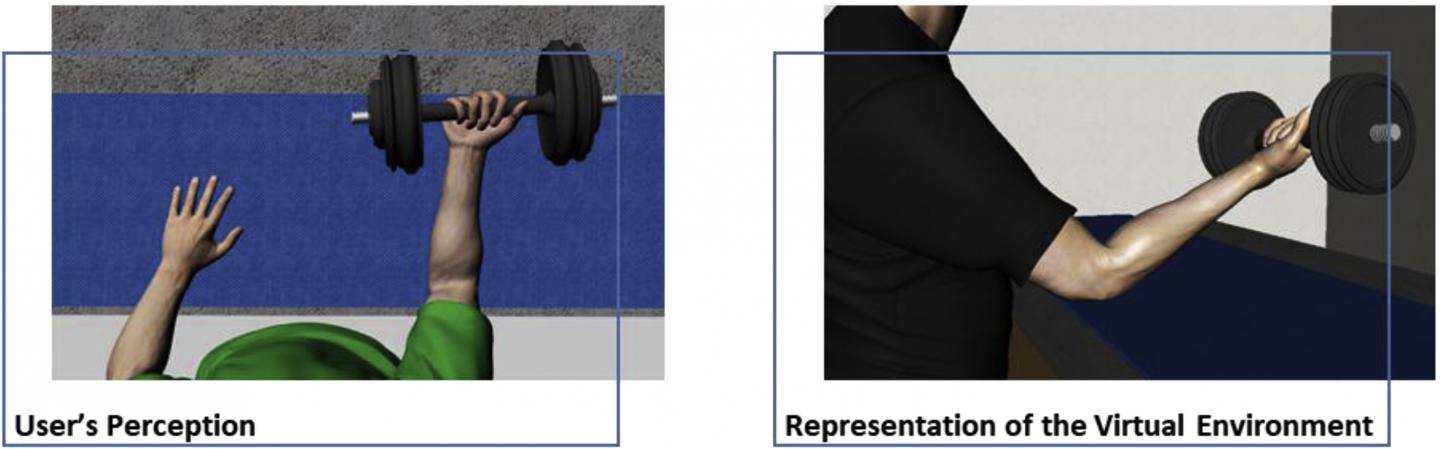
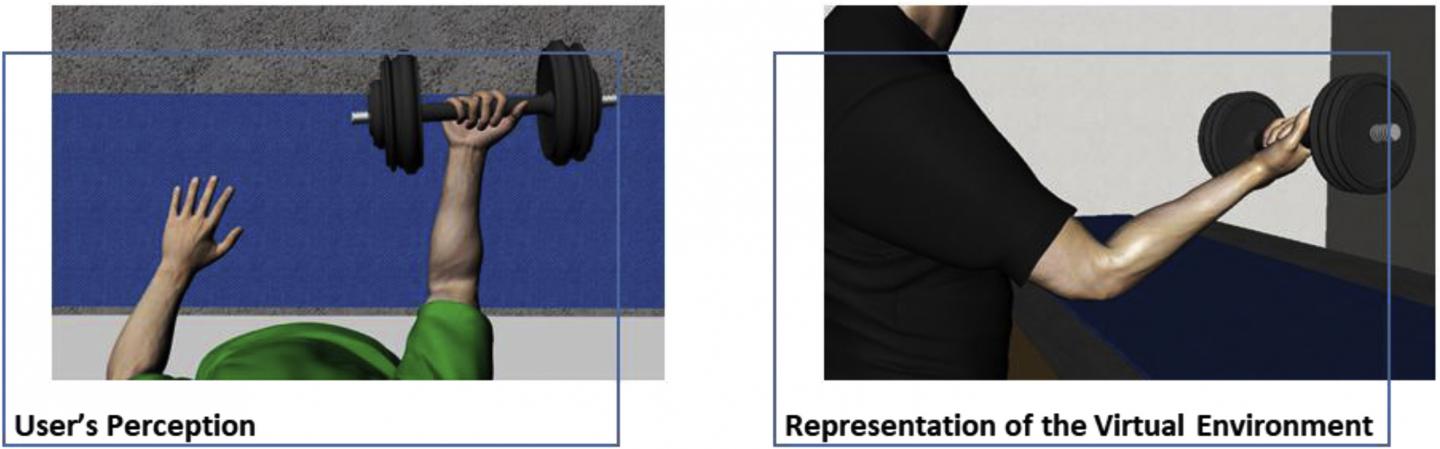
The VR group were placed in the same room with the same items. They then put on a VR headset and saw the same environment, including a visual representation of an arm and the weight (see image below). They then carried out the same lift and hold as the non-VR group.

The results showed a clear reduction in perception of pain and effort when using VR technology. The data showed that after a minute the VR group had reported a pain intensity that was 10% lower than the non-VR group.

Furthermore the time to exhaustion for the VR group was around two minutes longer than those doing conventional exercise. The VR group also showed a lower heart rate of three beats per minute than the non-VR group.

Results from the study also showed no significant effect of private body consciousness on the positive impact of VR. Private body consciousness is the subjective awareness each of us has to bodily sensations.

Previous research has shown that individuals who have a high private body consciousness tend to better understand their body and as a result perceive higher pain when exercising. However, the study's findings revealed that VR was effective in reducing perceived pain and that private body consciousness did not lessen this effect.

As such, the improvements shown by the VR group suggest that it could be a possible way to encourage less active people to exercise by reducing the perceived pain that exercise can cause and improving performance, regardless of private body consciousness.

Lead researcher Maria Matsangidou said: 'It is clear from the data gathered that the use of VR technology can improve performance during exercise on a number of criteria. This could have major implications for exercise regimes for everyone, from occasional gym users to professional athletes.'

###

Dr Jim Ang from EDA and Dr Alex Mauger from the School of Sport and Exercise Sciences at Kent were also involved in the research.

The paper has been published in the journal Psychology Sports and Exercise entitled Is your virtual self as sensational as your real? Virtual Reality: The effect of body consciousness on the experience of exercise sensations.

Media Contact

Dan Worth
[email protected]
01-227-816-769
@UniKent

http://www.kent.ac.uk

Original Source

https://www.kent.ac.uk/news/science/19368/virtual-reality-can-reduce-pain-and-increase-performance-during-exercise http://dx.doi.org/10.1016/j.psychsport.2018.07.004

Share12Tweet8Share2ShareShareShare2

Related Posts

Evaluating Pediatric Emergency Care Quality in Ethiopia

February 7, 2026

TPMT Expression Predictions Linked to Azathioprine Side Effects

February 7, 2026

Improving Dementia Care with Enhanced Activity Kits

February 7, 2026

Decoding Prostate Cancer Origins via snFLARE-seq, mxFRIZNGRND

February 7, 2026
Please login to join discussion

POPULAR NEWS

  • Robotic Ureteral Reconstruction: A Novel Approach

    Robotic Ureteral Reconstruction: A Novel Approach

    82 shares
    Share 33 Tweet 21
  • Digital Privacy: Health Data Control in Incarceration

    63 shares
    Share 25 Tweet 16
  • Study Reveals Lipid Accumulation in ME/CFS Cells

    57 shares
    Share 23 Tweet 14
  • Breakthrough in RNA Research Accelerates Medical Innovations Timeline

    53 shares
    Share 21 Tweet 13

About

We bring you the latest biotechnology news from best research centers and universities around the world. Check our website.

Follow us

Recent News

Evaluating Pediatric Emergency Care Quality in Ethiopia

TPMT Expression Predictions Linked to Azathioprine Side Effects

Improving Dementia Care with Enhanced Activity Kits

Subscribe to Blog via Email

Success! An email was just sent to confirm your subscription. Please find the email now and click 'Confirm' to start subscribing.

Join 73 other subscribers
  • Contact Us

Bioengineer.org © Copyright 2023 All Rights Reserved.

Welcome Back!

Login to your account below

Forgotten Password?

Retrieve your password

Please enter your username or email address to reset your password.

Log In
No Result
View All Result
  • Homepages
    • Home Page 1
    • Home Page 2
  • News
  • National
  • Business
  • Health
  • Lifestyle
  • Science

Bioengineer.org © Copyright 2023 All Rights Reserved.