• HOME
  • NEWS
  • EXPLORE
    • CAREER
      • Companies
      • Jobs
    • EVENTS
    • iGEM
      • News
      • Team
    • PHOTOS
    • VIDEO
    • WIKI
  • BLOG
  • COMMUNITY
    • FACEBOOK
    • INSTAGRAM
    • TWITTER
Saturday, February 7, 2026
BIOENGINEER.ORG
No Result
View All Result
  • Login
  • HOME
  • NEWS
  • EXPLORE
    • CAREER
      • Companies
      • Jobs
        • Lecturer
        • PhD Studentship
        • Postdoc
        • Research Assistant
    • EVENTS
    • iGEM
      • News
      • Team
    • PHOTOS
    • VIDEO
    • WIKI
  • BLOG
  • COMMUNITY
    • FACEBOOK
    • INSTAGRAM
    • TWITTER
  • HOME
  • NEWS
  • EXPLORE
    • CAREER
      • Companies
      • Jobs
        • Lecturer
        • PhD Studentship
        • Postdoc
        • Research Assistant
    • EVENTS
    • iGEM
      • News
      • Team
    • PHOTOS
    • VIDEO
    • WIKI
  • BLOG
  • COMMUNITY
    • FACEBOOK
    • INSTAGRAM
    • TWITTER
No Result
View All Result
Bioengineer.org
No Result
View All Result
Home NEWS Science News Biology

Determinations of air flow behaviors in the human upper airway by visualizing flowing air directly

Bioengineer by Bioengineer
October 1, 2018
in Biology
Reading Time: 2 mins read
0
Share on FacebookShare on TwitterShare on LinkedinShare on RedditShare on Telegram
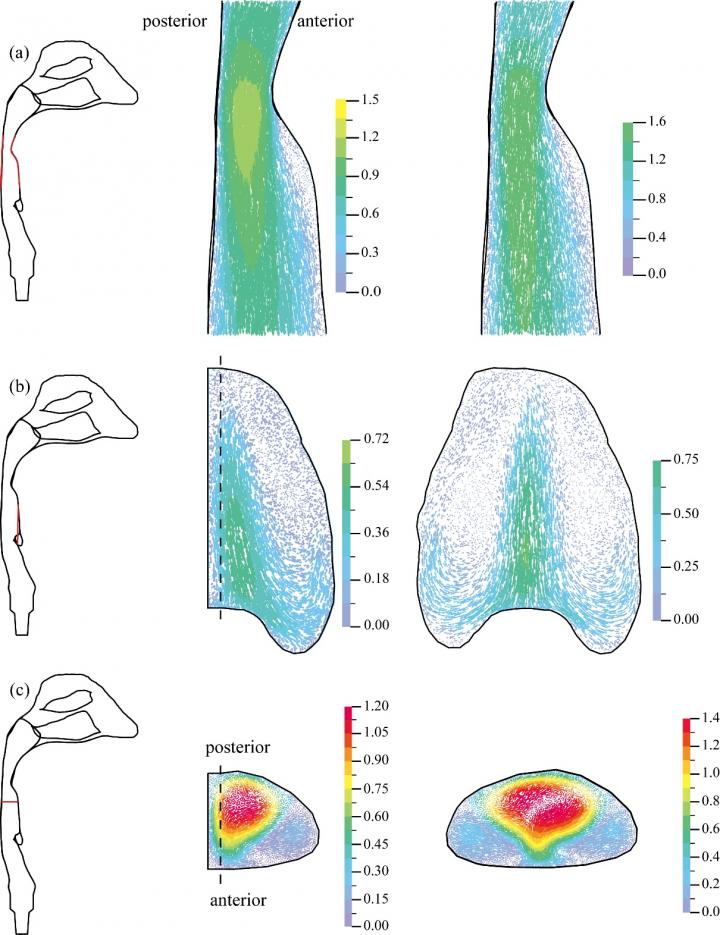
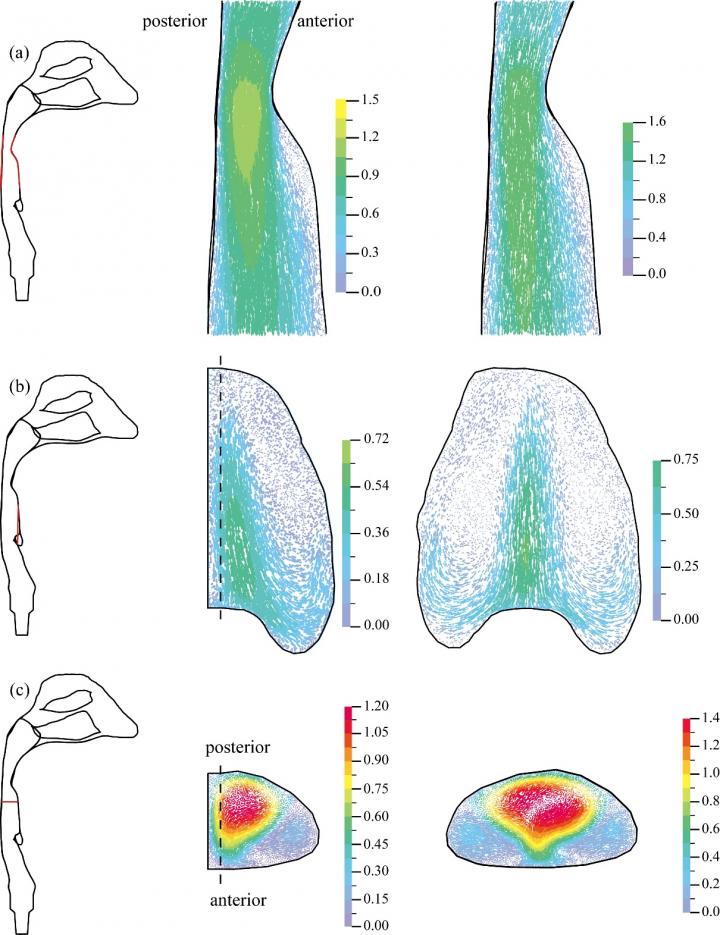
IMAGE

Credit: ©Science China Press

The determination of airflow characteristics in the human upper airway is crucial in investigating obstructive sleep apnea, particle sedimentation, drug delivery, and many biomedical problems. Currently?computational simulations have been used more and more in the upper airway related studies. A precondition to choose a correct flow model to obtain credible predictions in numerical simulations is to know the airflow characteristics in the upper airway. However, direct visualization of air flow patterns in in-vitro models with complex geometrical structures is a big challenge.

Professor Yaqi Huang's team in the Capital Medical University in Beijing, China, has developed a unique method and performed the first direct visualization of air flow in the in-vitro models built based on realistic anatomical structures of the upper airway. The paper entitled "Direct visualizations of air flow in the human upper airway using in-vitro models" was published in SCIENCE CHINA Life sciences recently.

The investigators constructed unique half-side transparent physical models of the upper airway for normal subjects (Figure 1). Using smoke-wire to trace the airflow on the green laser sheet background in the physical models, they captured the streamlines in the mid-sagittal plane of the pharyngeal airway using a high-speed camera. The results revealed that the airflow through the pharynx in both the mean-structure (Figure 1a) and the individual structure (Figure 1b) models was a laminar flow with vortexes but not a turbulent flow under normal inspiration. The flow field predicted numerically using the laminar model was consistent with the observations in the physical models.

From a comparison of the velocity fields predicted numerically using the half-side model (column 2 in Figure 2) and complete model (column 3 in Figure 2), one can fine that the speed range and flow patterns in both models are quite similar except for the slow flow in the boundary layer region of the flat wall in the half-side model. This confirms that it is reasonable to investigate the flow behaviors in the upper airway using the half-side model. The effects of the upper airway narrowing on pharyngeal resistance are also simulated and analyzed using numerical models in this study.

###

This research was funded by from the National Nature Science Foundation of China (Nos 31670959?81171422), the National Science and Technology Pillar Program of China (No, 2012BAI05B03), the Key Projects in Science and Technology Program of Beijing Municipal Education Commission, China (No. KZ201210025022), Beijing Postdoctoral Research Foundation (No. 2016ZZ-45), and Beijing Key Laboratory of Fundamental Research on Biomechanics in Clinical Application.

See the article:

Wu, H., Wang, M., Wang, J., An, Y., Wang, H., and Huang, Y. (2018). Direct visualizations of air flow in the human upper airway using in-vitro models. Sci China Life Sci 61, https://doi.org/10.1007/s11427-018-9373-y

http://engine.scichina.com/publisher/scp/journal/SCLS/doi/10.1007/s11427-018-9373-y?slug=full%20text

https://link.springer.com/article/10.1007%2Fs11427-018-9373-y

Media Contact

Yaqi Huang
[email protected]

http://www.scichina.com/

Related Journal Article

http://dx.doi.org/10.1007/s11427-018-9373-y

Share12Tweet8Share2ShareShareShare2

Related Posts

New Study Uncovers Mechanism Behind Burn Pit Particulate Matter–Induced Lung Inflammation

New Study Uncovers Mechanism Behind Burn Pit Particulate Matter–Induced Lung Inflammation

February 6, 2026

DeepBlastoid: Advancing Automated and Efficient Evaluation of Human Blastoids with Deep Learning

February 6, 2026

Navigating the Gut: The Role of Formic Acid in the Microbiome

February 6, 2026

AI-Enhanced Optical Coherence Photoacoustic Microscopy Revolutionizes 3D Cancer Model Imaging

February 6, 2026
Please login to join discussion

POPULAR NEWS

  • Robotic Ureteral Reconstruction: A Novel Approach

    Robotic Ureteral Reconstruction: A Novel Approach

    82 shares
    Share 33 Tweet 21
  • Digital Privacy: Health Data Control in Incarceration

    63 shares
    Share 25 Tweet 16
  • Study Reveals Lipid Accumulation in ME/CFS Cells

    57 shares
    Share 23 Tweet 14
  • Breakthrough in RNA Research Accelerates Medical Innovations Timeline

    53 shares
    Share 21 Tweet 13

About

We bring you the latest biotechnology news from best research centers and universities around the world. Check our website.

Follow us

Recent News

Palmitoylation of Tfr1 Drives Platelet Ferroptosis and Exacerbates Liver Damage in Heat Stroke

Oxygen-Enhanced Dual-Section Microneedle Patch Improves Drug Delivery and Boosts Photodynamic and Anti-Inflammatory Treatment for Psoriasis

Scientists Identify SARS-CoV-2 PLpro and RIPK1 Inhibitors Showing Potent Synergistic Antiviral Effects in Mouse COVID-19 Model

Subscribe to Blog via Email

Enter your email address to subscribe to this blog and receive notifications of new posts by email.

Join 73 other subscribers
  • Contact Us

Bioengineer.org © Copyright 2023 All Rights Reserved.

Welcome Back!

Login to your account below

Forgotten Password?

Retrieve your password

Please enter your username or email address to reset your password.

Log In
No Result
View All Result
  • Homepages
    • Home Page 1
    • Home Page 2
  • News
  • National
  • Business
  • Health
  • Lifestyle
  • Science

Bioengineer.org © Copyright 2023 All Rights Reserved.