• HOME
  • NEWS
  • EXPLORE
    • CAREER
      • Companies
      • Jobs
    • EVENTS
    • iGEM
      • News
      • Team
    • PHOTOS
    • VIDEO
    • WIKI
  • BLOG
  • COMMUNITY
    • FACEBOOK
    • INSTAGRAM
    • TWITTER
Friday, January 23, 2026
BIOENGINEER.ORG
No Result
View All Result
  • Login
  • HOME
  • NEWS
  • EXPLORE
    • CAREER
      • Companies
      • Jobs
        • Lecturer
        • PhD Studentship
        • Postdoc
        • Research Assistant
    • EVENTS
    • iGEM
      • News
      • Team
    • PHOTOS
    • VIDEO
    • WIKI
  • BLOG
  • COMMUNITY
    • FACEBOOK
    • INSTAGRAM
    • TWITTER
  • HOME
  • NEWS
  • EXPLORE
    • CAREER
      • Companies
      • Jobs
        • Lecturer
        • PhD Studentship
        • Postdoc
        • Research Assistant
    • EVENTS
    • iGEM
      • News
      • Team
    • PHOTOS
    • VIDEO
    • WIKI
  • BLOG
  • COMMUNITY
    • FACEBOOK
    • INSTAGRAM
    • TWITTER
No Result
View All Result
Bioengineer.org
No Result
View All Result
Home NEWS Science News Biology

Berkeley evolutionary biologist wins Milner Centre Prize

Bioengineer by Bioengineer
September 26, 2018
in Biology
Reading Time: 2 mins read
0
Share on FacebookShare on TwitterShare on LinkedinShare on RedditShare on Telegram
IMAGE

Credit: University of Bath

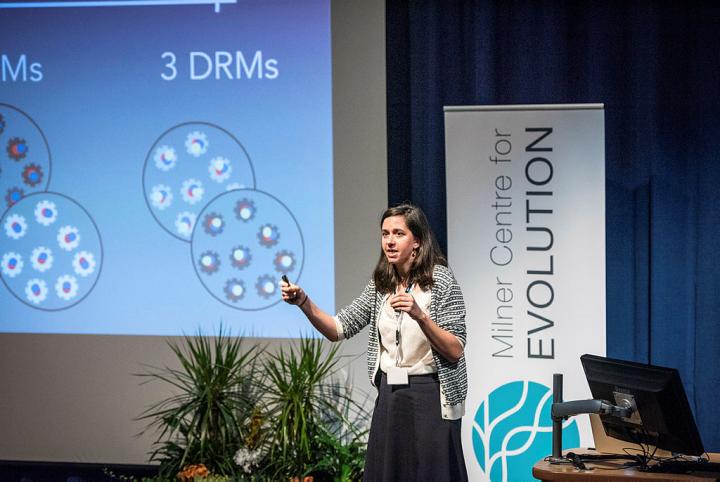
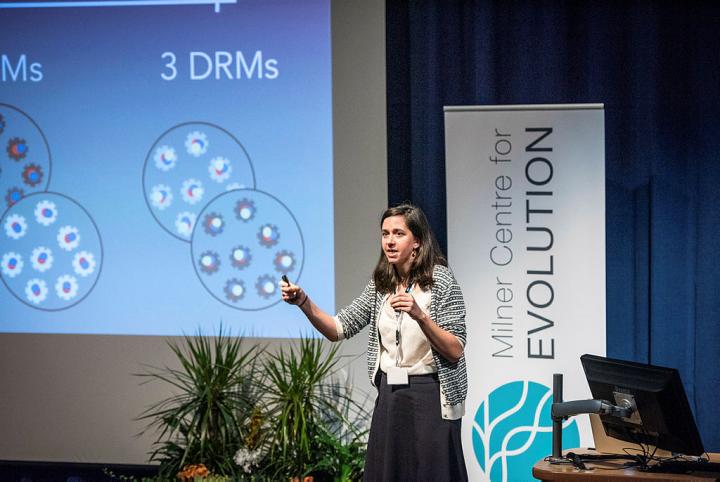
Evolutionary biologist Dr Alison Feder from University of California, Berkeley has been named winner of the very first Milner Prize by the Milner Centre for Evolution.

Dr Feder studies the evolution of infectious pathogens as they change within their hosts to understand more generally how populations adapt to overcome new and complex challenges.

Dr Feder presented her work on Thursday 20 September at the Inaugural Conference of the Milner Centre for Evolution: Evolution in the 21st Century. She talked about how HIV's high mutation rates and large population sizes makes it incredibly adaptable, especially to the drugs used in its treatment.

The lecture explored how drug resistance evolution has changed over the course of the epidemic and the role population spatial structure plays in influencing intra patient dynamics. More broadly, the talk addressed how studying evolution and disease jointly can improve our understanding of them both.

She received her prize from Dr Jonathan Milner, alumnus of the University of Bath and educational philanthropist whose donation helped establish the Milner Centre for Evolution.

Of the prize, Dr Feder says:

"I'm deeply honored to have been invited to give the inaugural Milner Prize lecture. Both the conference attendees and the members of the Milner Centre are such an impressive and inspiring group of scientists that the opportunity to present my work is really something very special."

Professor Laurence Hurst, Director of the Milner Centre for Evolution said:

"The committee were very impressed by Alison's research. Not only is it cutting-edge, but her work tackles both deep theoretical problems that have immediate relevance, to understanding how viruses like HIV adapt to drugs, thus tackling evolutionary biology closer to the clinic. We were delighted to be in a position to award the inaugural Milner Prize Lecture to such an outstanding candidate."

Dmitri Petrov, Michelle and Kevin Douglas Professor at Stanford and Alison's PhD supervisor, said:

"I was exceptionally fortunate that Alison Feder chose my lab for her Ph.D. She is an extraordinary young scientist with exceptional creativity, originality, focus, range of skills, and the sense of how to identify and then answer truly deep questions in evolution and evolutionary medicine.

"She is just at the beginning of what I am sure will be a brilliant career and I find it very fitting that she is the keynote speaker for the inaugural meeting of the Milner Centre for Evolution. It also makes me very proud."

###

Media Contact

Vicky Just
[email protected]
44-012-253-86883
@uniofbath

http://www.bath.ac.uk

Original Source

https://www.bath.ac.uk/announcements/berkeley-evolutionary-biologist-wins-milner-centre-prize/

Share12Tweet8Share2ShareShareShare2

Related Posts

Can Dogs Identify Human Knowledge in Strangers?

Can Dogs Identify Human Knowledge in Strangers?

January 23, 2026
Volatile Organic Compounds in Rice Wine: Origins & Analysis

Volatile Organic Compounds in Rice Wine: Origins & Analysis

January 23, 2026

Uncovering Two Key Enzymes in Tilianin Biosynthesis

January 23, 2026

Wolves and Dogs: A Love for New Experiences

January 23, 2026
Please login to join discussion

POPULAR NEWS

  • Enhancing Spiritual Care Education in Nursing Programs

    156 shares
    Share 62 Tweet 39
  • PTSD, Depression, Anxiety in Childhood Cancer Survivors, Parents

    148 shares
    Share 59 Tweet 37
  • Robotic Ureteral Reconstruction: A Novel Approach

    79 shares
    Share 32 Tweet 20
  • Digital Privacy: Health Data Control in Incarceration

    61 shares
    Share 24 Tweet 15

About

We bring you the latest biotechnology news from best research centers and universities around the world. Check our website.

Follow us

Recent News

3D Printing: Transforming Female Reproductive System Research

Improving Long-Term Care: TCALL Study Protocol Revealed

Best Seismic Measures for Slopes Under Ground Motions

Subscribe to Blog via Email

Enter your email address to subscribe to this blog and receive notifications of new posts by email.

Join 71 other subscribers
  • Contact Us

Bioengineer.org © Copyright 2023 All Rights Reserved.

Welcome Back!

Login to your account below

Forgotten Password?

Retrieve your password

Please enter your username or email address to reset your password.

Log In
No Result
View All Result
  • Homepages
    • Home Page 1
    • Home Page 2
  • News
  • National
  • Business
  • Health
  • Lifestyle
  • Science

Bioengineer.org © Copyright 2023 All Rights Reserved.