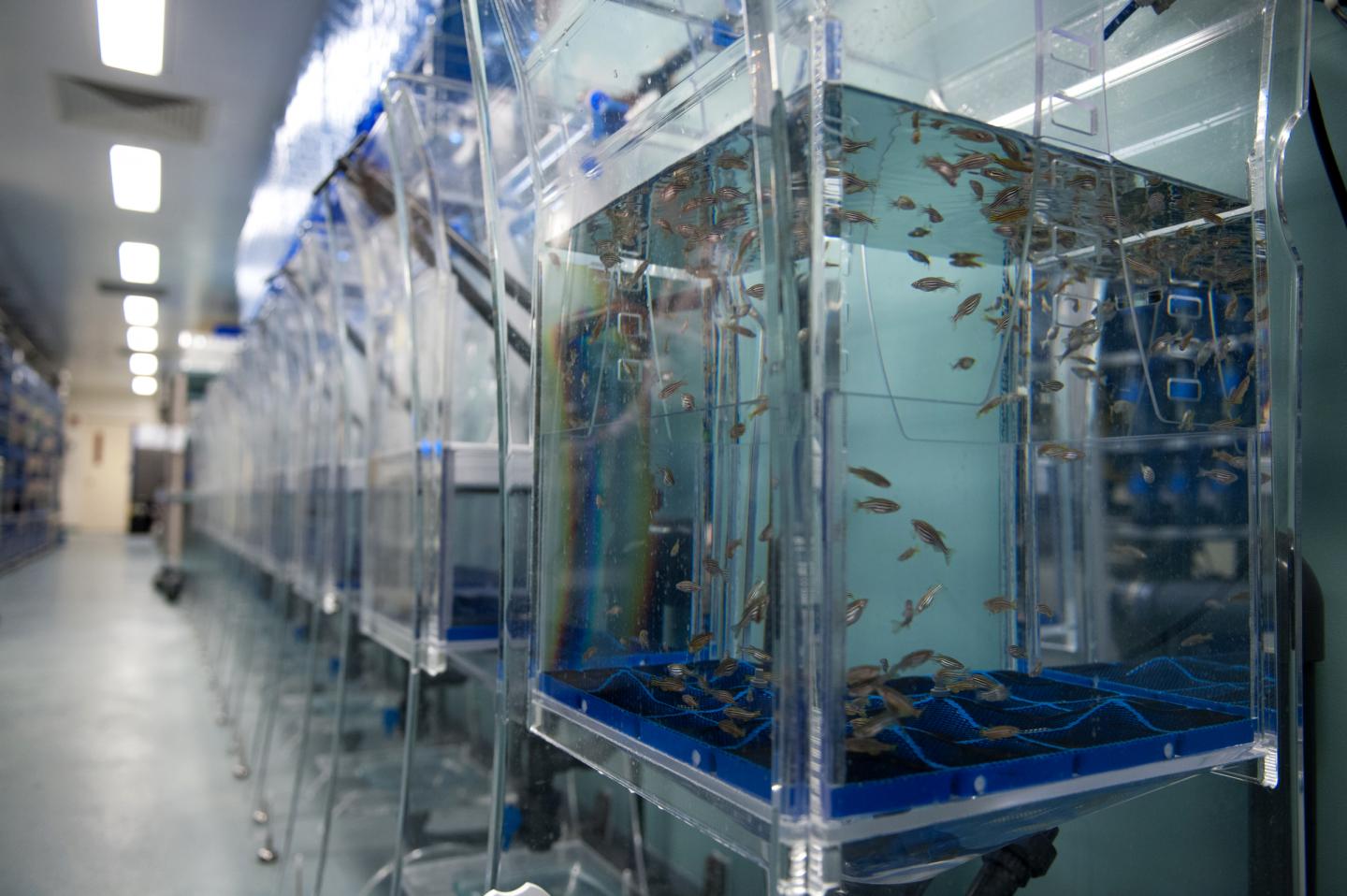
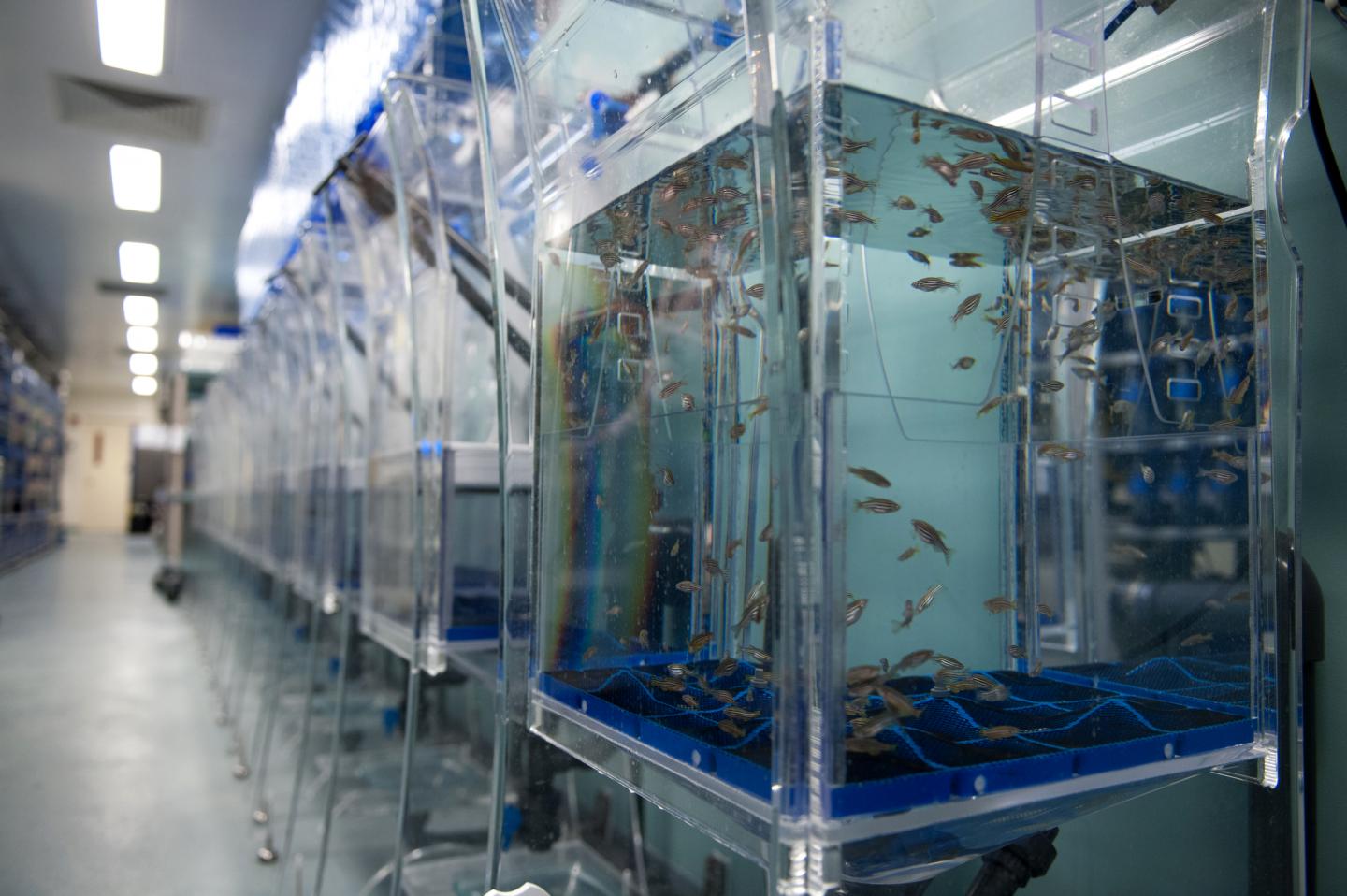
Credit: Katherine C. Cohen/Boston Children's Hospital
The lab of Leonard Zon, MD, at Boston Children's Hospital has long been interested in making blood stem cells in quantity for therapeutic purposes. Looking for a way to test for their presence in zebrafish, their go-to research model, they turned to the MYB gene, a marker of blood stem cells. To spot the cells, Joseph Mandelbaum, a PhD candidate in the lab, attached a green fluorescent tag to MYB, easily visible in transparent zebrafish embryos.
"It was a real workhorse line for us," says Zon, who directs the Stem Cell Research Program at Boston Children's.
The line has also proved valuable for discovering cancer drugs. In addition to being a marker of blood stem cells, MYB is an oncogene.
About five years ago, Zon was at a cancer meeting and serendipitously met Jeff Kaufman, who was also interested in MYB. Kaufman was excited to hear about Zon's fluorescing MYB zebrafish, which reproduce quickly, can be studied at scale and are surprisingly similar to humans genetically. He asked if Zon had ever heard of adenoid cystic carcinoma — and a collaboration was born.
Targeting a cancer driver
Kaufman had founded the Adenoid Cystic Carcinoma Research Foundation with his wife, Marnie, in 2005, after she felt a lump under her jawline and was diagnosed with the rare, often deadly malignancy. (ACC usually starts in the salivary glands, but can also appear in the larynx, trachea, lacrimal gland, breast and vulva.) Finding very little ongoing research on ACC, the Foundation began creating tissue repositories and funding studies.
"What we've learned over 12 to 13 years is that MYB is the main driver of ACC," Kaufman says. He asked Zon, "Do you think you could shut off the MYB gene by giving chemicals to your zebrafish?"
Zon and his colleagues agreed to try, with the Foundation providing grant support. Their findings, reported last week in the Journal of Experimental Medicine, have laid the groundwork for a clinical trial in patients with ACC at the Dana-Farber Cancer Institute. More broadly, they suggest the power of zebrafish as a tool for cancer drug discovery.
Turning off the green
Despite more than 30 phase II clinical trials since 1985, there is no standard chemotherapy or drug regimen for ACC. About half of all patients develop metastatic disease, and no drug therapy has been shown to prolong overall or progression-free survival.
Zon, Mandelbaum and colleagues set up a high-throughput drug screening system. They loaded tiny zebrafish blastomeres — very early embryos consisting of just a few cells — into 384-well plates. Each embryo's MYB genes were tagged with green fluorescent protein. The team then systematically exposed the blastomeres to 3,840 small molecules. Using an automated cell imaging system, they looked to see if any chemical would "shut off the green."
"We could have done the screen in whole embryos, but the cell culture system was so much faster," says Zon. "We were able to do a screen in six months, versus what might've taken one and a half years with whole embryos."
In the end, 22 chemicals shut off MYB, of which retinoic acid or derivatives of retinoic acid were the most potent. Retinoic acid, best known as acne treatment, is a derivative of vitamin A.
Slowing tumor growth
The team further validated retinoic acid's efficacy in human tumor cells. Since no one has been able to create a viable ACC cell line, the team turned to a human myeloid leukemia line, which also expresses MYB at high levels. Retinoic acid not only downregulated MYB, but did so within just one hour.
Finally, through the Foundation, the team collaborated with South Texas Accelerated Research Therapeutics (START) to test retinoic acid in "primagraft" models — live mice bearing tumors derived from actual ACC patients. They showed that retinoic acid (specifically, a preparation called ATRA) slowed tumor growth.
"With the tumor, the gas pedal is all the way down," says Zon. "When you give retinoic acid, it takes the foot off the pedal."
Finally, the team worked out how retinoic acid works. In ACC, a chromosome rearrangement brings MYB adjacent to another gene, NFIB, which has an "enhancer" region. The genes bind together and NFIB's enhancer causes MYB to get stuck "on," so more and more of the oncogene is made in the cell. But Zon's group found that when the cell's retinoic acid receptors are triggered by retinoic acid, they bind to the NFIB enhancer and shut down most MYB production.
"Len's work is incredibly exciting, because this is really the first drug that appears to directly target MYB, and we really haven't had any drug that has effectively done that before," says Kaufman. "Through our preclinical drug screening program and mouse models of ACC, we have screened over 100 anticancer agents, and we've very seldom seen a drug as active as retinoic acid."
Clinical trial on deck
Mandelbaum and Zon, part of the Division of Hematology/Oncology at Boston Children's and Dana-Farber, presented the study results at a meeting of Dana-Farber head and neck oncologists. They were equally excited. "We're all in agreement to do a clinical trial," says Zon.
Since retinoic acid and ATRA are old drugs no longer protected by patent, drug companies are unlikely to sponsor such a trial, so the team has a proposal out for foundation funding. The plan is to test ATRA in 12 Dana-Farber patients with ACC. ATRA has already been used to treat promyelocytic leukemia, so the ACC patients would receive the same doses. Zon thinks the trial could begin within a year.
"If it turns out to be effective, you've got a drug that's been given to thousands and thousands of patients with a known safety profile," says Kaufman. "The hope is that it will get moved fairly quickly into the clinic."
A versatile cancer discovery platform
Alterations in MYB have been implicated in a variety of cancers, including leukemia, pediatric gliomas, and cancers of the colon, breast and prostate. But the applicability of the zebrafish test system potentially goes even further.
"Potentially, if the cancer is driven by a particular gene, you could use that in a zebrafish model, create a reporter, do a chemical genetic screen and then look at tumor inhibition," says Mandelbaum, first author on the paper. "Chemical screening in zebrafish is a very powerful and fast system."
###
Other supporters of the study include the Harvard Stem Cell Institute, the Howard Hughes Medical Institute and the National Institutes of Health. See the paper for a complete list of funders and authors.
About Boston Children's Hospital
Boston Children's Hospital, the primary pediatric teaching affiliate of Harvard Medical School, is home to the world's largest research enterprise based at a pediatric medical center. Its discoveries have benefited both children and adults since 1869. Today, more than 3,000 scientists, including nine members of the National Academy of Sciences, 17 members of the National Academy of Medicine and 11 Howard Hughes Medical Investigators comprise Boston Children's research community. Founded as a 20-bed hospital for children, Boston Children's is now a 415-bed comprehensive center for pediatric and adolescent health care. For more, visit our Vector and Thriving blogs and follow us on social media @BostonChildrens, @BCH_Innovation, Facebook and YouTube.
Media Contact
Peter Cohenno
[email protected]
617-919-3110
@BostonChildrens
http://www.childrenshospital.org/newsroom
Original Source
https://vector.childrenshospital.org/2018/09/zebrafish-reveal-potential-cancer-treatments/ http://dx.doi.org/10.1084/jem.20180939