• HOME
  • NEWS
  • EXPLORE
    • CAREER
      • Companies
      • Jobs
    • EVENTS
    • iGEM
      • News
      • Team
    • PHOTOS
    • VIDEO
    • WIKI
  • BLOG
  • COMMUNITY
    • FACEBOOK
    • INSTAGRAM
    • TWITTER
Saturday, February 7, 2026
BIOENGINEER.ORG
No Result
View All Result
  • Login
  • HOME
  • NEWS
  • EXPLORE
    • CAREER
      • Companies
      • Jobs
        • Lecturer
        • PhD Studentship
        • Postdoc
        • Research Assistant
    • EVENTS
    • iGEM
      • News
      • Team
    • PHOTOS
    • VIDEO
    • WIKI
  • BLOG
  • COMMUNITY
    • FACEBOOK
    • INSTAGRAM
    • TWITTER
  • HOME
  • NEWS
  • EXPLORE
    • CAREER
      • Companies
      • Jobs
        • Lecturer
        • PhD Studentship
        • Postdoc
        • Research Assistant
    • EVENTS
    • iGEM
      • News
      • Team
    • PHOTOS
    • VIDEO
    • WIKI
  • BLOG
  • COMMUNITY
    • FACEBOOK
    • INSTAGRAM
    • TWITTER
No Result
View All Result
Bioengineer.org
No Result
View All Result
Home NEWS Science News Health

New way to target advanced breast cancers

Bioengineer by Bioengineer
September 20, 2018
in Health
Reading Time: 2 mins read
0
Share on FacebookShare on TwitterShare on LinkedinShare on RedditShare on Telegram
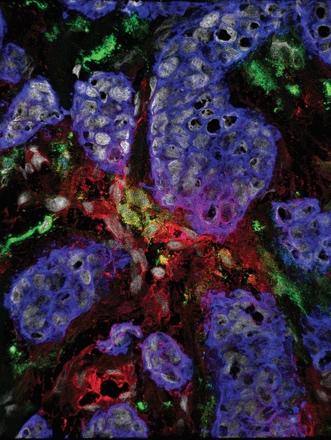
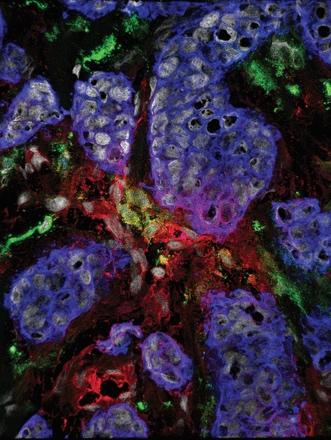
IMAGE

Credit: Jackson Laboratory

A cytokine signature found in certain kinds of breast cancer cells can not only serve as a diagnostic tool for HER2-negative cancers but also offer an effective treatment target.

A research team led by Karolina Palucka, M.D., Ph.D., a professor at The Jackson Laboratory (JAX), has collaborated with researchers at The Baylor Institute for Immunology Research to show that IL1b, a member of the interleukin 1 family of cytokines (proteins released by certain cells of the immune system) drives the inflammation often found in cancer, and appears as an "IL1 signature" in women with HER2-negative metastatic breast cancer.

"We found that IL1b orchestrates tumor-promoting inflammation in breast cancer," Palucka says, "and its presence corresponds with poor clinical outcomes. We show that it can be effectively targeted in patients using anakinra, a naturally occurring IL1 receptor antagonist."

Anakinra is already widely used to treat autoimmune and autoinflammatory diseases, and is being tested as an adjunct therapy to reduce the inflammation of metastatic cancer, including metastatic colorectal cancer. In the new study, 11 women with advanced metastatic HER2-negative breast cancer received anakinra treatment, and after just two weeks showed reduced gene expression of IL1b and other cytokines and signaling pathways.

The patients then received anakinra in combination with standard chemotherapeutics for HER2-negative cancers for a median duration of four months. Some patients reported less pain and increased quality of life during this combination treatment, and three of them are still alive.

The team's report appears as the cover article in the journal Cancer Research, along with a commentary by Charles A. Dinarello, Ph.D., of the University of Colorado Denver Anschutz Medical Campus, who discovered, cloned and characterized the essential biology of a human "fever molecule," which was later named Interleukin-1 (IL-1).

"The study represents several years of dedicated research on cancer by Palucka and colleagues," Dinarello writes. "Although there are several advantages of knowing a transcriptional signature, including risk and prognosis, a real benefit is the exploitation of the signature to develop specific, targeted therapies. In the case of patients with cancer with IL-1 signature genes, one could simply block IL1. In fact, this is exactly what the study accomplished."

###

Media Contact

News
[email protected]
@jacksonlab

http://www.jax.org

Related Journal Article

http://dx.doi.org/10.1158/0008-5472

Share12Tweet8Share2ShareShareShare2

Related Posts

Evaluating Pediatric Emergency Care Quality in Ethiopia

February 7, 2026

TPMT Expression Predictions Linked to Azathioprine Side Effects

February 7, 2026

Improving Dementia Care with Enhanced Activity Kits

February 7, 2026

Decoding Prostate Cancer Origins via snFLARE-seq, mxFRIZNGRND

February 7, 2026
Please login to join discussion

POPULAR NEWS

  • Robotic Ureteral Reconstruction: A Novel Approach

    Robotic Ureteral Reconstruction: A Novel Approach

    82 shares
    Share 33 Tweet 21
  • Digital Privacy: Health Data Control in Incarceration

    63 shares
    Share 25 Tweet 16
  • Study Reveals Lipid Accumulation in ME/CFS Cells

    57 shares
    Share 23 Tweet 14
  • Breakthrough in RNA Research Accelerates Medical Innovations Timeline

    53 shares
    Share 21 Tweet 13

About

We bring you the latest biotechnology news from best research centers and universities around the world. Check our website.

Follow us

Recent News

Evaluating Pediatric Emergency Care Quality in Ethiopia

TPMT Expression Predictions Linked to Azathioprine Side Effects

Improving Dementia Care with Enhanced Activity Kits

Subscribe to Blog via Email

Success! An email was just sent to confirm your subscription. Please find the email now and click 'Confirm' to start subscribing.

Join 73 other subscribers
  • Contact Us

Bioengineer.org © Copyright 2023 All Rights Reserved.

Welcome Back!

Login to your account below

Forgotten Password?

Retrieve your password

Please enter your username or email address to reset your password.

Log In
No Result
View All Result
  • Homepages
    • Home Page 1
    • Home Page 2
  • News
  • National
  • Business
  • Health
  • Lifestyle
  • Science

Bioengineer.org © Copyright 2023 All Rights Reserved.