• HOME
  • NEWS
  • EXPLORE
    • CAREER
      • Companies
      • Jobs
    • EVENTS
    • iGEM
      • News
      • Team
    • PHOTOS
    • VIDEO
    • WIKI
  • BLOG
  • COMMUNITY
    • FACEBOOK
    • INSTAGRAM
    • TWITTER
Monday, October 5, 2026
BIOENGINEER.ORG
No Result
View All Result
  • Login
  • HOME
  • NEWS
  • EXPLORE
    • CAREER
      • Companies
      • Jobs
        • Lecturer
        • PhD Studentship
        • Postdoc
        • Research Assistant
    • EVENTS
    • iGEM
      • News
      • Team
    • PHOTOS
    • VIDEO
    • WIKI
  • BLOG
  • COMMUNITY
    • FACEBOOK
    • INSTAGRAM
    • TWITTER
  • HOME
  • NEWS
  • EXPLORE
    • CAREER
      • Companies
      • Jobs
        • Lecturer
        • PhD Studentship
        • Postdoc
        • Research Assistant
    • EVENTS
    • iGEM
      • News
      • Team
    • PHOTOS
    • VIDEO
    • WIKI
  • BLOG
  • COMMUNITY
    • FACEBOOK
    • INSTAGRAM
    • TWITTER
No Result
View All Result
Bioengineer.org
No Result
View All Result
Home NEWS Science News Health

New method improves temperature imaging accuracy in fat-containing tissues

Bioengineer by Bioengineer
September 20, 2018
in Health
Reading Time: 2 mins read
0
Share on FacebookShare on TwitterShare on LinkedinShare on RedditShare on Telegram
IMAGE

Credit: SIAT

Magnetic resonance thermometry (MRT) is the only imaging technique that noninvasively provides temperature distribution in vivo. The water proton resonance frequency shift (PRFS)-based method is the most popular choice for MR temperature monitoring in aqueous tissues.

A research team led by Prof. ZHENG Hairong from the Shenzhen Institutes of Advanced Technology (SIAT) of the Chinese Academy of Sciences developed a "dual-step iterative temperature estimation (DITE)" method for fat-referenced PRFS temperature imaging in fat-containing tissues.

In mammals, there are two types of adipose (i.e., fat-containing) tissue: white adipose tissue (WAT) and brown adipose tissue (BAT).

"WAT stores excess energy as triacylglycerol, whereas BAT burns fat to dissipate energy in the form of heat after activation and is now considered to be the next potential therapeutic target for metabolic syndrome" said ZHENG.

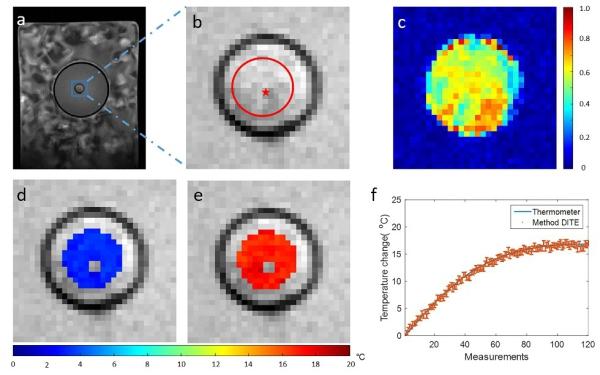
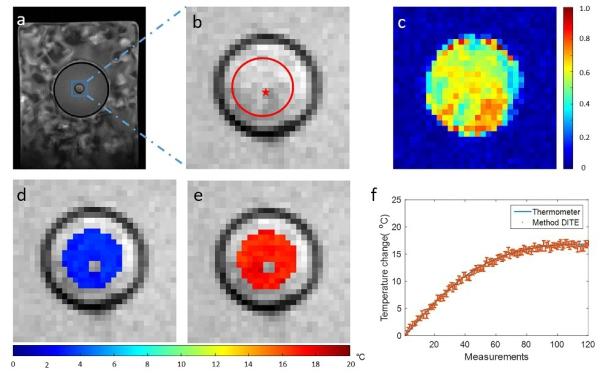
The proposed DITE method achieved accurate and precise temperature estimation compared with the results measured by the fluorescent thermometer, a common method and a golden standard of measuring temperature.

The average mean error, standard deviation, and root mean squared error were -0.08°C, 0.46°C and 0.56°C, respectively, within the region of interest (ROI) around the thermometer in the ex vivo BAT using a water bath experiment. The method can provide a potential imaging tool for the characterization of brown adipose tissue in vivo.

Prof. ZHENG said, "In the future, we will apply this method to monitor the temperature in BAT in vivo and characterize BAT activity using this temperature imaging technique."

By modulating BAT activity, this study provides crucial insight relevant to the treatment of metabolic diseases such as diabetes, obesity, and non-alcoholic fatty liver disease.

###

The study entitled "Dual-step iterative temperature estimation method for accurate and precise fat-referenced PRFS temperature imaging" was published in Magnetic Resonance in Medicine.

Media Contact

ZHANG Xiaomin
[email protected]

http://english.cas.cn/

Original Source

http://english.cas.cn/ http://dx.doi.org/10.1002/mrm.27396

Share14Tweet7Share2ShareShareShare1

Related Posts

Traditional Liver Remedies From Ethiopia Fail a Simple Toxicity Test, Raising Safety Alarms

Traditional Liver Remedies From Ethiopia Fail a Simple Toxicity Test, Raising Safety Alarms

October 5, 2026
Blood Protein May Signal Nerve Damage in Rare Autoimmune Disease, Study Finds

Blood Protein May Signal Nerve Damage in Rare Autoimmune Disease, Study Finds

October 5, 2026

Large Extracellular Vesicles Step Out of the Shadow of Exosomes in Landmark Review

October 5, 2026

Engineering Plant Immune Receptors to Build Durable, Broad-Spectrum Crop Resistance

October 5, 2026
Please login to join discussion

POPULAR NEWS

  • Alloys That Shrink Their Own Grains: New PIX Mechanism Refines Metals With Heat Alone

    Alloys That Shrink Their Own Grains: New PIX Mechanism Refines Metals With Heat Alone

    29 shares
    Share 12 Tweet 7
  • Endurance Exercise Reshapes the Liver in Males and Females Through Distinct Molecular Routes

    29 shares
    Share 12 Tweet 7
  • Single Transcription Factor PU.1 Rapidly Converts Fibroblasts into Macrophage-Lineage Cells

    29 shares
    Share 12 Tweet 7
  • New Scale Measures How Ready Nurse Educators Really Are for the AI Era

    29 shares
    Share 12 Tweet 7

About

We bring you the latest biotechnology news from best research centers and universities around the world. Check our website.

Follow us

Recent News

Alloys That Shrink Their Own Grains: New PIX Mechanism Refines Metals With Heat Alone

Endurance Exercise Reshapes the Liver in Males and Females Through Distinct Molecular Routes

Single Transcription Factor PU.1 Rapidly Converts Fibroblasts into Macrophage-Lineage Cells

Subscribe to Blog via Email

Success! An email was just sent to confirm your subscription. Please find the email now and click 'Confirm' to start subscribing.

Join 85 other subscribers
  • Contact Us

Bioengineer.org © Copyright 2023 All Rights Reserved.

Welcome Back!

Login to your account below

Forgotten Password?

Retrieve your password

Please enter your username or email address to reset your password.

Log In
No Result
View All Result
  • Homepages
    • Home Page 1
    • Home Page 2
  • News
  • National
  • Business
  • Health
  • Lifestyle
  • Science

Bioengineer.org © Copyright 2023 All Rights Reserved.