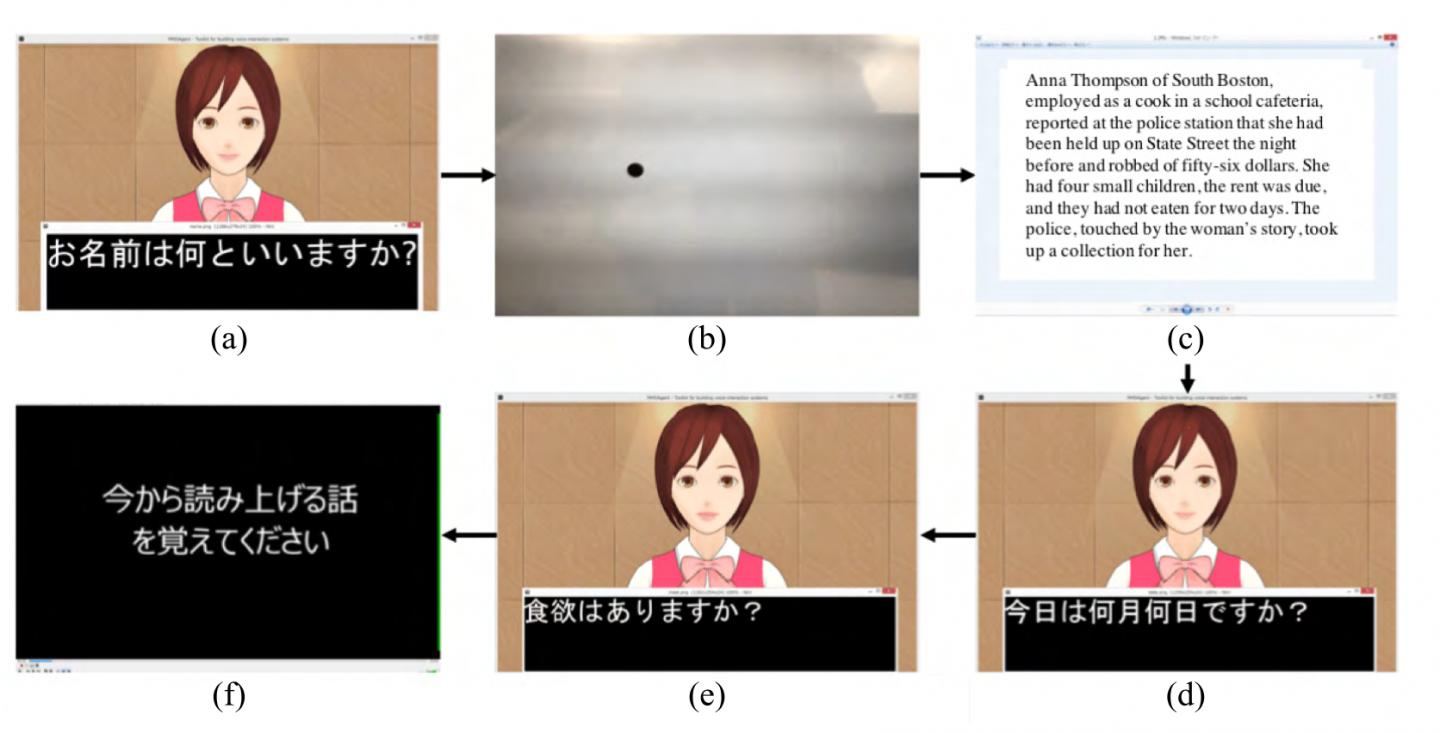
(a) Introduction: "What's your name? "
(b) Gaze measurement
(c) Reading test
(d) Fixed question: "What's the date today? "
(e) Random question: "How is your appetite? "
(f) Story recall test: "Please memorize the story I'm going…
Credit: Osaka University
Diagnosis of dementia was made via cognitive function tests such as Mini-Mental State Examination (MMSE) and medical imaging systems at hospitals, a fairly large system for the purpose. As our population ages, an increasing number of people are developing dementia. Thus, easy-to-use dementia detection tests are sought after. In previous studies, diagnoses were made mainly using neuropsychological questions, so habituation to the same questions lowered performance in detecting dementia.
A joint group of researchers from Osaka University and Nara Institute of Science and Technology demonstrated that it was possible to detect dementia from conversations in human-agent interaction. This technique has been realized through machine-learning: a machine learns characteristics of sounds of elderly people who answered easy questions from avatars on a computer.
The researchers proposed machine learning algorithms for detecting signs of dementia in its early stages, developing a dementia detection system using interactive computer avatars. They created a model for machine learning based on features of speech, language, and faces from recorded dialogues with elderly participants. Through machine learning, a computer came to able to distinguish individuals with dementia from healthy controls at a rate of 90 percent in 6 questions (2-3 minutes per question).
The team prepared fixed questions based on neuropsychological tests and random questions not based on specific tests, recording interactive data of spoken dialogues with avatars from 12 participants (individuals diagnosed with dementia by a psychiatrist according to the diagnosis criteria Diagnostic and Statistical Manual of Mental Disorders (DSM)-IV) and 12 healthy controls. They extracted speech, language, and image features from the recorded data, creating a model for detecting dementia and enabling a computer to learn for itself to detect dementia.
As a result, the computer was able to distinguish between healthy controls and individuals with dementia with an accuracy of 92%. It was found that dementia could be distinguished with high accuracy by combining features of dementia, such as delay in response to questions from avatars depending on the content of questions, intonation, articulation rate of the voice, and the percentage of nouns and verbs in utterance.
Senior author Takashi Kudo says, "If this technology is further developed, it will become possible to know whether or not an elderly individual is in the early stages of dementia through conversation with computer avatars at home on a daily basis. It will encourage them to seek medical help, leading to early diagnosis."
###
The article, "Identifying Dementia Patients based on Behavioral Markers in Human-Avatar Interaction" was presented at WFSBP (The World Federation of Societies of Biological Psychiatry) Asia Pacific Regional Congress of Biological Psychiatry, 7-9 September 2018, and the article "Detecting Dementia through Interactive Computer Avatars" was published in IEEE Journal of Translational Engineering in Health and Medicine, https://doi.org/10.1109/JTEHM.2017.2752152.
About Osaka University
Osaka University was founded in 1931 as one of the seven imperial universities of Japan and now has expanded to one of Japan's leading comprehensive universities. The University has now embarked on open research revolution from a position as Japan's most innovative university and among the most innovative institutions in the world according to Reuters 2015 Top 100 Innovative Universities and the Nature Index Innovation 2017. The university's ability to innovate from the stage of fundamental research through the creation of useful technology with economic impact stems from its broad disciplinary spectrum.
Website: http://resou.osaka-u.ac.jp/en/top
This study was presented at the conference on 8 September 2018 and part of this study was published in IEEE Journal of Translational Engineering in Health and Medicine on 15 September 2017
Media Contact
Saori Obayashi
[email protected]
81-661-055-886
@osaka_univ_e
http://www.osaka-u.ac.jp/en
Original Source
https://resou.osaka-u.ac.jp/en/research/2018/20180908_1 http://dx.doi.org/10.1109/JTEHM.2017.2752152