• HOME
  • NEWS
  • EXPLORE
    • CAREER
      • Companies
      • Jobs
    • EVENTS
    • iGEM
      • News
      • Team
    • PHOTOS
    • VIDEO
    • WIKI
  • BLOG
  • COMMUNITY
    • FACEBOOK
    • INSTAGRAM
    • TWITTER
Sunday, February 8, 2026
BIOENGINEER.ORG
No Result
View All Result
  • Login
  • HOME
  • NEWS
  • EXPLORE
    • CAREER
      • Companies
      • Jobs
        • Lecturer
        • PhD Studentship
        • Postdoc
        • Research Assistant
    • EVENTS
    • iGEM
      • News
      • Team
    • PHOTOS
    • VIDEO
    • WIKI
  • BLOG
  • COMMUNITY
    • FACEBOOK
    • INSTAGRAM
    • TWITTER
  • HOME
  • NEWS
  • EXPLORE
    • CAREER
      • Companies
      • Jobs
        • Lecturer
        • PhD Studentship
        • Postdoc
        • Research Assistant
    • EVENTS
    • iGEM
      • News
      • Team
    • PHOTOS
    • VIDEO
    • WIKI
  • BLOG
  • COMMUNITY
    • FACEBOOK
    • INSTAGRAM
    • TWITTER
No Result
View All Result
Bioengineer.org
No Result
View All Result
Home NEWS Science News Health

New tool developed at UBC screens online health ads for deception

Bioengineer by Bioengineer
September 12, 2018
in Health
Reading Time: 2 mins read
0
Share on FacebookShare on TwitterShare on LinkedinShare on RedditShare on Telegram
IMAGE

Credit: University of British Columbia

The internet is rife with ads for health products, from weight-loss systems to arthritis cures–but whether they actually work can be difficult to discern. Now, experts at the University of British Columbia have devised a simple screening tool to evaluate if the products popping up on your newsfeed are likely to be scams.

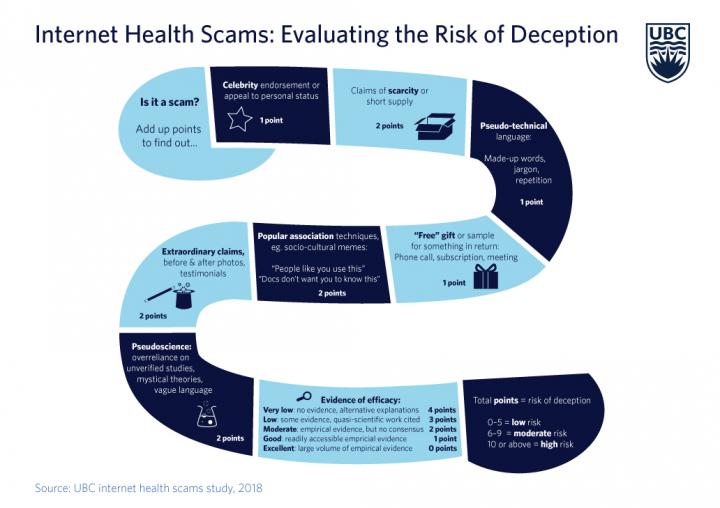
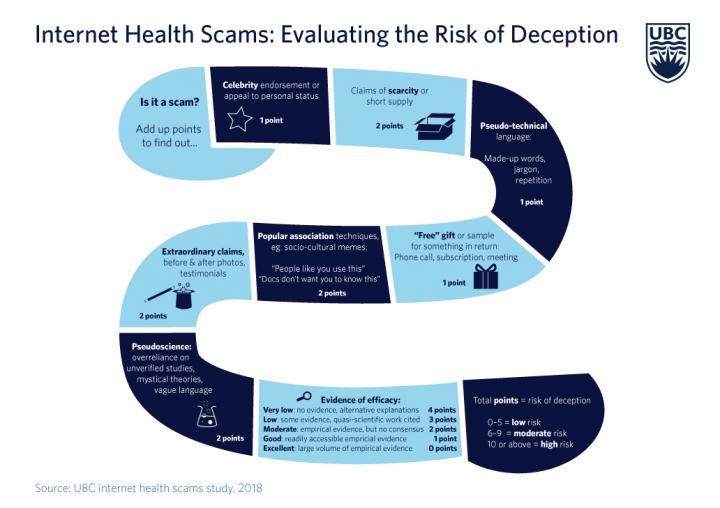
The Risk of Deception Tool (see graphic) assigns points based on the type and number of persuasion techniques used in the ad. If the ad includes a celebrity endorsement, it gets one point; if it uses pseudo-technical language, it gets another point. More points are added if the ad uses "mystical" language or claims that the product is very rare or in short supply. The higher the overall score, the greater the probability that the ad is a scam.

The system was devised by a team of two nurses, two doctors, two physiotherapists, a pharmacist and a social worker, all from UBC.

"We were exploring internet health ads and found, not surprisingly, that the internet provided a massive market for people to promote, in some cases, completely deceptive products that are not based on any scientific evidence," said lead researcher Bernie Garrett, an associate professor in the school of nursing.

Researchers analyzed advertisements targeting 112 different health concerns. They found that the most common deceptive ads were those promoting bodybuilding and weight loss, followed by medicinal products, which claim to treat pain, asthma or other conditions, and lifestyle products, which include anti-aging or sexual enhancement remedies.

"We also found a high number of advertisements from alternative health practitioners that made claims that were well outside what their therapies could reasonably achieve," said Garrett.

Most of the scams identified originated in the United States.

"There were many wacky and weird ones," said Garrett. "The one that surprised us the most was a video course that claimed to teach individuals how to repair their own DNA to achieve healing and spiritual changes."

Misleading health ads on the internet are concerning because consumers may end up self-medicating, say researchers.

"Research shows that only about one per cent of people exposed to fraudulent offers eventually lose money to them," said Garrett. "However, even if the worst outcome is that consumers are losing money, we should still be concerned. People may take these as actual therapeutic options for their own illnesses, rather than seek proper medical advice."

###

The study was published this week in Health and Social Care in the Community.

Media Contact

Lou Bosshart
[email protected]
604-999-0473
@UBCnews

http://www.ubc.ca

Original Source

https://news.ubc.ca/2018/09/12/new-tool-developed-at-ubc-screens-online-health-ads-for-deception/ http://dx.doi.org/10.1111/hsc.12643


Share12Tweet7Share2ShareShareShare1

Related Posts

Evaluating Digital Diabetes Screening’s B2C Potential in Switzerland

February 8, 2026

Resilient Together: A Promising Post-Diagnosis Intervention

February 8, 2026

Barriers and Facilitators to Smoking Cessation for HIV+ Men

February 8, 2026

Community Involvement Eases Depression in China’s Empty Nesters

February 8, 2026
Please login to join discussion

POPULAR NEWS

  • Robotic Ureteral Reconstruction: A Novel Approach

    Robotic Ureteral Reconstruction: A Novel Approach

    82 shares
    Share 33 Tweet 21
  • Digital Privacy: Health Data Control in Incarceration

    63 shares
    Share 25 Tweet 16
  • Breakthrough in RNA Research Accelerates Medical Innovations Timeline

    53 shares
    Share 21 Tweet 13
  • Mapping Tertiary Lymphoid Structures for Kidney Cancer Biomarkers

    50 shares
    Share 20 Tweet 13

About

We bring you the latest biotechnology news from best research centers and universities around the world. Check our website.

Follow us

Recent News

Mapping NYC Foot Traffic: Insights for Urban Planning

Evaluating Digital Diabetes Screening’s B2C Potential in Switzerland

Resilient Together: A Promising Post-Diagnosis Intervention

Subscribe to Blog via Email

Enter your email address to subscribe to this blog and receive notifications of new posts by email.

Join 74 other subscribers
  • Contact Us

Bioengineer.org © Copyright 2023 All Rights Reserved.

Welcome Back!

Login to your account below

Forgotten Password?

Retrieve your password

Please enter your username or email address to reset your password.

Log In
No Result
View All Result
  • Homepages
    • Home Page 1
    • Home Page 2
  • News
  • National
  • Business
  • Health
  • Lifestyle
  • Science

Bioengineer.org © Copyright 2023 All Rights Reserved.