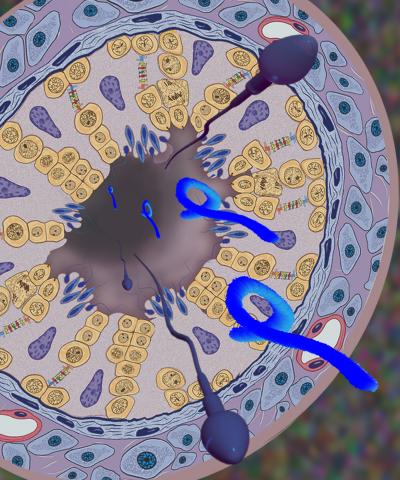
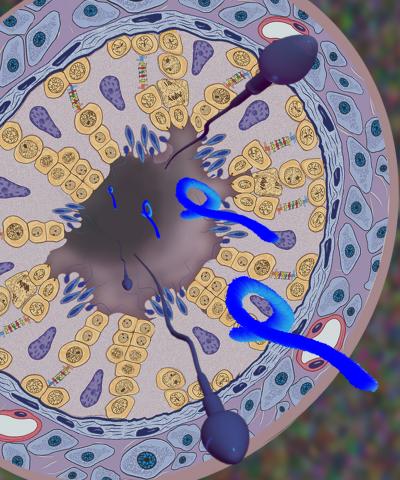
Credit: William Discher, U.S. Army Medical Research Institute of Infectious Diseases
Research published today by a team of Army scientists sheds light on the mechanism of sexual transmission of filoviruses, including Ebola and Marburg virus, which have been shown to persist in the testes and other immune privileged sites. Their work appears online in the journal Cell Host and Microbe.
Sexual transmission of filoviruses was first reported in 1968 after an outbreak of Marburg virus disease and recently caused flare-ups of Ebola virus disease in the 2013-2016 outbreak, according to the authors. How filoviruses establish testicular persistence and are shed in semen, however, was unknown.
Led by Dr. Xiankun (Kevin) Zeng, investigators at the U.S. Army Medical Research Institute of Infectious Diseases (USAMRIID) conducted a study using cynomolgus macaques to examine the persistence of Marburg virus in the testes of animals that survived infection after being treated with antiviral compounds.
The team found that Marburg virus persists in the seminiferous tubules, which are the sites of immune privilege and sperm production in the testes. Persistence leads to severe testicular damage, including cell depletion and breakdown of the blood-testis barrier, according to the authors. In addition, they identified a type of specialized cells, known as the Sertoli cells, as the reservoir for the Marburg virus.
"Importantly, we also identified local infiltration of immunosuppressive regulatory T cells, which may play an important role in sustaining Marburg virus persistence," said Zeng. "Targeting these T cells may help to clear Marburg virus from the testes, thereby preventing sexual transmission of the virus."
About 30 percent of cynomolgus monkeys that survived Marburg virus infection after antiviral treatment had persistent Marburg virus infection in the testes, but not in other common target organs such as the liver, spleen, and lymph nodes, according to the authors. The fact that it takes longer for Marburg virus to infect the testes strongly suggests that early intervention with therapeutics can prevent testicular persistence.
The 2013-2016 outbreak of Ebola virus disease in Western Africa resulted in about 11,000 deaths, and left behind the biggest cohort (over 17,000 individuals) of Ebola survivors in history, according to the World Health Organization. Many follow-up studies have detected Ebola virus RNA in the semen of survivors up to 18 months after recovery.
"Sexual transmission of Ebola virus has been implicated in the initiation of entirely new transmission chains," Zeng explained. "Our study illustrates the mechanism behind testicular filovirus persistence and sexual transmission of filoviruses."
According to Zeng, the team's next step is to develop animal models to evaluate the efficacy of medical countermeasures to prevent and clear Marburg and Ebola viral persistence in the testes.
###
USAMRIID's mission is to provide leading edge medical capabilities to deter and defend against current and emerging biological threat agents. Research conducted at USAMRIID leads to medical solutions–vaccines, drugs, diagnostics, and information–that benefit both military personnel and civilians. The Institute plays a key role as the lead military medical research laboratory for the Defense Threat Reduction Agency's Joint Science and Technology Office for Chemical and Biological Defense. USAMRIID is a subordinate laboratory of the U.S. Army Medical Research and Materiel Command. For more information, visit http://www.usamriid.army.mil
Reference: Coffin et al., Persistent Marburg virus infection in the testes of nonhuman primate survivors. Cell Host and Microbe, http://dx.doi.org/10.1016/j.chom.2018.08.003.
Media Contact
Caree Vander Linden
[email protected]
http://www.usamriid.army.mil
Related Journal Article
http://dx.doi.org/10.1016/j.chom.2018.08.003